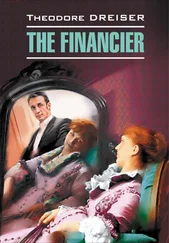
Theodore Dreiser - The Financier
Здесь есть возможность читать онлайн «Theodore Dreiser - The Financier» весь текст электронной книги совершенно бесплатно (целиком полную версию без сокращений). В некоторых случаях можно слушать аудио, скачать через торрент в формате fb2 и присутствует краткое содержание. Жанр: Классическая проза, на английском языке. Описание произведения, (предисловие) а так же отзывы посетителей доступны на портале библиотеки ЛибКат.
- Название:The Financier
- Автор:
- Жанр:
- Год:неизвестен
- ISBN:нет данных
- Рейтинг книги:5 / 5. Голосов: 1
-
Избранное:Добавить в избранное
- Отзывы:
-
Ваша оценка:
The Financier: краткое содержание, описание и аннотация
Предлагаем к чтению аннотацию, описание, краткое содержание или предисловие (зависит от того, что написал сам автор книги «The Financier»). Если вы не нашли необходимую информацию о книге — напишите в комментариях, мы постараемся отыскать её.
The Financier — читать онлайн бесплатно полную книгу (весь текст) целиком
Ниже представлен текст книги, разбитый по страницам. Система сохранения места последней прочитанной страницы, позволяет с удобством читать онлайн бесплатно книгу «The Financier», без необходимости каждый раз заново искать на чём Вы остановились. Поставьте закладку, и сможете в любой момент перейти на страницу, на которой закончили чтение.
Интервал:
Закладка:
He turned to the window, thinking of how easy it would have been, if Aileen and he had not been exposed by this anonymous note, to have arranged all with Butler. Rather than injure the party, Butler, in extremis , would have assisted him. Now . . . !
His father got up to go. He was as stiff with despair as though he were suffering from cold.
“Well,” he said, wearily.
Cowperwood suffered intensely for him. What a shame! His father! He felt a great surge of sorrow sweep over him but a moment later mastered it, and settled to his quick, defiant thinking. As the old man went out, Harper Steger was brought in. They shook hands, and at once started for Stener’s office. But Stener had sunk in on himself like an empty gas-bag, and no efforts were sufficient to inflate him. They went out, finally, defeated.
“I tell you, Frank,” said Steger, “I wouldn’t worry. We can tie this thing up legally until election and after, and that will give all this row a chance to die down. Then you can get your people together and talk sense to them. They’re not going to give up good properties like this, even if Stener does go to jail.”
Steger did not know of the sixty thousand dollars’ worth of hypothecated securities as yet. Neither did he know of Aileen Butler and her father’s boundless rage.
Chapter XXX
There was one development in connection with all of this of which Cowperwood was as yet unaware. The same day that brought Edward Butler the anonymous communication in regard to his daughter, brought almost a duplicate of it to Mrs. Frank Algernon Cowperwood, only in this case the name of Aileen Butler had curiously been omitted.
Perhaps you don’t know that your husband is running with another woman. If you don’t believe it, watch the house at 931 North Tenth Street.
Mrs. Cowperwood was in the conservatory watering some plants when this letter was brought by her maid Monday morning. She was most placid in her thoughts, for she did not know what all the conferring of the night before meant. Frank was occasionally troubled by financial storms, but they did not see to harm him.
“Lay it on the table in the library, Annie. I’ll get it.”
She thought it was some social note.
In a little while (such was her deliberate way), she put down her sprinkling-pot and went into the library. There it was lying on the green leather sheepskin which constituted a part of the ornamentation of the large library table. She picked it up, glanced at it curiously because it was on cheap paper, and then opened it. Her face paled slightly as she read it; and then her hand trembled—not much. Hers was not a soul that ever loved passionately, hence she could not suffer passionately. She was hurt, disgusted, enraged for the moment, and frightened; but she was not broken in spirit entirely. Thirteen years of life with Frank Cowperwood had taught her a number of things. He was selfish, she knew now, self-centered, and not as much charmed by her as he had been. The fear she had originally felt as to the effect of her preponderance of years had been to some extent justified by the lapse of time. Frank did not love her as he had—he had not for some time; she had felt it. What was it?—she had asked herself at times—almost, who was it? Business was engrossing him so.
Finance was his master. Did this mean the end of her regime, she queried. Would he cast her off? Where would she go? What would she do? She was not helpless, of course, for she had money of her own which he was manipulating for her. Who was this other woman? Was she young, beautiful, of any social position? Was it—? Suddenly she stopped. Was it? Could it be, by any chance—her mouth opened—Aileen Butler?
She stood still, staring at this letter, for she could scarcely countenance her own thought. She had observed often, in spite of all their caution, how friendly Aileen had been to him and he to her. He liked her; he never lost a chance to defend her. Lillian had thought of them at times as being curiously suited to each other temperamentally. He liked young people. But, of course, he was married, and Aileen was infinitely beneath him socially, and he had two children and herself. And his social and financial position was so fixed and stable that he did not dare trifle with it. Still she paused; for forty years and two children, and some slight wrinkles, and the suspicion that we may be no longer loved as we once were, is apt to make any woman pause, even in the face of the most significant financial position. Where would she go if she left him? What would people think? What about the children? Could she prove this liaison? Could she entrap him in a compromising situation? Did she want to?
She saw now that she did not love him as some women love their husbands. She was not wild about him. In a way she had been taking him for granted all these years, had thought that he loved her enough not to be unfaithful to her; at least fancied that he was so engrossed with the more serious things of life that no petty liaison such as this letter indicated would trouble him or interrupt his great career. Apparently this was not true. What should she do? What say? How act? Her none too brilliant mind was not of much service in this crisis. She did not know very well how either to plan or to fight.
The conventional mind is at best a petty piece of machinery. It is oyster-like in its functioning, or, perhaps better, clam-like. It has its little siphon of thought-processes forced up or down into the mighty ocean of fact and circumstance; but it uses so little, pumps so faintly, that the immediate contiguity of the vast mass is not disturbed. Nothing of the subtlety of life is perceived. No least inkling of its storms or terrors is ever discovered except through accident. When some crude, suggestive fact, such as this letter proved to be, suddenly manifests itself in the placid flow of events, there is great agony or disturbance and clogging of the so-called normal processes. The siphon does not work right. It sucks in fear and distress. There is great grinding of maladjusted parts—not unlike sand in a machine—and life, as is so often the case, ceases or goes lamely ever after.
Mrs. Cowperwood was possessed of a conventional mind. She really knew nothing about life. And life could not teach her. Reaction in her from salty thought-processes was not possible. She was not alive in the sense that Aileen Butler was, and yet she thought that she was very much alive. All illusion. She wasn’t. She was charming if you loved placidity. If you did not, she was not. She was not engaging, brilliant, or forceful. Frank Cowperwood might well have asked himself in the beginning why he married her. He did not do so now because he did not believe it was wise to question the past as to one’s failures and errors. It was, according to him, most unwise to regret. He kept his face and thoughts to the future.
But Mrs. Cowperwood was truly distressed in her way, and she went about the house thinking, feeling wretchedly. She decided, since the letter asked her to see for herself, to wait. She must think how she would watch this house, if at all. Frank must not know. If it were Aileen Butler by any chance—but surely not—she thought she would expose her to her parents. Still, that meant exposing herself. She determined to conceal her mood as best she could at dinner-time—but Cowperwood was not able to be there. He was so rushed, so closeted with individuals, so closely in conference with his father and others, that she scarcely saw him this Monday night, nor the next day, nor for many days.
For on Tuesday afternoon at two-thirty he issued a call for a meeting of his creditors, and at five-thirty he decided to go into the hands of a receiver. And yet, as he stood before his principal creditors—a group of thirty men—in his office, he did not feel that his life was ruined. He was temporarily embarrassed. Certainly things looked very black. The city-treasurership deal would make a great fuss. Those hypothecated city loan certificates, to the extent of sixty thousand, would make another, if Stener chose. Still, he did not feel that he was utterly destroyed.
Читать дальшеИнтервал:
Закладка:
Похожие книги на «The Financier»
Представляем Вашему вниманию похожие книги на «The Financier» списком для выбора. Мы отобрали схожую по названию и смыслу литературу в надежде предоставить читателям больше вариантов отыскать новые, интересные, ещё непрочитанные произведения.










Обсуждение, отзывы о книге «The Financier» и просто собственные мнения читателей. Оставьте ваши комментарии, напишите, что Вы думаете о произведении, его смысле или главных героях. Укажите что конкретно понравилось, а что нет, и почему Вы так считаете.