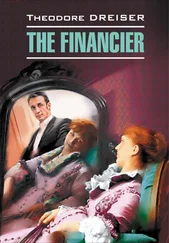
Theodore Dreiser - The Financier
Здесь есть возможность читать онлайн «Theodore Dreiser - The Financier» весь текст электронной книги совершенно бесплатно (целиком полную версию без сокращений). В некоторых случаях можно слушать аудио, скачать через торрент в формате fb2 и присутствует краткое содержание. Жанр: Классическая проза, на английском языке. Описание произведения, (предисловие) а так же отзывы посетителей доступны на портале библиотеки ЛибКат.
- Название:The Financier
- Автор:
- Жанр:
- Год:неизвестен
- ISBN:нет данных
- Рейтинг книги:5 / 5. Голосов: 1
-
Избранное:Добавить в избранное
- Отзывы:
-
Ваша оценка:
The Financier: краткое содержание, описание и аннотация
Предлагаем к чтению аннотацию, описание, краткое содержание или предисловие (зависит от того, что написал сам автор книги «The Financier»). Если вы не нашли необходимую информацию о книге — напишите в комментариях, мы постараемся отыскать её.
The Financier — читать онлайн бесплатно полную книгу (весь текст) целиком
Ниже представлен текст книги, разбитый по страницам. Система сохранения места последней прочитанной страницы, позволяет с удобством читать онлайн бесплатно книгу «The Financier», без необходимости каждый раз заново искать на чём Вы остановились. Поставьте закладку, и сможете в любой момент перейти на страницу, на которой закончили чтение.
Интервал:
Закладка:
“Av’nin’, Mark, I’m glad to see you,” was Butler’s greeting.
“How are you, Edward?” came the quiet reply.
“Well, Senator, you’re not looking any the worse for wear. Can I pour you something?”
“Nothing to-night, Henry,” replied Simpson. “I haven’t long to stay. I just stopped by on my way home. My wife’s over here at the Cavanaghs’, and I have to stop by to fetch her.”
“Well, it’s a good thing you dropped in, Senator, just when you did,” began Mollenhauer, seating himself after his guest. “Butler here has been telling me of a little political problem that has arisen since I last saw you. I suppose you’ve heard that Chicago is burning?”
“Yes; Cavanagh was just telling me. It looks to be quite serious. I think the market will drop heavily in the morning.”
“I wouldn’t be surprised myself,” put in Mollenhauer, laconically.
“Here’s the paper now,” said Butler, as John, the servant, came in from the street bearing the paper in his hand. Mollenhauer took it and spread it out before them. It was among the earliest of the “extras” that were issued in this country, and contained a rather impressive spread of type announcing that the conflagration in the lake city was growing hourly worse since its inception the day before.
“Well, that is certainly dreadful,” said Simpson. “I’m very sorry for Chicago. I have many friends there. I shall hope to hear that it is not so bad as it seems.”
The man had a rather grandiloquent manner which he never abandoned under any circumstances.
“The matter that Butler was telling me about,” continued Mollenhauer, “has something to do with this in a way. You know the habit our city treasurers have of loaning out their money at two per cent.?”
“Yes?” said Simpson, inquiringly.
“Well, Mr. Stener, it seems, has been loaning out a good deal of the city’s money to this young Cowperwood, in Third Street, who has been handling city loans.”
“You don’t say!” said Simpson, putting on an air of surprise. “Not much, I hope?” The Senator, like Butler and Mollenhauer, was profiting greatly by cheap loans from the same source to various designated city depositories.
“Well, it seems that Stener has loaned him as much as five hundred thousand dollars, and if by any chance Cowperwood shouldn’t be able to weather this storm, Stener is apt to be short that amount, and that wouldn’t look so good as a voting proposition to the people in November, do you think? Cowperwood owes Mr. Butler here one hundred thousand dollars, and because of that he came to see him to-night. He wanted Butler to see if something couldn’t be done through us to tide him over. If not”—he waved one hand suggestively—“well, he might fail.”
Simpson fingered his strange, wide mouth with his delicate hand. “What have they been doing with the five hundred thousand dollars?” he asked.
“Oh, the boys must make a little somethin’ on the side,” said Butler, cheerfully. “I think they’ve been buyin’ up street-railways, for one thing.” He stuck his thumbs in the armholes of his vest. Both Mollenhauer and Simpson smiled wan smiles.
“Quite so,” said Mollenhauer. Senator Simpson merely looked the deep things that he thought.
He, too, was thinking how useless it was for any one to approach a group of politicians with a proposition like this, particularly in a crisis such as bid fair to occur. He reflected that if he and Butler and Mollenhauer could get together and promise Cowperwood protection in return for the surrender of his street-railway holdings it would be a very different matter. It would be very easy in this case to carry the city treasury loan along in silence and even issue more money to support it; but it was not sure, in the first place, that Cowperwood could be made to surrender his stocks, and in the second place that either Butler or Mollenhauer would enter into any such deal with him, Simpson. Butler had evidently come here to say a good word for Cowperwood. Mollenhauer and himself were silent rivals. Although they worked together politically it was toward essentially different financial ends. They were allied in no one particular financial proposition, any more than Mollenhauer and Butler were. And besides, in all probability Cowperwood was no fool. He was not equally guilty with Stener; the latter had loaned him money. The Senator reflected on whether he should broach some such subtle solution of the situation as had occurred to him to his colleagues, but he decided not. Really Mollenhauer was too treacherous a man to work with on a thing of this kind. It was a splendid chance but dangerous. He had better go it alone. For the present they should demand of Stener that he get Cowperwood to return the five hundred thousand dollars if he could. If not, Stener could be sacrificed for the benefit of the party, if need be. Cowperwood’s stocks, with this tip as to his condition, would, Simpson reflected, offer a good opportunity for a little stock-exchange work on the part of his own brokers. They could spread rumors as to Cowperwood’s condition and then offer to take his shares off his hands—for a song, of course. It was an evil moment that led Cowperwood to Butler.
“Well, now,” said the Senator, after a prolonged silence, “I might sympathize with Mr. Cowperwood in his situation, and I certainly don’t blame him for buying up street-railways if he can; but I really don’t see what can be done for him very well in this crisis. I don’t know about you, gentlemen, but I am rather certain that I am not in a position to pick other people’s chestnuts out of the fire if I wanted to, just now. It all depends on whether we feel that the danger to the party is sufficient to warrant our going down into our pockets and assisting him.”
At the mention of real money to be loaned Mollenhauer pulled a long face. “I can’t see that I will be able to do very much for Mr. Cowperwood,” he sighed.
“Begad,” said Butler, with a keen sense of humor, “it looks to me as if I’d better be gettin’ in my one hundred thousand dollars. That’s the first business of the early mornin’.” Neither Simpson nor Mollenhauer condescended on this occasion to smile even the wan smile they had smiled before. They merely looked wise and solemn.
“But this matter of the city treasury, now,” said Senator Simpson, after the atmosphere had been allowed to settle a little, “is something to which we shall have to devote a little thought. If Mr. Cowperwood should fail, and the treasury lose that much money, it would embarrass us no little. What lines are they,” he added, as an afterthought, “that this man has been particularly interested in?”
“I really don’t know,” replied Butler, who did not care to say what Owen had told him on the drive over.
“I don’t see,” said Mollenhauer, “unless we can make Stener get the money back before this man Cowperwood fails, how we can save ourselves from considerable annoyance later; but if we did anything which would look as though we were going to compel restitution, he would probably shut up shop anyhow. So there’s no remedy in that direction. And it wouldn’t be very kind to our friend Edward here to do it until we hear how he comes out on his affair.” He was referring to Butler’s loan.
“Certainly not,” said Senator Simpson, with true political sagacity and feeling.
“I’ll have that one hundred thousand dollars in the mornin’,” said Butler, “and never fear.”
“I think,” said Simpson, “if anything comes of this matter that we will have to do our best to hush it up until after the election. The newspapers can just as well keep silent on that score as not. There’s one thing I would suggest”—and he was now thinking of the street-railway properties which Cowperwood had so judiciously collected—“and that is that the city treasurer be cautioned against advancing any more money in a situation of this kind. He might readily be compromised into advancing much more. I suppose a word from you, Henry, would prevent that.”
Читать дальшеИнтервал:
Закладка:
Похожие книги на «The Financier»
Представляем Вашему вниманию похожие книги на «The Financier» списком для выбора. Мы отобрали схожую по названию и смыслу литературу в надежде предоставить читателям больше вариантов отыскать новые, интересные, ещё непрочитанные произведения.









Обсуждение, отзывы о книге «The Financier» и просто собственные мнения читателей. Оставьте ваши комментарии, напишите, что Вы думаете о произведении, его смысле или главных героях. Укажите что конкретно понравилось, а что нет, и почему Вы так считаете.