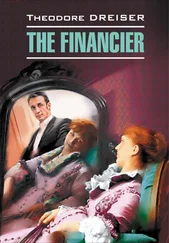
Theodore Dreiser - The Financier
Здесь есть возможность читать онлайн «Theodore Dreiser - The Financier» весь текст электронной книги совершенно бесплатно (целиком полную версию без сокращений). В некоторых случаях можно слушать аудио, скачать через торрент в формате fb2 и присутствует краткое содержание. Жанр: Классическая проза, на английском языке. Описание произведения, (предисловие) а так же отзывы посетителей доступны на портале библиотеки ЛибКат.
- Название:The Financier
- Автор:
- Жанр:
- Год:неизвестен
- ISBN:нет данных
- Рейтинг книги:5 / 5. Голосов: 1
-
Избранное:Добавить в избранное
- Отзывы:
-
Ваша оценка:
The Financier: краткое содержание, описание и аннотация
Предлагаем к чтению аннотацию, описание, краткое содержание или предисловие (зависит от того, что написал сам автор книги «The Financier»). Если вы не нашли необходимую информацию о книге — напишите в комментариях, мы постараемся отыскать её.
The Financier — читать онлайн бесплатно полную книгу (весь текст) целиком
Ниже представлен текст книги, разбитый по страницам. Система сохранения места последней прочитанной страницы, позволяет с удобством читать онлайн бесплатно книгу «The Financier», без необходимости каждый раз заново искать на чём Вы остановились. Поставьте закладку, и сможете в любой момент перейти на страницу, на которой закончили чтение.
Интервал:
Закладка:
“So that’s it,” he said. “You’re expectin’ trouble to-morrow. How are your own affairs?”
“I’m in pretty good shape, I think, all told, if the money element of this town doesn’t lose its head and go wild. There has to be a lot of common sense exercised to-morrow, or to-night, even. You know we are facing a real panic. Mr. Butler, you may as well know that. It may not last long, but while it does it will be bad. Stocks are going to drop to-morrow ten or fifteen points on the opening. The banks are going to call their loans unless some arrangement can be made to prevent them. No one man can do that. It will have to be a combination of men. You and Mr. Simpson and Mr. Mollenhauer might do it—that is, you could if you could persuade the big banking people to combine to back the market. There is going to be a raid on local street-railways—all of them. Unless they are sustained the bottom is going to drop out. I have always known that you were long on those. I thought you and Mr. Mollenhauer and some of the others might want to act. If you don’t I might as well confess that it is going to go rather hard with me. I am not strong enough to face this thing alone.”
He was meditating on how he should tell the whole truth in regard to Stener.
“Well, now, that’s pretty bad,” said Butler, calmly and meditatively. He was thinking of his own affairs. A panic was not good for him either, but he was not in a desperate state. He could not fail. He might lose some money, but not a vast amount—before he could adjust things. Still he did not care to lose any money.
“How is it you’re so bad off?” he asked, curiously. He was wondering how the fact that the bottom was going to drop out of local street-railways would affect Cowperwood so seriously. “You’re not carryin’ any of them things, are you?” he added.
It was now a question of lying or telling the truth, and Cowperwood was literally afraid to risk lying in this dilemma. If he did not gain Butler’s comprehending support he might fail, and if he failed the truth would come out, anyhow.
“I might as well make a clean breast of this, Mr. Butler,” he said, throwing himself on the old man’s sympathies and looking at him with that brisk assurance which Butler so greatly admired. He felt as proud of Cowperwood at times as he did of his own sons. He felt that he had helped to put him where he was.
“The fact is that I have been buying street-railway stocks, but not for myself exactly. I am going to do something now which I think I ought not to do, but I cannot help myself. If I don’t do it, it will injure you and a lot of people whom I do not wish to injure. I know you are naturally interested in the outcome of the fall election. The truth is I have been carrying a lot of stocks for Mr. Stener and some of his friends. I do not know that all the money has come from the city treasury, but I think that most of it has. I know what that means to Mr. Stener and the Republican party and your interests in case I fail. I don’t think Mr. Stener started this of his own accord in the first place—I think I am as much to blame as anybody—but it grew out of other things. As you know, I handled that matter of city loan for him and then some of his friends wanted me to invest in street-railways for them. I have been doing that ever since. Personally I have borrowed considerable money from Mr. Stener at two per cent. In fact, originally the transactions were covered in that way. Now I don’t want to shift the blame on any one. It comes back to me and I am willing to let it stay there, except that if I fail Mr. Stener will be blamed and that will reflect on the administration. Naturally, I don’t want to fail. There is no excuse for my doing so. Aside from this panic I have never been in a better position in my life. But I cannot weather this storm without assistance, and I want to know if you won’t help me. If I pull through I will give you my word that I will see that the money which has been taken from the treasury is put back there. Mr. Stener is out of town or I would have brought him here with me.”
Cowperwood was lying out of the whole cloth in regard to bringing Stener with him, and he had no intention of putting the money back in the city treasury except by degrees and in such manner as suited his convenience; but what he had said sounded well and created a great seeming of fairness.
“How much money is it Stener has invested with you?” asked Butler. He was a little confused by this curious development. It put Cowperwood and Stener in an odd light.
“About five hundred thousand dollars,” replied Cowperwood.
The old man straightened up. “Is it as much as that?” he said.
“Just about—a little more or a little less; I’m not sure which.”
The old contractor listened solemnly to all Cowperwood had to say on this score, thinking of the effect on the Republican party and his own contracting interests. He liked Cowperwood, but this was a rough thing the latter was telling him—rough, and a great deal to ask. He was a slow-thinking and a slow-moving man, but he did well enough when he did think. He had considerable money invested in Philadelphia street-railway stocks—perhaps as much as eight hundred thousand dollars. Mollenhauer had perhaps as much more. Whether Senator Simpson had much or little he could not tell. Cowperwood had told him in the past that he thought the Senator had a good deal. Most of their holdings, as in the case of Cowperwood’s, were hypothecated at the various banks for loans and these loans invested in other ways. It was not advisable or comfortable to have these loans called, though the condition of no one of the triumvirate was anything like as bad as that of Cowperwood. They could see themselves through without much trouble, though not without probable loss unless they took hurried action to protect themselves.
He would not have thought so much of it if Cowperwood had told him that Stener was involved, say, to the extent of seventy-five or a hundred thousand dollars. That might be adjusted. But five hundred thousand dollars!
“That’s a lot of money,” said Butler, thinking of the amazing audacity of Stener, but failing at the moment to identify it with the astute machinations of Cowperwood. “That’s something to think about. There’s no time to lose if there’s going to be a panic in the morning. How much good will it do ye if we do support the market?”
“A great deal,” returned Cowperwood, “although of course I have to raise money in other ways. I have that one hundred thousand dollars of yours on deposit. Is it likely that you’ll want that right away?”
“It may be,” said Butler.
“It’s just as likely that I’ll need it so badly that I can’t give it up without seriously injuring myself,” added Cowperwood. “That’s just one of a lot of things. If you and Senator Simpson and Mr. Mollenhauer were to get together—you’re the largest holders of street-railway stocks—and were to see Mr. Drexel and Mr. Cooke, you could fix things so that matters would be considerably easier. I will be all right if my loans are not called, and my loans will not be called if the market does not slump too heavily. If it does, all my securities are depreciated, and I can’t hold out.”
Old Butler got up. “This is serious business,” he said. “I wish you’d never gone in with Stener in that way. It don’t look quite right and it can’t be made to. It’s bad, bad business,” he added dourly. “Still, I’ll do what I can. I can’t promise much, but I’ve always liked ye and I’ll not be turning on ye now unless I have to. But I’m sorry—very. And I’m not the only one that has a hand in things in this town.” At the same time he was thinking it was right decent of Cowperwood to forewarn him this way in regard to his own affairs and the city election, even though he was saving his own neck by so doing. He meant to do what he could.
Читать дальшеИнтервал:
Закладка:
Похожие книги на «The Financier»
Представляем Вашему вниманию похожие книги на «The Financier» списком для выбора. Мы отобрали схожую по названию и смыслу литературу в надежде предоставить читателям больше вариантов отыскать новые, интересные, ещё непрочитанные произведения.










Обсуждение, отзывы о книге «The Financier» и просто собственные мнения читателей. Оставьте ваши комментарии, напишите, что Вы думаете о произведении, его смысле или главных героях. Укажите что конкретно понравилось, а что нет, и почему Вы так считаете.