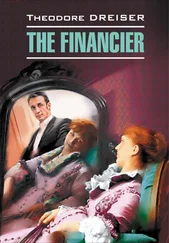
Theodore Dreiser - The Financier
Здесь есть возможность читать онлайн «Theodore Dreiser - The Financier» весь текст электронной книги совершенно бесплатно (целиком полную версию без сокращений). В некоторых случаях можно слушать аудио, скачать через торрент в формате fb2 и присутствует краткое содержание. Жанр: Классическая проза, на английском языке. Описание произведения, (предисловие) а так же отзывы посетителей доступны на портале библиотеки ЛибКат.
- Название:The Financier
- Автор:
- Жанр:
- Год:неизвестен
- ISBN:нет данных
- Рейтинг книги:5 / 5. Голосов: 1
-
Избранное:Добавить в избранное
- Отзывы:
-
Ваша оценка:
The Financier: краткое содержание, описание и аннотация
Предлагаем к чтению аннотацию, описание, краткое содержание или предисловие (зависит от того, что написал сам автор книги «The Financier»). Если вы не нашли необходимую информацию о книге — напишите в комментариях, мы постараемся отыскать её.
The Financier — читать онлайн бесплатно полную книгу (весь текст) целиком
Ниже представлен текст книги, разбитый по страницам. Система сохранения места последней прочитанной страницы, позволяет с удобством читать онлайн бесплатно книгу «The Financier», без необходимости каждый раз заново искать на чём Вы остановились. Поставьте закладку, и сможете в любой момент перейти на страницу, на которой закончили чтение.
Интервал:
Закладка:
In the evening inpour of young men and women came Aileen and Norah, the former throwing off a thin net veil of black lace and a dolman of black silk, which her brother Owen took from her. Norah was with Callum, a straight, erect, smiling young Irishman, who looked as though he might carve a notable career for himself. She wore a short, girlish dress that came to a little below her shoe-tops, a pale-figured lavender and white silk, with a fluffy hoop-skirt of dainty laced-edged ruffles, against which tiny bows of lavender stood out in odd places. There was a great sash of lavender about her waist, and in her hair a rosette of the same color. She looked exceedingly winsome—eager and bright-eyed.
But behind her was her sister in ravishing black satin, scaled as a fish with glistening crimsoned-silver sequins, her round, smooth arms bare to the shoulders, her corsage cut as low in the front and back as her daring, in relation to her sense of the proprieties, permitted. She was naturally of exquisite figure, erect, full-breasted, with somewhat more than gently swelling hips, which, nevertheless, melted into lovely, harmonious lines; and this low-cut corsage, receding back and front into a deep V, above a short, gracefully draped overskirt of black tulle and silver tissue, set her off to perfection. Her full, smooth, roundly modeled neck was enhanced in its cream-pink whiteness by an inch-wide necklet of black jet cut in many faceted black squares. Her complexion, naturally high in tone because of the pink of health, was enhanced by the tiniest speck of black court-plaster laid upon her cheekbone; and her hair, heightened in its reddish-gold by her dress, was fluffed loosely and adroitly about her eyes. The main mass of this treasure was done in two loose braids caught up in a black spangled net at the back of her neck; and her eyebrows had been emphasized by a pencil into something almost as significant as her hair. She was, for the occasion, a little too emphatic, perhaps, and yet more because of her burning vitality than of her costume. Art for her should have meant subduing her physical and spiritual significance. Life for her meant emphasizing them.
“Lillian!” Anna nudged her sister-in-law. She was grieved to think that Aileen was wearing black and looked so much better than either of them.
“I see,” Lillian replied, in a subdued tone.
“So you’re back again.” She was addressing Aileen. “It’s chilly out, isn’t it?”
“I don’t mind. Don’t the rooms look lovely?”
She was gazing at the softly lighted chambers and the throng before her.
Norah began to babble to Anna. “You know, I just thought I never would get this old thing on.” She was speaking of her dress. “Aileen wouldn’t help me—the mean thing!”
Aileen had swept on to Cowperwood and his mother, who was near him. She had removed from her arm the black satin ribbon which held her train and kicked the skirts loose and free. Her eyes gleamed almost pleadingly for all her hauteur, like a spirited collie’s, and her even teeth showed beautifully.
Cowperwood understood her precisely, as he did any fine, spirited animal.
“I can’t tell you how nice you look,” he whispered to her, familiarly, as though there was an old understanding between them. “You’re like fire and song.”
He did not know why he said this. He was not especially poetic. He had not formulated the phrase beforehand. Since his first glimpse of her in the hall, his feelings and ideas had been leaping and plunging like spirited horses. This girl made him set his teeth and narrow his eyes. Involuntarily he squared his jaw, looking more defiant, forceful, efficient, as she drew near.
But Aileen and her sister were almost instantly surrounded by young men seeking to be introduced and to write their names on dance-cards, and for the time being she was lost to view.
Chapter XVIII
The seeds of change—subtle, metaphysical—are rooted deeply. From the first mention of the dance by Mrs. Cowperwood and Anna, Aileen had been conscious of a desire toward a more effective presentation of herself than as yet, for all her father’s money, she had been able to achieve. The company which she was to encounter, as she well knew, was to be so much more impressive, distinguished than anything she had heretofore known socially. Then, too, Cowperwood appeared as something more definite in her mind than he had been before, and to save herself she could not get him out of her consciousness.
A vision of him had come to her but an hour before as she was dressing. In a way she had dressed for him. She was never forgetful of the times he had looked at her in an interested way. He had commented on her hands once. To-day he had said that she looked “stunning,” and she had thought how easy it would be to impress him to-night—to show him how truly beautiful she was.
She had stood before her mirror between eight and nine—it was nine-fifteen before she was really ready—and pondered over what she should wear. There were two tall pier-glasses in her wardrobe—an unduly large piece of furniture—and one in her closet door. She stood before the latter, looking at her bare arms and shoulders, her shapely figure, thinking of the fact that her left shoulder had a dimple, and that she had selected garnet garters decorated with heart-shaped silver buckles. The corset could not be made quite tight enough at first, and she chided her maid, Kathleen Kelly. She studied how to arrange her hair, and there was much ado about that before it was finally adjusted. She penciled her eyebrows and plucked at the hair about her forehead to make it loose and shadowy. She cut black court-plaster with her nail-shears and tried different-sized pieces in different places. Finally, she found one size and one place that suited her. She turned her head from side to side, looking at the combined effect of her hair, her penciled brows, her dimpled shoulder, and the black beauty-spot. If some one man could see her as she was now, some time! Which man? That thought scurried back like a frightened rat into its hole. She was, for all her strength, afraid of the thought of the one—the very deadly—the man.
And then she came to the matter of a train-gown. Kathleen laid out five, for Aileen had come into the joy and honor of these things recently, and she had, with the permission of her mother and father, indulged herself to the full. She studied a golden-yellow silk, with cream-lace shoulder-straps, and some gussets of garnet beads in the train that shimmered delightfully, but set it aside. She considered favorably a black-and-white striped silk of odd gray effect, and, though she was sorely tempted to wear it, finally let it go. There was a maroon dress, with basque and overskirt over white silk; a rich cream-colored satin; and then this black sequined gown, which she finally chose. She tried on the cream-colored satin first, however, being in much doubt about it; but her penciled eyes and beauty-spot did not seem to harmonize with it. Then she put on the black silk with its glistening crimsoned-silver sequins, and, lo, it touched her. She liked its coquettish drapery of tulle and silver about the hips. The “overskirt,” which was at that time just coming into fashion, though avoided by the more conservative, had been adopted by Aileen with enthusiasm. She thrilled a little at the rustle of this black dress, and thrust her chin and nose forward to make it set right. Then after having Kathleen tighten her corsets a little more, she gathered the train over her arm by its train-band and looked again. Something was wanting. Oh, yes, her neck! What to wear—red coral? It did not look right. A string of pearls? That would not do either. There was a necklace made of small cameos set in silver which her mother had purchased, and another of diamonds which belonged to her mother, but they were not right. Finally, her jet necklet, which she did not value very highly, came into her mind, and, oh, how lovely it looked! How soft and smooth and glistening her chin looked above it. She caressed her neck affectionately, called for her black lace mantilla, her long, black silk dolman lined with red, and she was ready.
Читать дальшеИнтервал:
Закладка:
Похожие книги на «The Financier»
Представляем Вашему вниманию похожие книги на «The Financier» списком для выбора. Мы отобрали схожую по названию и смыслу литературу в надежде предоставить читателям больше вариантов отыскать новые, интересные, ещё непрочитанные произведения.










Обсуждение, отзывы о книге «The Financier» и просто собственные мнения читателей. Оставьте ваши комментарии, напишите, что Вы думаете о произведении, его смысле или главных героях. Укажите что конкретно понравилось, а что нет, и почему Вы так считаете.