Antal Szerb - The Pendragon Legend
Здесь есть возможность читать онлайн «Antal Szerb - The Pendragon Legend» весь текст электронной книги совершенно бесплатно (целиком полную версию без сокращений). В некоторых случаях можно слушать аудио, скачать через торрент в формате fb2 и присутствует краткое содержание. Жанр: Классическая проза, на английском языке. Описание произведения, (предисловие) а так же отзывы посетителей доступны на портале библиотеки ЛибКат.
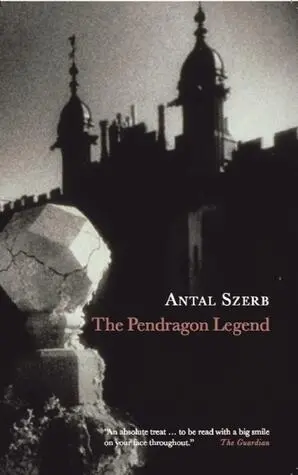
- Название:The Pendragon Legend
- Автор:
- Жанр:
- Год:неизвестен
- ISBN:нет данных
- Рейтинг книги:5 / 5. Голосов: 1
-
Избранное:Добавить в избранное
- Отзывы:
-
Ваша оценка:
The Pendragon Legend: краткое содержание, описание и аннотация
Предлагаем к чтению аннотацию, описание, краткое содержание или предисловие (зависит от того, что написал сам автор книги «The Pendragon Legend»). Если вы не нашли необходимую информацию о книге — напишите в комментариях, мы постараемся отыскать её.
The Pendragon Legend — читать онлайн бесплатно полную книгу (весь текст) целиком
Ниже представлен текст книги, разбитый по страницам. Система сохранения места последней прочитанной страницы, позволяет с удобством читать онлайн бесплатно книгу «The Pendragon Legend», без необходимости каждый раз заново искать на чём Вы остановились. Поставьте закладку, и сможете в любой момент перейти на страницу, на которой закончили чтение.
Интервал:
Закладка:
He opened his desk drawer and pulled out a slip of paper.
“Someone stuck this on the windscreen of the little Rover yesterday morning.”
I studied the paper. It was covered in a strange, archaic writing, of the sort you find in seventeenth-century manuscripts in the British Museum. No one nowadays writes with such a flourish. Our hands have altered their shape since then.
It read: ‘Pendragon, forte si vellis videre Petrum senem vade ad lacum castelli media nocte ubi et alium rerum mirabilium testis eris.’
“It’s Spanish,” declared Maloney, “and, I’m sorry to say, it’s not a language I ever learnt.”
“Not at all. It’s Latin,” said Osborne, and translated it: “‘Pendragon, if you wish to see old Peter (i.e. Pierce), go to the Castle Lake at midnight, where you will be witness to other miraculous things as well.’”
“If this was actually written by the old boy himself,” said Maloney, nodding thoughtfully, “I’d say he’d be a teacher by profession, or why on earth would he write in Latin? Anyway, he’s a real show-off.”
“Perhaps he doesn’t know English?” Osborne observed.
“Or else … ” I blurted out, then stopped short. The stupidity of my idea surpassed even Maloney’s.
It had occurred to me that the man who had written it — the stranger by the lake — was in fact so old, so truly ancient, that had he written in English his archaic turn of phrase would have been incomprehensible. That was why he had chosen the timeless, unchanging language of Latin. But of course I couldn’t utter this daft notion, which could have occurred only to a philologist.
“And did you see the old gent yesterday too?” asked Maloney.
“No,” replied Osborne, “only Habakkuk, sitting in his coracle, as he was tonight. The other chap didn’t appear. Or he might have, only I didn’t wait long enough to find out.”
At this point we went off to bed, each nursing his own private theory about what had occurred. Maloney was no doubt wracking his brain for the most spectacular and Connemaran method of catching the old man.
The next morning a boy from the village called on me. He had been sent by the Rev Dafyd Jones. He handed me a letter, the gist of which was that the vicar desired to speak with me urgently and in the strictest confidence. He asked me to meet him in the little graveyard behind the church at ten, adding, with a profusion of apologies, that it was a matter of extreme importance.
I had absolutely no idea what it might be. Against what species of non-existent horror could this excitable visionary be seeking my help? Then I recalled the previous night’s events at the lake, and I hastened off, in some agitation, down to the village.
I had no problem finding the little graveyard behind the church, with its lovely trees beckoning to eternal rest. The parson was already there, pacing back and forth, and gesticulating to himself in the restrained manner imposed by his ecclesiastical dignity and by British reserve. I thought he might be rehearsing his Sunday sermon.
When I called out to him he gave such a start that I became alarmed myself.
“Yes, yes, yes, yes,” he gabbled. “You, sir, are a well-known physician.”
“Sir, I am not a well-known physician,” I replied in astonishment. These people had obviously conspired to make me a medical doctor.
“I see,” said the priest, “it’s a secret. The Earl keeps his activities secret. But in vain. All in vain. Because, you see, it has come to the light of day. What never could bear the light of day. Do you know, sir, what was caught in the Castle Lake this morning?”
“In the Castle Lake? What was?”
He gazed at me in triumph, as at a man exposed.
“Come.”
He led me with quick, short steps to a small hut, where the macabre tools of the grave-digger leant against a wall. It was a dark, damp, unfriendly place. In a corner stood a table with something lying on it. Though I couldn’t make out what it was, in the darkness it filled me with a most unpleasant feeling.
“This is what was caught,” he announced, bringing his torch to bear on it.
One of the Earl’s monsters lay there, lifeless.
It was no longer transparent but a shapeless lump of jelly, in the early stages of decomposition. It was revolting.
“Do you recognise it?” the vicar asked.
“I do. It’s one of the Earl’s miraculous animals. How did it get into the Castle Lake?”
“That’s something you ought to know.”
“Me?”
“Yes. I implore you, as an immortal soul, to do something about it. This sort of thing cannot carry on. I can’t remonstrate with him — I depend on him for everything. You, sir, must take action. He cannot pollute God’s pure lakes with these unspeakable monsters.”
“How was this one found?”
“I shall tell you. Do you know that Pierce Gwyn Mawr has disappeared? Someone — a half-crazed peasant — told me he’d seen Pierce’s ghost rowing on the Castle Lake one moonlit night. He wasn’t alone … ”
The vicar seized my arm, glanced furtively around, and continued in a whisper:
“He wasn’t alone. There was someone with him. A giant, he said, in strange black garments like the ones worn by the night watchmen of the Castle. My first thought was … yes, there was no other conclusion … it was the midnight rider. But now I know who it really was. The monster has betrayed him.”
“Who was it?”
“Who else could it be but the Earl of Gwynedd? He was hiding the monster in the Castle Lake. We went there at sunrise. The waves washed it ashore … ”
But it was not the Earl of Gwynedd, I said to myself. He might have looked like the Earl, but it was someone quite different. Or, who knows …?
But I said not a word about my own nocturnal adventures. Stay out of this, don’t get yourself involved … Janos Bátky from Budapest. It’s no business of yours … Mere scientific curiosity …
“You are a famous doctor,” the vicar suddenly began, in a rather different parsonical tone. “The Hippocratic oath requires you to do no harm, but to serve mankind in its suffering. As a physician of the soul I appeal to you, I implore you, I require you with the full weight of my authority, to abandon your horrible experiments forthwith.”
“Sir, you are mistaken … ”
“I am not mistaken. I know everything. The creature is an axolotl; it comes from Mexico. The Earl brought it back from his travels in America. There it is much smaller. By some secret and unnatural means the Earl has grown it to ten times the size God made it. With an extract of cow’s thyroid. It’s an abomination.”
“Why an ‘abomination’?”
“I also know what the Earl does with these animals. He suspends their vital functions. He freezes them. He poisons them. Then he revives them again. Some of his axolotls have died as many as ten times, and are still living.”
“That’s amazing!”
“And I know why the Earl is doing this.”
“Why?” I demanded, seizing his arm.
“The Pendragons’ motto — or rather their curse! ‘I believe in the resurrection of the body.’ This heresy has led to the ruin of the greatest sons of the house — Asaph Pendragon, Bonaventura Pendragon, and now the present Earl.”
“How can a belief bring a man to ruin?”
“The Earl has brooded over it so long it has clouded his understanding. Can you not see the connection? He wants the power for himself to raise the dead … the dead Earls at rest in the vaults of Pendragon.”
Now I felt certain I was talking to a lunatic. As Osborne had said: a degree of mild abnormality is essential for anyone who crosses the threshold of Llanvygan.
“Excuse my interrupting, Reverend, but does the Earl ever discuss his experiments with you?”
Читать дальшеИнтервал:
Закладка:
Похожие книги на «The Pendragon Legend»
Представляем Вашему вниманию похожие книги на «The Pendragon Legend» списком для выбора. Мы отобрали схожую по названию и смыслу литературу в надежде предоставить читателям больше вариантов отыскать новые, интересные, ещё непрочитанные произведения.







Обсуждение, отзывы о книге «The Pendragon Legend» и просто собственные мнения читателей. Оставьте ваши комментарии, напишите, что Вы думаете о произведении, его смысле или главных героях. Укажите что конкретно понравилось, а что нет, и почему Вы так считаете.