Louis Couperus - Inevitable
Здесь есть возможность читать онлайн «Louis Couperus - Inevitable» весь текст электронной книги совершенно бесплатно (целиком полную версию без сокращений). В некоторых случаях можно слушать аудио, скачать через торрент в формате fb2 и присутствует краткое содержание. Год выпуска: 2013, ISBN: 2013, Издательство: Pushkin Press, Жанр: Классическая проза, на английском языке. Описание произведения, (предисловие) а так же отзывы посетителей доступны на портале библиотеки ЛибКат.
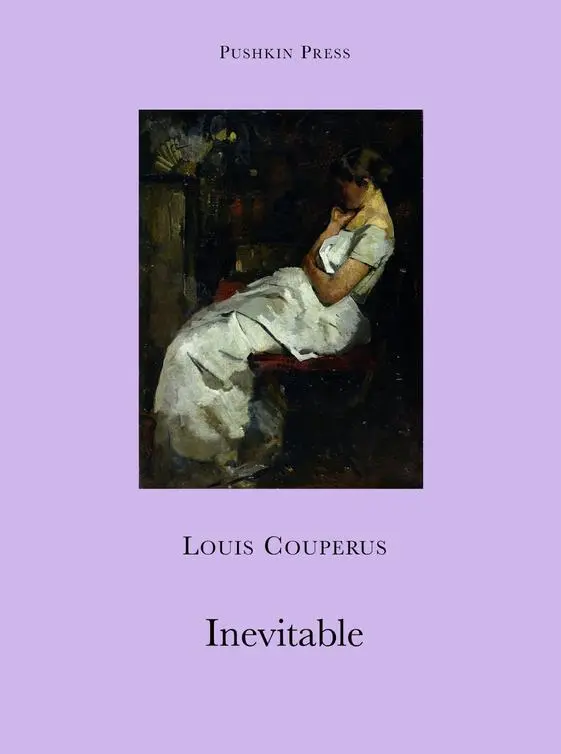
- Название:Inevitable
- Автор:
- Издательство:Pushkin Press
- Жанр:
- Год:2013
- ISBN:9781908968562
- Рейтинг книги:4 / 5. Голосов: 1
-
Избранное:Добавить в избранное
- Отзывы:
-
Ваша оценка:
Inevitable: краткое содержание, описание и аннотация
Предлагаем к чтению аннотацию, описание, краткое содержание или предисловие (зависит от того, что написал сам автор книги «Inevitable»). Если вы не нашли необходимую информацию о книге — напишите в комментариях, мы постараемся отыскать её.
Inevitable — читать онлайн бесплатно полную книгу (весь текст) целиком
Ниже представлен текст книги, разбитый по страницам. Система сохранения места последней прочитанной страницы, позволяет с удобством читать онлайн бесплатно книгу «Inevitable», без необходимости каждый раз заново искать на чём Вы остановились. Поставьте закладку, и сможете в любой момент перейти на страницу, на которой закончили чтение.
Интервал:
Закладка:
She was now with Mrs Uxeley and occupied two charming rooms of the huge twelve-roomed villa, with a view of the sea and of the Promenade des Anglais. Urania had helped her arrange them. And she lived in an unreal dream of alienation, non-existence, of soulless being, of unfelt actions and gestures, in accordance with the will of others. In the mornings she would visit Mrs Uxeley in her boudoir and read to her: American and French newspapers, and sometimes an extract from a French novelette. Humbly, she did her best. Mrs Uxeley thought she read well, but simply said she should cheer up now, that her sad days were over. No mention was made of Duco and Mrs Uxeley acted as if he did not exist. The great boudoir, with its balcony doors open, looked out over the sea where the morning promenade was already beginning, with the colourful and patchy shapes of parasols, delicately garish against the deep-blue sea, a sea of luxury, water of wealth, wavelets that had an expensive look before charmingly consenting to break into foam. The old lady, already made up, with her wig on and a white lace cap over it against the draught lay on her chaise-longue piled with cushions in the black and white lace of her white silk peignoir . With her lorgnette, initialled in diamonds, in her wrinkled hand, she liked to peer at the brash patches of the parasols outside. Now and then a rheumatic twinge would suddenly make her wince so that her face became a single crumpled surface of wrinkles, beneath which the even sheen of her make-up almost cracked, like craquelé china. In daylight she seemed scarcely alive, she seemed an automaton assembled from desiccated limbs, which still spoke and gesticulated. She was always a little tired in the mornings, at night she never slept; after eleven she took a nap. She lived according to a strict regime, and her doctor, who called every day, seemed to breathe new life into her every time, enabling her to hold out till evening. In the afternoons she drove around, got out at the Jetée and made her calls. But in the evenings she revived, with a hint of real animation, dressed, put on her jewels, recovered her exuberance, her exclamations, and her poses … Then it was balls, parties, the theatre. Then she was not a day over fifty.
But those were the good days. Sometimes, after a night of unbearable pain, she stayed in her bedroom, the previous day’s make-up not retouched, a black lace shawl over her bald head, in a black satin morning coat, which hung round her like a comfortable sack, and she groaned, screamed, shouted and seemed to be begging for mercy from her torment. This went on for a few days and occurred at regular three-week intervals: then she gradually revived again.
Her hectic conversation was limited to a regularly recurring discussion of all kinds of family matters. She explained to Cornélie all the family relations of her acquaintances, American and European, but was particularly fond of expanding on the great European families that she included among her acquaintances. Cornélie could never bear to listen and immediately forgot the acquaintances. It was sometimes intolerable to listen for so long, and for no other reason, as if compelled, Cornélie found the strength to talk a little herself, tell an anecdote or a story. When she saw that the old woman was very partial to anecdotes, riddles, puns, especially with a slightly risqué edge, she collected as many as she could from the Vie Parisienne and the Journal pour Rire , and always had them to hand. And Mrs Uxeley found her amusing. Once, noticing Duco’s daily letter, she made an allusion, and Cornélie suddenly realised that she was dying with curiosity. So she calmly told the truth: her marriage, her divorce, her liberal ideas, her meeting and relationship with Duco. The old woman was a little disappointed that Cornélie should talk about this with such simplicity. Her only advice was that the proprieties should now be observed. What friends said about the past was less important. But there must be no offence given now. Cornélie meekly gave her word. And Mrs Uxeley showed her albums, her own portraits from when she was a young woman, and the portraits of all kinds of men. And she talked of this friend and that, and in her vanity hinted at a very turbulent past. But she had always observed the proprieties … That was her pride. What Cornélie had done was not good …
The time between eleven and twelve-thirty brought relief. The old woman regularly had a siesta at that time — her only sleep — and Urania would come to collect Cornélie. They drove round a little or walked along the Promenade or sat in the Jardin Public. It was the only moment when Cornélie appreciated some of her newfound luxury and to some extent flattered her vanity. Walkers looked round at the two beautiful young women in their immaculate linen outfits, whose fashionably hatted heads withdrew under the twilight of their parasols and they admired the gleaming victoria, the impeccable livery and the grey horses of the Princess di Forte-Braccio.
Gilio was diffident and modest in his dealings with Cornélie. He was polite, but at a courteous distance, if he joined the two ladies for a moment in the garden or on the Jetée. Since the night in the pergola, after the sudden flash of his angry dagger, she was afraid of him, partly because she had lost much of her courage and her pride. But she could not be any cooler to him in her replies than she already was, since she was grateful to him, as she was to Urania, for looking after her for the first few days, and for the tact with which they had not left her immediately to the mercy of Mrs Uxeley, but had kept her at their place where she had regained some strength.
On those mornings off, when she felt released from the caricature of her life, from the old woman — vain, selfish, insignificant, ridiculous — she felt herself, with Urania’s friendship, regaining her old self, became aware of being in Nice, saw the colourful bustle around her with clearer eyes and lost the sense of unreality of the first few days. And it was as if she were seeing herself again for the first time, in her light linen walking suit, sitting in the Garden, her gloved fingers playing with the tassels of her parasol. She could still scarcely believe in herself, but she could see herself. She kept her longing, her homesickness, her oppressive discontent, deep inside, hidden even from Urania. Sometimes she felt she would choke. But she listened to Urania and talked and joined in the laughter and looked up at Gilio with a laugh, as he stood in front of her posing on the toes of his shoes, his walking stick dangling in his hands, behind his back. Sometimes — as in a vision swirling through the crowd — she would suddenly see Duco, the studio, her past happiness fading away for a brief moment. And then placing her fingertips between the lace strips curling in front of her bolero she would feel his letter of that morning and crumpled the stiff envelope against her breast like something of his that caressed her. There was no escaping it: she saw herself, and Nice around her, and she felt her new life: it was not unreality, although for her soul it was not real: it was sad play-acting in which, dull, tired, weak and listless — she played a part. …
XLV
EVERYTHING WAS ARRANGED as if according to a strict regime, which excluded even the slightest variation: everything was fixed as if by law. The reading of the newspaper, her one and a half hours off; then lunch, after lunch the drive, the Jetée, the visits; every day the calls, afternoon teas; occasionally a dinner, in the evenings generally a ball, a soir é e, a play. She made scores of new acquaintances and immediately forgot about them, and when she saw them again could never remember whether she knew them or not. In general she was quite well treated in those cosmopolitan circles, as it was known that she was a close friend of Princess Urania. But like Urania herself, on the female side of the old Italian names and titles, who sometimes made their dazzling appearance in those circles, she experienced devastating haughtiness and contempt. The gentlemen were always introduced to her, but whenever she was occasionally introduced to their ladies, a vague, astonished nod of the head was the only response. It mattered little to her personally, but she felt sorry for Urania, for she saw clearly, at Urania’s own soirées, how they scarcely regarded her as the hostess, how they surrounded and fêted Gilio, but gave his wife only a minimum of politeness due to her as Princess di Forte-Braccio, without forgetting for a moment that she was Miss Hope. And such lack of respect was harder for Urania to endure than for her. She assumed her role of lady’s companion. She kept a constant watch on Mrs Uxeley, repeatedly joining her for a moment, fetching a fan that Mrs Uxeley had left behind from another drawing-room, constantly performing some small service or other. Then, alone in the hectic hubbub of the room, she sat down against the wall, looking indifferently ahead of her. She sat there, still elegant, in an attitude of graceful indifference and dull boredom. Tapping her foot, or opening her fan. She paid no attention to anyone. Sometimes a few gentlemen would come over to her, and she would talk to them or dance a little, indifferently as if she were bestowing a favour. Once, when Gilio was talking to her, she seated and he standing, and the Duchess di Luca and Countess Costi came up together and, still standing, began bantering exuberantly with him without giving her so much as a look or a word, she first sat and looked the ladies up and down with mocking irony, then slowly rose and taking Gilio’s arm said, giving them a piercing needle-like look from narrowed eyes:
Читать дальшеИнтервал:
Закладка:
Похожие книги на «Inevitable»
Представляем Вашему вниманию похожие книги на «Inevitable» списком для выбора. Мы отобрали схожую по названию и смыслу литературу в надежде предоставить читателям больше вариантов отыскать новые, интересные, ещё непрочитанные произведения.











Обсуждение, отзывы о книге «Inevitable» и просто собственные мнения читателей. Оставьте ваши комментарии, напишите, что Вы думаете о произведении, его смысле или главных героях. Укажите что конкретно понравилось, а что нет, и почему Вы так считаете.