Louis Couperus - Inevitable
Здесь есть возможность читать онлайн «Louis Couperus - Inevitable» весь текст электронной книги совершенно бесплатно (целиком полную версию без сокращений). В некоторых случаях можно слушать аудио, скачать через торрент в формате fb2 и присутствует краткое содержание. Год выпуска: 2013, ISBN: 2013, Издательство: Pushkin Press, Жанр: Классическая проза, на английском языке. Описание произведения, (предисловие) а так же отзывы посетителей доступны на портале библиотеки ЛибКат.
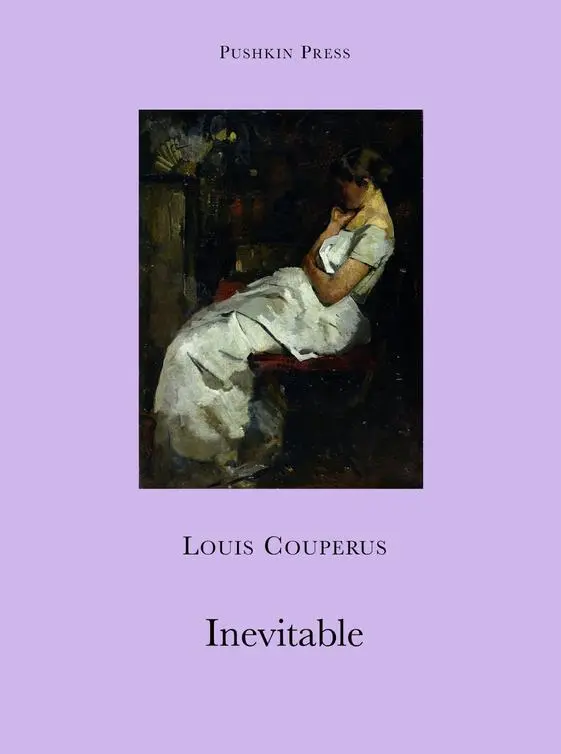
- Название:Inevitable
- Автор:
- Издательство:Pushkin Press
- Жанр:
- Год:2013
- ISBN:9781908968562
- Рейтинг книги:4 / 5. Голосов: 1
-
Избранное:Добавить в избранное
- Отзывы:
-
Ваша оценка:
Inevitable: краткое содержание, описание и аннотация
Предлагаем к чтению аннотацию, описание, краткое содержание или предисловие (зависит от того, что написал сам автор книги «Inevitable»). Если вы не нашли необходимую информацию о книге — напишите в комментариях, мы постараемся отыскать её.
Inevitable — читать онлайн бесплатно полную книгу (весь текст) целиком
Ниже представлен текст книги, разбитый по страницам. Система сохранения места последней прочитанной страницы, позволяет с удобством читать онлайн бесплатно книгу «Inevitable», без необходимости каждый раз заново искать на чём Вы остановились. Поставьте закладку, и сможете в любой момент перейти на страницу, на которой закончили чтение.
Интервал:
Закладка:
She said that she would write to Urania: the Forte-Braccios were in Nice. Unenthusiastically, he agreed. And as soon as she received a reply, she took out her suitcase and, like an automaton, packed her old clothes. Urania wrote telling her to come and saying that Mrs Uxeley wanted to see her. Mrs Uxeley sent her the fare. She was at her wits’ end, nervous and constantly breaking into sobs, and felt as if she were tearing herself away from him, from the home she loved that was crumbling around them, through her fault alone. When she received the registered letter containing the fare, she had a fit of hysteria, nestling against him like a child, crying plaintively that she could not do it, that she did not want to do it, that she could not live without him, that she would love him forever, that she would die so far from him. She lay on the sofa, her legs stiff, her arms stiff, and screamed with her mouth contorted as if in physical pain. He rocked her in his arms, dabbed her forehead, gave her ether to sniff, comforted her, said that it would all come right later … Later … She looked blankly at him, almost crazed with the pain. She threw everything out of her case again, across the room, underwear, blouses, and laughed and laughed … He begged her to control herself. When she saw the dismay on his face and when he too sobbed in her arms, she hugged him tightly to her, kissed him, comforted him in turn … And everything in her subsided, dull and limp … They repacked the case together. Then she looked round and in a burst of energy arranged the studio for him , got him to remove her bed, fixed his own sketches to the wall, tried to rebuild something of what had crumbled around them, rearranged everything and did her best. She cooked their final meal, banked up the fire … But a desperate threat of loneliness and desolation was all-pervading. They could not do it, they could not do it … They fell asleep sobbing, in each others’ arms, close together. The next morning he took her to the station. And once she had boarded the train and was in her compartment, both of them lost control. They embraced sobbing, as the conductor tried to close the door. She saw him walking away like a madman, barging his way through the thronging crowd, and broken with sorrow threw herself back in her seat. She was so overcome and so close to fainting that a lady next to her came to her assistance and washed her face with eau de Cologne …
She thanked the lady, apologised and, seeing the other passengers looking at her with sympathy, she controlled herself and fell into a dull stupor, staring blankly out of the window. She travelled on and on, stopping nowhere, getting out only to change trains. Though hungry, she had no energy to order anything at the stations. She ate nothing and drank nothing. She travelled for a day and a night and arrived late the next evening in Nice. Urania was at the station and was alarmed at Cornélie’s grey pallor, utter exhaustion and hollow-eyed expression. She was very sweet to her; she took Cornélie home with her, nursed her for a few days, made her stay in bed, and went personally to Mrs Uxeley to tell her that her friend was too unwell to report. Gilio briefly paid his respects to Cornélie, and she could only thank him for the days of hospitality and care under his roof. The young princess was like a sister, a mother, building up Cornélie’s strength with milk, eggs, and fortifying tonics. Obediently she submitted to Urania’s ministrations, dull and indifferent, and ate in order to please Urania. After a few days Urania said that Mrs Uxeley, curious to see her new companion, was going to visit that afternoon. Mrs Uxeley was now alone, but could wait until Cornélie was better. Dressed as smartly as she could she sat with Urania and awaited the old lady’s arrival. She made an exuberant entrance, talking non-stop, and in the dim light of Urania’s drawing-room Cornélie could not believe that she was ninety. Urania winked at her, but she could only smile feebly: she was dreading this first interview. But Mrs Uxeley, probably because Cornélie was the friend of the Princess di Forte-Braccio, was very unstuffy, very pleasant, not at all condescending towards her future lady’s companion; she inquired after Cornélie’s health in an exhaustingly expansive stream of exclamations and phrases and helpful hints. In the subdued light of the lace-shaded standard lamps, Cornélie surveyed her and saw a woman of fifty, with her wrinkles carefully powdered, in a mauve velvet outfit embroidered with old gold and sequins and beads, her brown wavy chignon topped by a hat with white feathers. She was very mobile and hectic, so that her jewels were constantly sparkling. She now took Cornélie’s hand and began talking intimately … So Cornélie would be coming the day after tomorrow? Good. She usually paid a hundred dollars a month, or five hundred francs: never less, but never more. But she realised that Cornélie needed something at once, for new outfits: so would she order what she needed from this address, on Mrs Uxeley’s account? A couple of ball gowns, a couple of less dressy evening outfits, everything in fact. Princess Urania would no doubt tell her and go with her. And she got up, doing her best to behave like a young woman, fluttering about with her lorgnette, but all the while leaning on her parasol, while a sudden twinge of rheumatism revealed all kinds of wrinkles. Urania accompanied her to the corridor and came back shrieking with laughter; Cornélie joined in very feebly. It mattered nothing to her: she was more astonished than amused by Mrs Uxeley. Ninety! Ninety!! What energy, worthy of a better goal than trying to remain elegant: ‘ la femme la plus élégante d’Ostende!! ’
Ninety! How that woman must suffer, the hours of time-consuming toilet, in order to turn herself into this caricature. Urania said that everything was false, her hair and her neckline! And Cornélie felt revulsion at the prospect of living from now on with that woman, as if with something unworthy. Much of her energy had been drained by her happy love life, as if their twin happiness — Duco’s and hers — had made her less fit for further existential struggle and had softened her in its splendour, but it had refined and purified something in her soul and she was revolted by so much pretence for so petty and vain a purpose. And it was only pure necessity — the gradualness of life that impelled her and pushed her gently with its guiding finger along a lifeline that was now winding away into loneliness — necessity that gave her the strength to hide away her sorrow, her longing, her homesickness for all she had left behind, deep within her. She decided to say no more about it to Urania. Urania was so happy to see her, regarded her as a good friend, in the loneliness of her exalted life, in her isolation amid her aristocratic acquaintances. Urania had enthusiastically accompanied her to seamstresses and shops and helped her choose her new trousseau. It left her cold. She, the elegant woman, innately elegant, who in her appearance had always defended herself against poverty, who with a fresh ribbon was able to wear an old blouse gracefully, in the days of her happiness, was totally indifferent to everything she was now buying at Mrs Uxeley’s expense. It was as if it were not for her. She let Urania ask and choose, and went along with everything. She tried things on like an automaton. She was so upset to have to spend so much at a stranger’s expense. She felt demeaned, humiliated: all her haughty pride in herself had gone. She was afraid of what might be thought of her in Mrs Uxeley’s circle of acquaintances, unsure whether they would know of her liberal ideas, her relationship with Duco, and she was afraid of Mrs Uxeley’s opinion. Because Urania had had to be honest and tell her everything. It was only because of Urania’s warm recommendation that Mrs Uxeley was still prepared to employ her. She felt out of place, now she had to join in with all those people again, and she was afraid of showing her true colours. She would have to play-act, disguise her ideas, weigh her words, and she was no longer used to that. And all that for money. All because she did not have the strength to earn her living alongside Duco, and happily and independent, encourage him in his work, his art. Oh, if only she had been able and had found some way, how happy she would have been. If only she had not allowed to fester in her the wretched languor of her blood, her upbringing, her brilliant drawing-room education languor, which rendered her unfit for anything! In her blood she was both a woman of love and a woman of luxury, but more love than luxury: she could be happy with the simplest thing if only she could love. And now life had torn her from him, slowly but surely. And now she had luxury, dependent luxury, and it no longer satisfied her blood, because she could no longer satisfy her deepest need. Fatal discontent ran riot in that lonely soul. The only happiness she possessed were his letters, his long letters, letters of longing, but also letters of comfort. He wrote to her of his longing, but also wrote to give her courage and hope. He wrote to her every day. He was in Florence now and sought consolation in the Uffizi and the Pitti Palace. He had not been able to stay in Rome, and the studio was now closed up. In Florence he was slightly closer to her. And his letters were like a book of love to her, the only novel she read, and it was as if she saw his landscapes in his style, the same haziness of intensely felt colour, the pearly white and dreamily hazy light distance: the horizon of his longing, as if his eyes were always straying to the horizon, where the night of their parting had disappeared as if into a peacock-grey sunset; a whiff of the sad Campagna. In those letters they were still living together. But she could not write to him in the same way. Although she wrote to him every day, she wrote concisely, always the same thing in different words: her longing, her dull indifference. She told him, though, how she loved his letters, which were like her daily bread.
Читать дальшеИнтервал:
Закладка:
Похожие книги на «Inevitable»
Представляем Вашему вниманию похожие книги на «Inevitable» списком для выбора. Мы отобрали схожую по названию и смыслу литературу в надежде предоставить читателям больше вариантов отыскать новые, интересные, ещё непрочитанные произведения.










Обсуждение, отзывы о книге «Inevitable» и просто собственные мнения читателей. Оставьте ваши комментарии, напишите, что Вы думаете о произведении, его смысле или главных героях. Укажите что конкретно понравилось, а что нет, и почему Вы так считаете.