Louis Couperus - The Hidden Force
Здесь есть возможность читать онлайн «Louis Couperus - The Hidden Force» весь текст электронной книги совершенно бесплатно (целиком полную версию без сокращений). В некоторых случаях можно слушать аудио, скачать через торрент в формате fb2 и присутствует краткое содержание. Год выпуска: 2012, ISBN: 2012, Издательство: Pushkin Press, Жанр: Классическая проза, на английском языке. Описание произведения, (предисловие) а так же отзывы посетителей доступны на портале библиотеки ЛибКат.
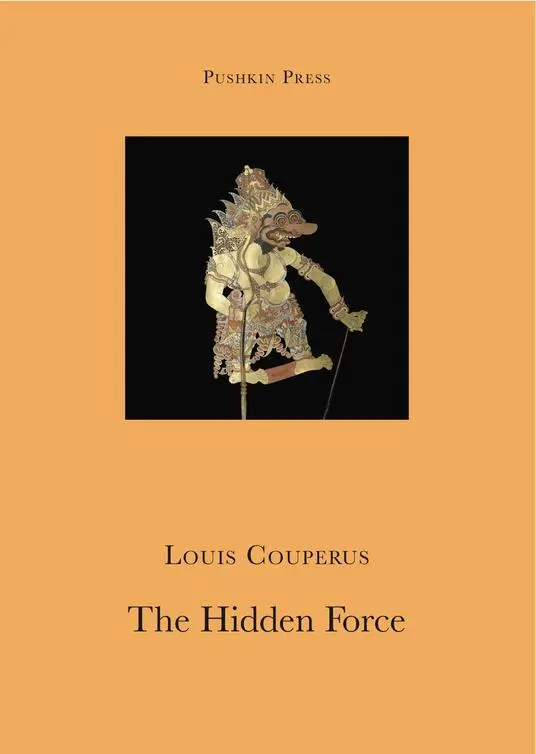
- Название:The Hidden Force
- Автор:
- Издательство:Pushkin Press
- Жанр:
- Год:2012
- ISBN:9781908968227
- Рейтинг книги:4 / 5. Голосов: 1
-
Избранное:Добавить в избранное
- Отзывы:
-
Ваша оценка:
The Hidden Force: краткое содержание, описание и аннотация
Предлагаем к чтению аннотацию, описание, краткое содержание или предисловие (зависит от того, что написал сам автор книги «The Hidden Force»). Если вы не нашли необходимую информацию о книге — напишите в комментариях, мы постараемся отыскать её.
The Hidden Force — читать онлайн бесплатно полную книгу (весь текст) целиком
Ниже представлен текст книги, разбитый по страницам. Система сохранения места последней прочитанной страницы, позволяет с удобством читать онлайн бесплатно книгу «The Hidden Force», без необходимости каждый раз заново искать на чём Вы остановились. Поставьте закладку, и сможете в любой момент перейти на страницу, на которой закончили чтение.
Интервал:
Закладка:
In this family they had preserved traditions that have died out — as one remembers them in Indies families from years ago. Here one still found in the grounds on the back veranda the countless maids, one of whom does nothing but grind up rice powder, while another provides incense and a third pounds sambal for a hot sauce, all dreamy-eyed with agile, playful fingers. It was also where the succession of dishes in the rijsttafel seemed endless; where a long line of servants — one after another — solemnly served yet more varieties of vegetable sauce, yet another chicken dish, while maids ground sambal in an earthenware mortar to suit the different tastes and requirements and spoiled palates. Here it was still the custom, when the family attended the races at Ngajiwa, for each of the ladies to appear followed by a maid, moving slowly and solemnly; one maid carried a jar of rice powder, another a box of peppermints, binoculars, a fan, a bottle of perfume, like a court procession with state insignia. Here one also found old-fashioned hospitality; the row of guest rooms was open to whoever called; one could stay as long as one liked: no one asked about the purpose of your journey, or your date of departure. A great inner simplicity, an all-embracing cordiality, instinctive and innate, prevailed here alongside limitless boredom and dreariness, a complete lack of ideas, few words, but with a gentle smile making up for ideas and words; materially life was full to overflowing, all day long one was served with cool drinks and biscuits and spicy fruit salad, and three maids were assigned to make salad and biscuits. There were numerous animals in the grounds: a cage full of monkeys, a few parrots, dogs, cats, tame squirrels and a small, exquisite mouse deer that roamed free. The house, built onto the factory, and at milling time ringing with the thunder of the machines — the sound of steamship propellers — was spacious and furnished with old, outdated furniture: the low wooden beds with four carved bedposts hung with mosquito nets, the rocking chairs with very rounded backs — all the kind of things one could no longer buy, everything without a single modern feature, except — only during the meal — the electric light in the front veranda! The district commissioners, always in indoor dress, the men in white or blue stripes, the women in sarongs and jackets, looking after either monkeys or parrots or deer, in simplicity of soul, always with the same sweet pleasantness, slowly and long drawn out, and the same gentle smile. Then, once the milling season was over, and all the rush had subsided — during which the lines of sugar wagons drawn by superb oxen with gleaming brown coats had kept bringing more and more and more loads of sugar cane down the road strewn with their shreds and ruined by the wide cart tracks — and the seed for next year had been bought, and the machines were still, there was a sudden chance to relax after their unremitting toil. There came the long, long Sundays, the months of rest, the need for partying and fun. At the great dinner given by the lady of the house, with a ball and tableaux vivants , the whole house was full of visitors, both known and unknown, who stayed on and on. The old, wrinkled grandma — the lady of the house, the radèn-ayu, Mrs De Luce, whatever one wished to call her — was affable with her dulled eyes and betel-stained mouth, affable with everyone, always with an anak mas behind her — a “golden child”, a poor adopted princess — who followed her, the great princess from Solo, carrying the box of betel nuts: the child, a small slim girl of eight, with a fringe, her forehead made up with wet rice powder, round breasts already developing under the pink silk jacket and the gold miniature sarong around her narrow hips, like a doll, a toy belonging to the radèn-ayu , the dowager Mrs De Luce. And for the native villages there were popular festivals, a traditional gesture of liberality in which all Pajaram shared, according to the age-old tradition that was always observed, despite crisis or unrest.
It was relatively peaceful in the house now that the milling season and the celebrations were over, and an indolent calm had ensued. But Mrs Van Oudijck, Theo and Doddy had come over for the celebrations and were staying on at Pajaram for a few days. Seated around the marble table, on which there were glasses of syrup, lemonade and whisky soda, was a large group of people: they did not say much, but rocked contentedly up and down, occasionally exchanging a few words. Mrs De Luce and Mrs Van Oudijck spoke Malay, but very little: a gentle, good-natured boredom descended on a large number of rocking people. It was strange to see the different types: the beautiful milky-white Léonie next to the yellow, wrinkled Princess dowager; Theo, light-skinned and blond as a Dutchman with his full, sensual lips that he had inherited from his Eurasian mother; Doddy, already like a mature rose with her irises sparkling in her black pupils; the son of the director, Achille de Luce — tall, well-built, brown — whose thoughts were focused solely on his machinery and his seed; the second son, Roger — short, thin, brown — the bookkeeper, whose thoughts were focused solely on that year’s profits, with his Armenian wife; the eldest daughter, already old — stupid and ugly, brown — with her full-blooded Dutch husband, who looked like a country bumpkin. The other sons and daughters, in all shades of brown, and hard to distinguish at first glance; and around them the children, the grandchildren, the maids, the little golden foster-children, the parrots and the deer and, as if sprinkled over all these grown-ups and children and animals, the same benevolent togetherness, but also over everyone the same pride in their Solo matriarch, who caused a pale halo of Javanese aristocracy to gleam behind all their heads, and as proud as any of them were her Armenian daughter-in-law and her clodhopping Dutch son-in-law.
The liveliest of all of these elements that had merged through long cohabitation in the patriarchal seat was the youngest son, Addy, in whom the blood of the Solo princess and the French adventurer had mingled harmoniously. While it had not made him brainy, it had given him the good looks of a young Eurasian, with a Moorish touch, something southern, something Spanish. And in this youngest child the two racial elements, so far removed from each other, had for the first time been joined harmoniously, had for the first time married with complete mutual understanding — as if in him, this last child of so many, the adventurer and the princess had met in harmony for the first time. Addy appeared to have no imagination or intellect to speak of, and was incapable of stringing together two ideas to make a coherent train of thought; all he felt was the vague benevolence that had descended on the whole family, and apart from that he was like a beautiful animal that had degenerated spiritually and mentally, degenerated into one big emptiness. His body had become like a resurrection of racial perfection, full of strength and beauty, while his marrow and his blood and his flesh and his muscles had developed into a harmony of physical attraction, so utterly, mindlessly, beautifully sensual that the harmony had an immediate appeal for women. The young man had only to appear, like a beautiful southern god, for every woman’s eyes to be on him, and absorb him deep into their imaginations so they could later summon him up in their mind’s eye; the young man had only to come to a ball after the races at Ngajiwa for all the young girls to fall in love with him. He plucked love wherever he found it, and he found it particularly abundant in the villages around Pajaram. Every woman was in love with him, from his mother to his little nieces. Doddy van Oudijck worshipped him. She had been in love hundreds of times since the age of seven, with anyone whom she spied with her bright eyes, but never before as she was with Addy. It radiated so strongly from her that it was like a flame everyone could see, and that made them smile. For her, the milling party had been one round of enchantment… when she danced with him; one round of torture… when he danced with anyone else. He had not proposed, but she was thinking of proposing to him , and dying if he refused. She knew that her father, the Commissioner, was opposed; he did not like the De Luce family, that Solo-French crowd, as he called them. But if Addy wanted to, her father would give in, because otherwise she, Doddy, would die. For this child of love, the young Eros was the whole world, the universe, life itself. He courted her, kissed her secretly on the lips, but no more than in the thoughtless way he did with others; he kissed other girls, too. If he was allowed to, he went further, quite naturally, like a devastating young god, an unthinking god. But he still had some respect for the commissioner’s daughter. He had neither courage nor impudence, and lacked much passion in his choices, seeing women as women and so sated with conquest that obstacles were not a stimulus. His garden was full of flowers, all of which strained towards him; he stretched out his hand almost without seeing, and just plucked.
Читать дальшеИнтервал:
Закладка:
Похожие книги на «The Hidden Force»
Представляем Вашему вниманию похожие книги на «The Hidden Force» списком для выбора. Мы отобрали схожую по названию и смыслу литературу в надежде предоставить читателям больше вариантов отыскать новые, интересные, ещё непрочитанные произведения.











Обсуждение, отзывы о книге «The Hidden Force» и просто собственные мнения читателей. Оставьте ваши комментарии, напишите, что Вы думаете о произведении, его смысле или главных героях. Укажите что конкретно понравилось, а что нет, и почему Вы так считаете.