Louis Couperus - The Hidden Force
Здесь есть возможность читать онлайн «Louis Couperus - The Hidden Force» весь текст электронной книги совершенно бесплатно (целиком полную версию без сокращений). В некоторых случаях можно слушать аудио, скачать через торрент в формате fb2 и присутствует краткое содержание. Год выпуска: 2012, ISBN: 2012, Издательство: Pushkin Press, Жанр: Классическая проза, на английском языке. Описание произведения, (предисловие) а так же отзывы посетителей доступны на портале библиотеки ЛибКат.
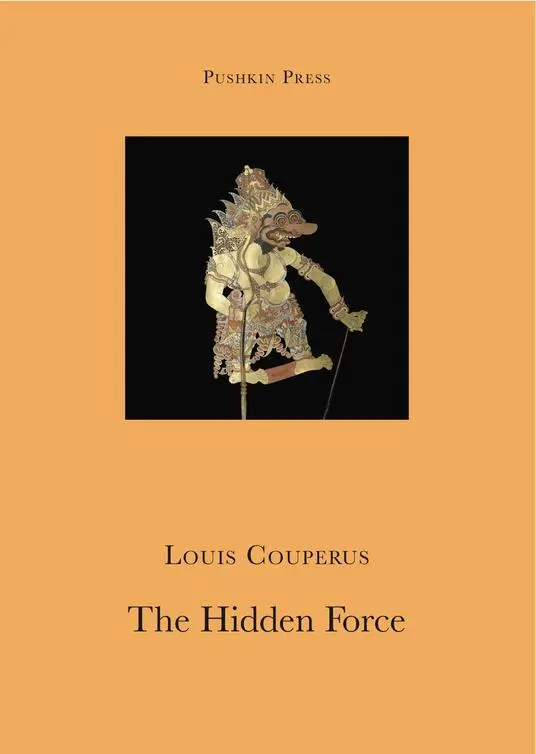
- Название:The Hidden Force
- Автор:
- Издательство:Pushkin Press
- Жанр:
- Год:2012
- ISBN:9781908968227
- Рейтинг книги:4 / 5. Голосов: 1
-
Избранное:Добавить в избранное
- Отзывы:
-
Ваша оценка:
The Hidden Force: краткое содержание, описание и аннотация
Предлагаем к чтению аннотацию, описание, краткое содержание или предисловие (зависит от того, что написал сам автор книги «The Hidden Force»). Если вы не нашли необходимую информацию о книге — напишите в комментариях, мы постараемся отыскать её.
The Hidden Force — читать онлайн бесплатно полную книгу (весь текст) целиком
Ниже представлен текст книги, разбитый по страницам. Система сохранения места последней прочитанной страницы, позволяет с удобством читать онлайн бесплатно книгу «The Hidden Force», без необходимости каждый раз заново искать на чём Вы остановились. Поставьте закладку, и сможете в любой момент перейти на страницу, на которой закончили чтение.
Интервал:
Закладка:
“But you love your work, and you’re a good official. Eldersma always says: anyone in the Indies who doesn’t work and doesn’t like his work is lost…”
“You haven’t got a nature for love, and I haven’t got one for work, for nothing but work. I can work for a purpose, which I can see before me in all its beauty, but I can’t work… for the sake of work and to fill the emptiness in my life.”
“Your purpose is the Indies.”
He shrugged his shoulders.
“Fine words,” he said. “That may be true of someone like the Commissioner, whose career is going smoothly, who has never sat and pored over the Colonial List and speculated about so-and-so’s illness and so-and-so’s death… in the hope of promotion. For someone like Van Oudijck, who really believes, in all his idealistic honesty, that the Indies are his purpose, not for Holland but for the Indies themselves, for the Javanese, whom he as an administrator protects from the tyranny of landlords and planters. I’m more cynically inclined…”
“But don’t be so lukewarm about the Indies. It isn’t just fine words: that’s what I feel. The Indies are where the true greatness of us Dutch lies. Listen to foreigners talk about the Indies, and they are all enraptured by its glories and about our way of colonizing… Don’t associate yourself with that wretched spirit you find in Holland, which knows nothing about the Indies and always has a sarcastic word for them in its petty, stiff, bourgeois narrow-mindedness…”
“I didn’t realize you were such a fan of the Indies. Just yesterday you felt anxious here, and I defended my country…”
“Oh, I feel a shudder in the mysteriousness of the evenings, when some imminent danger — I don’t know what — seems to threaten: a frightening future, a danger to us… I feel that I personally remain far removed from the Indies, though I don’t wish to be… that here I miss the art I was brought up with, that here I’m without that line of beauty in people’s lives, which my parents always drew my attention to… But I’m not unjust. The Indies as our colony I find great; us, in our colony, I find great…”
“In the past perhaps, but now everything is going wrong, now we are no longer great. You have an artistic nature; despite the fact that you seldom find it, you always look for the artistic line in the Indies. Then that great, glorious image comes to your mind. That is the poetry. The prose is a huge, but exhausted colony, still ruled from Holland with one idea in mind: profit. The reality is not that the rulers are great in the Indies, but that the rulers are petty-minded exploiters. The country is being sucked dry, and the real population — not the Dutch, who spend their money from the Indies in The Hague, but the native population, attached to the soil of the Indies — are being oppressed by a disdainful overlord, who once helped create that population from his own blood. Now they are threatening to rise up against that oppression and that contempt. You, being an artist, feel the danger approaching, vaguely, like a cloud in the air, in the tropical night. I see a very real danger arising — for Holland — if not from America and Japan, then from the soil of this land itself.”
She smiled.
“I like it when you talk like that,” she said. “You might convince me in the long run.”
“If only I could achieve that much with words!” he laughed bitterly as he got up. “My half hour is up: the Commissioner is expecting me and he doesn’t like to be kept waiting. Goodbye, forgive me.”
“Tell me, am I a flirt?”
“No,” he replied. “You are as you are. And I can’t help loving you… I keep extending my antennae. That’s my fate…”
“I’ll help you to forget me,” she said, with warm conviction.
He laughed briefly and took his leave. She saw him crossing the road to the Commissioner’s compound, where he was met by an attendant…
“Actually life is one long self-deception, one long wild-goose chase after illusions,” she thought despondently. “A great goal, a universal goal… or a small private goal, for my own body and soul… Oh God, how little it all means! We wander round a bit, without knowing anything, and every one of us is in pursuit of his own little goal, his own fantasy. The only ones who are happy are the exceptions, such as Léonie van Oudijck, who is no more alive than a beautiful flower, or a beautiful animal.”
Her child toddled towards her, an engaging, fat, blond little boy.
“My baby!” she thought. “What will become of you? What will life bring you? Oh, nothing out of the ordinary perhaps. Perhaps a repeat of what has happened countless times before… Oh, when one feels like this, the Indies are so oppressive!”
She hugged her son and her tears dripped on to his blond curls.
“Van Oudijck has his office of commissioner; I have my little circle of… admiration and domination; Frans has his love… for me… we all have our toys to play with, just as my little Onno plays with his little horse. How little there is to us, how little there is to us!.. All through our lives we give ourselves airs, imagine all kinds of things. We are convinced we have a direction and purpose to our poor, lost, little lives. Oh, what’s got into me, darling? And what awaits you, my darling?”
BOOK III
1
FOURTEEN MILES FROM LABUWANGI, and thirteen miles from Ngajiwa, lay the Pajaram sugar factory, belonging to the De Luce family — half Creole, half Solo in origin — once millionaires, no longer as rich as they were because of the recent sugar crisis, but still maintaining a large household. This indissoluble family comprised: an old mother and grandmother, a Solo princess; the eldest son, an administrator; three married daughters and their husbands — employed as clerks in the business — who lived in the shadow of the factory; the numerous grandchildren playing close to the factory; the great-grandchildren germinating close to the factory. In this family old Indies traditions were preserved, which — once universal — are today becoming rarer because of more intensive contact with Europeans. The mother and grandmother was the daughter of a Solo prince, who had married a young, energetic adventurer and bohemian, Ferdinand de Luce, the scion of a noble family from Mauritius, who, after some years of roaming and searching for his niche in the world, had sailed to the Indies as a steward on board a ship, and after all kinds of vicissitudes had been stranded in Solo, where he won fame for a tomato dish and one of stuffed peppers! Ferdinand de Luce’s cooking gained him access to the Prince of Solo, whose daughter he later married, and even to the old Susuhunan. After his marriage he became a landowner, according to Solo law a vassal of the Susuhunan, to whom he sent a daily tribute of rice and fruit for the Palace household. Then he had gone into sugar, guessing the millions that a favourable destiny had in store for him. He had died before the crisis, wealthy and universally honoured.
The old grandmother, who had retained nothing of the young princess who had married Ferdinand de Luce for social advancement, was invariably approached with servile respect by the servants and the Javanese staff of the factory, and everyone gave her the title of radèn-ayu pangéran . She spoke not a word of Dutch. As wrinkled as a shrivelled fruit, with her cloudy eyes and withered, betel-stained mouth, she lived out her last years peacefully, always in a dark silk jacket, with a jewelled fastening at the neck and tight sleeves. Before her dimmed eyes flickered the vision of the former palatial greatness she had abandoned for the love of that aristocratic French cook, who had delighted her father’s taste buds with his recipes; her poor hearing caught the constant muffled whoosh of the centrifuges — like ships’ propellers — during the milling of the sugar cane, which lasted for months. Around her were her children, grandchildren and great-grandchildren; the sons and daughters called radèn and radèn-ayeng , all of them still surrounded by the pale aura of their Solo origins. The eldest daughter had married a full-blooded, blond Dutchman; the son who followed her, an Armenian girl; both the other daughters had married Eurasians, both brown-skinned, as were their children — now themselves married and with children and mingling with the blond family of the eldest daughter; and the glory of the whole family was the youngest son and brother Adrien, or Addy, who was paying court to Doddy van Oudijck, and who, despite the busy milling period, was constantly at Labuwangi.
Читать дальшеИнтервал:
Закладка:
Похожие книги на «The Hidden Force»
Представляем Вашему вниманию похожие книги на «The Hidden Force» списком для выбора. Мы отобрали схожую по названию и смыслу литературу в надежде предоставить читателям больше вариантов отыскать новые, интересные, ещё непрочитанные произведения.



Обсуждение, отзывы о книге «The Hidden Force» и просто собственные мнения читателей. Оставьте ваши комментарии, напишите, что Вы думаете о произведении, его смысле или главных героях. Укажите что конкретно понравилось, а что нет, и почему Вы так считаете.