Sandor Marai - The Rebels
Здесь есть возможность читать онлайн «Sandor Marai - The Rebels» весь текст электронной книги совершенно бесплатно (целиком полную версию без сокращений). В некоторых случаях можно слушать аудио, скачать через торрент в формате fb2 и присутствует краткое содержание. Год выпуска: 2004, ISBN: 2004, Издательство: Knopf Doubleday Publishing Group, Жанр: Классическая проза, на английском языке. Описание произведения, (предисловие) а так же отзывы посетителей доступны на портале библиотеки ЛибКат.
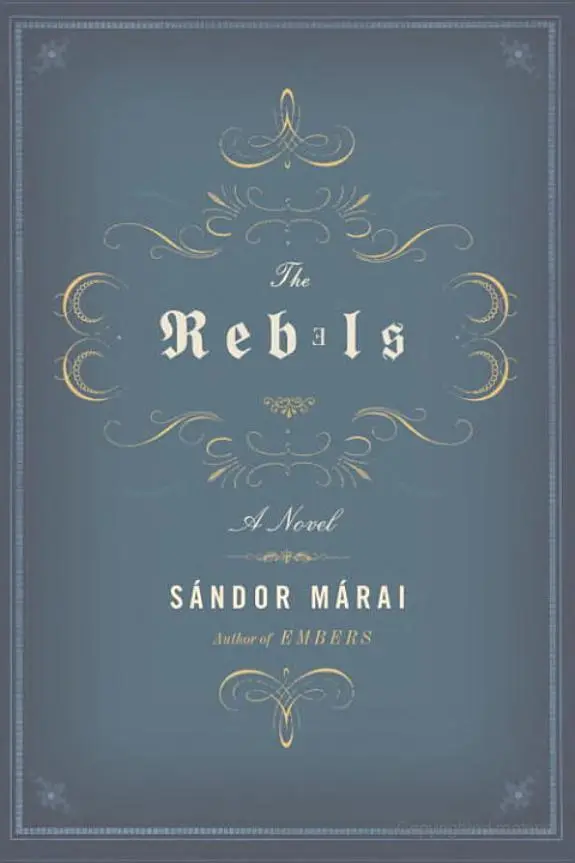
- Название:The Rebels
- Автор:
- Издательство:Knopf Doubleday Publishing Group
- Жанр:
- Год:2004
- ISBN:9780307267405
- Рейтинг книги:3 / 5. Голосов: 1
-
Избранное:Добавить в избранное
- Отзывы:
-
Ваша оценка:
The Rebels: краткое содержание, описание и аннотация
Предлагаем к чтению аннотацию, описание, краткое содержание или предисловие (зависит от того, что написал сам автор книги «The Rebels»). Если вы не нашли необходимую информацию о книге — напишите в комментариях, мы постараемся отыскать её.
is a haunting story of a group of alienated boys on the cusp of adult life—and possibly death—during World War I.
It is the summer of 1918, and four boys approaching graduation are living in a ghost town bereft of fathers, uncles, and older brothers, who are off fighting at the front. The boys know they will very soon be sent to join their elders, and in their final weeks of freedom they begin acting out their frustrations and fears in a series of subversive games and petty thefts. But when they attract the attention of a stranger in town—an actor with a traveling theater company—their games, and their lives, begin to move in a direction they could not have predicted and cannot control, and one that reveals them to be strangers to one another. Resisting and defying adulthood, they find themselves still subject to its baffling power even in their attempted rebellion.
The Rebels — читать онлайн бесплатно полную книгу (весь текст) целиком
Ниже представлен текст книги, разбитый по страницам. Система сохранения места последней прочитанной страницы, позволяет с удобством читать онлайн бесплатно книгу «The Rebels», без необходимости каждый раз заново искать на чём Вы остановились. Поставьте закладку, и сможете в любой момент перейти на страницу, на которой закончили чтение.
Интервал:
Закладка:
“My father has principles! I have none!” He was reeling with laughter. “If only he could see me here…”
“Box two was better,” said Ábel. “That was our box, number two on the right. Tibor, if only your father could see you now! Careful, your skirt is riding up.”
Tibor sat up and smoothed his skirt down. Ábel addressed him most solemnly.
“Have you ever read poems with cotton wool in your ears? Or prose, for that matter…It’s quite different, you know. You should try it some time…”
The actor fished in his pocket for a contraption that looked a little like a pocket watch and splashed perfume on his palms and cheeks. The cloud of sickening chypre enveloped Tibor too.
“A proper sailor likes his scents,” said the actor. “His pockets and his chest are full of gifts for his friends and brides.”
So saying he dipped in his pocket again and brought out a small hand-mirror, a comb, some cakes of soap, and ceremoniously handed them round. What was left of the chypre he poured all over Tibor.
THERE WERE CONTRARY STORIES AS TO WHAThappened later. Ernõ asserted that everyone, with the exception of the actor, who had in fact drunk the most, was drunk. The actor was only pretending. The one-armed one obstinately maintained that the actor was genuinely and helplessly drunk because there was that embarrassing moment when he touched him with his fingertip and the actor collapsed like a sack.
What they all remembered was that round about dawn the actor made an interminable torrent of a speech and behaved most strangely. He walked up and down waving his arms and told ridiculous stories in a mixture of languages. No one the next day could remember what he actually said. He kept mentioning the names of foreign cities, made grandiloquent gestures at the dark auditorium, and shouted obscene remarks into it. There was one time when they were all speaking at once. The one-armed one was weeping and staggering around. He went from person to person, tapping each on the arm and pointing to the space where his missing arm should have been. “There’s yours,” he said, “but where is mine?” He wept, sat down on the ground, and felt about himself. “There must be a mistake,” he pleaded. “Help me look for it. It must be here somewhere.” They stood around not knowing what to do. They tried whispering soothing things into his ear. He was impossible to console or calm. He screamed and shouted and started vomiting. They washed his face. Tibor sat down with him and laid his brother’s head in his lap. The one-armed one was twitching, his whole body racked with tears.
“More,” advised the actor. “Give him more drink. Crying is just a stage you go through. Let’s see where this leads!”
They drank straight from the bottle, the actor disappearing from time to time, returning with more bottles. He obviously had a supply at hand. Ernõ bellowed over the chaos:
“Where did you get the money?”
They stared at each other in the unexpected silence. True enough. How could he afford all this? The actor was known to be stingy with money. Now he grinned.
“You’re my friends…,” he said. “What does it matter? Think of me as your patron…” He lurched over to the prompter’s box. “Ladies and gentlemen…Behold Maecenas…patron of the arts…for my little friends…”
He reeled about, laughing.
“Let there be music!” he declared.
He pulled a gramophone from one of the trunks and with uncertain fingers put a record on.
“Hush, needle,” he cajoled. “Hush. Let’s dance.”
He stood up straight, stepped over to Tibor, and made a bow. The one-armed one scrambled to his feet.
“Look in the trunk,” he said. “The trunk.”
The record was playing so quietly that at first they did not hear it. The actor swept Tibor into his arms and began to dance with him.
Ábel followed them, somewhat ill at ease. The actor was dancing properly, as if he hadn’t drunk anything, dancing as if it were the most natural form of locomotion for him, as if his heavy body were rendered weightless, mercilessly dragging Tibor along with him, barely perceptibly lifting him with both arms. The music was so quiet and slow that for some time the two caught up in the dance were the only ones to hear it. It was a mewling, selfpitying kind of tune, with much rubato, the rhythm broken up, and the actor was performing a hitherto unknown kind of dance to it, improvising sweeping gestures, taking Tibor with him. His face was solemn now, almost pious. It seemed to Ábel as he trailed them that the actor was staring deep into Tibor’s eyes. Both of them were highly serious as they danced, disciplined in opposition, staring each other out, not turning away their heads, not even for a second. The two pairs of eyes were watching each other with such anxiety, such close attention it seemed to be vital not to let the other out of sight as their feet and bodies swayed. They kept their necks stiff, head and neck indifferent to the dipping and rising of the torso. How does Tibor know how to dance? thought Ábel. Perhaps he was simply allowing his helpless body to be guided by the actor who had caught him up in his own orbit, Tibor following wherever he was led. Where was this dance leading? They were moving slowly in constant, calm, even patterns as the record wound down. The actor released Tibor and the boy put his hand to his forehead, staggering and grasping at the air before him as if he needed something to hold on to. He stood there, his hand raised, waiting for the actor to return, and it seemed to Ábel that he was not entirely in control of himself. The actor meanwhile was back at the gramophone, putting on another record.
This one was louder. The one-armed one stopped whimpering. The actor seized Tibor and swept him into an ever faster rhythm, occasionally slowing and hesitating, holding back. Ábel felt the pair were stating oppositions in their dance, resisting its true momentum. The actor held Tibor at such a great, precise distance from himself, he was like someone fastidiously carrying a weight over a deep crevice, a feat of considerable strength but one that clearly showed the effort required. In both music and dance there was a latent progress towards some rapidly approaching, desired, irresistible event, a restrained intensification as the actor danced into a circle of light and remained there, not moving out of it, not for a second. Béla stood beside the gramophone, adjusting the needle, winding the mechanism. They did not change the record. The actor stopped between two bars, stopped for a second, let go of Tibor, and in a single movement pulled off his vest and disposed of his wig, throwing it high into the catwalk.
He danced on half-naked. His heavy breasts shook with each maneuver and his bare back shimmered like pale bacon in the spotlight. The actor now tried a new movement, drawing almost imperceptibly closer to Tibor so that without actually touching they were still dancing body-to-body, with an all-but-invisible synchronicity that seemed to join them ever more firmly with each step. It was as if a veil were winding about them, one that tightened with each turn, becoming so tight it was impossible to push against. It was as if it were dictating the pace of the music, so that it was the record that was speeding up with them, growing more tense and excited, clicking over the grooves.
The one-armed one scrambled to his feet again and stole up behind Ábel, craning forward, gazing at the dance. Ábel felt uncomfortable like that and stepped away, but the one-armed one reached for him, squeezed his shoulder, and whispered: “Turn off the music!”
But before Ábel could respond something happened, something that struck them as so sudden and unexpected that for a moment they could do no more than stare without moving, as if they were witnessing some extraordinary natural phenomenon.
Читать дальшеИнтервал:
Закладка:
Похожие книги на «The Rebels»
Представляем Вашему вниманию похожие книги на «The Rebels» списком для выбора. Мы отобрали схожую по названию и смыслу литературу в надежде предоставить читателям больше вариантов отыскать новые, интересные, ещё непрочитанные произведения.








Обсуждение, отзывы о книге «The Rebels» и просто собственные мнения читателей. Оставьте ваши комментарии, напишите, что Вы думаете о произведении, его смысле или главных героях. Укажите что конкретно понравилось, а что нет, и почему Вы так считаете.