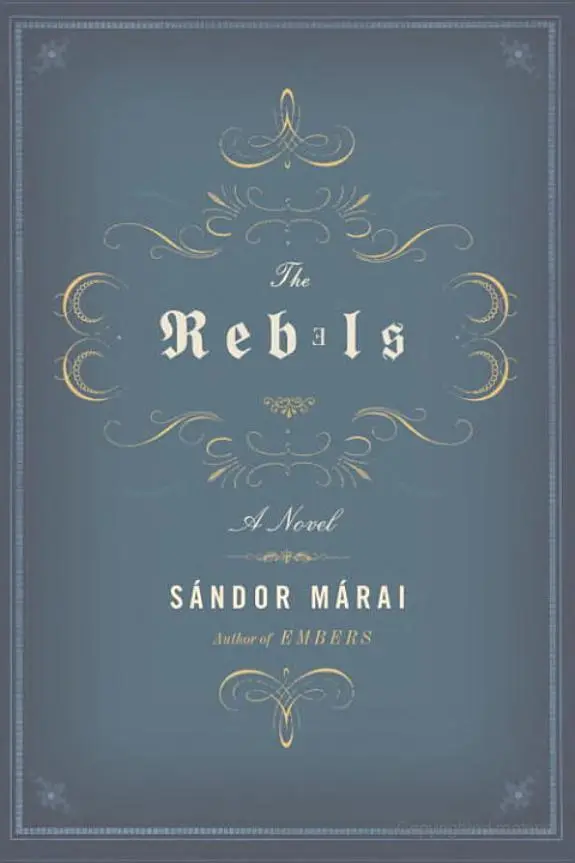
Sandor Marai - The Rebels
Здесь есть возможность читать онлайн «Sandor Marai - The Rebels» весь текст электронной книги совершенно бесплатно (целиком полную версию без сокращений). В некоторых случаях можно слушать аудио, скачать через торрент в формате fb2 и присутствует краткое содержание. Год выпуска: 2004, ISBN: 2004, Издательство: Knopf Doubleday Publishing Group, Жанр: Классическая проза, на английском языке. Описание произведения, (предисловие) а так же отзывы посетителей доступны на портале библиотеки ЛибКат.
- Название:The Rebels
- Автор:
- Издательство:Knopf Doubleday Publishing Group
- Жанр:
- Год:2004
- ISBN:9780307267405
- Рейтинг книги:3 / 5. Голосов: 1
-
Избранное:Добавить в избранное
- Отзывы:
-
Ваша оценка:
The Rebels: краткое содержание, описание и аннотация
Предлагаем к чтению аннотацию, описание, краткое содержание или предисловие (зависит от того, что написал сам автор книги «The Rebels»). Если вы не нашли необходимую информацию о книге — напишите в комментариях, мы постараемся отыскать её.
is a haunting story of a group of alienated boys on the cusp of adult life—and possibly death—during World War I.
It is the summer of 1918, and four boys approaching graduation are living in a ghost town bereft of fathers, uncles, and older brothers, who are off fighting at the front. The boys know they will very soon be sent to join their elders, and in their final weeks of freedom they begin acting out their frustrations and fears in a series of subversive games and petty thefts. But when they attract the attention of a stranger in town—an actor with a traveling theater company—their games, and their lives, begin to move in a direction they could not have predicted and cannot control, and one that reveals them to be strangers to one another. Resisting and defying adulthood, they find themselves still subject to its baffling power even in their attempted rebellion.
The Rebels — читать онлайн бесплатно полную книгу (весь текст) целиком
Ниже представлен текст книги, разбитый по страницам. Система сохранения места последней прочитанной страницы, позволяет с удобством читать онлайн бесплатно книгу «The Rebels», без необходимости каждый раз заново искать на чём Вы остановились. Поставьте закладку, и сможете в любой момент перейти на страницу, на которой закончили чтение.
Интервал:
Закладка:
“I have approximately thirty-four faces,” he mentioned as if in passing. “Thirty-four, or it may be thirty-six, it’s a long time since I counted them. I can do a Negro priest, darlings…I have a Cyrano. I have a Caesar that is without a wig, genuinely bald, it only needs two lines here by the mouth…Watch!”
He picked up a stick of charcoal and drew two lines by his cheekbones. His face looked markedly thinner. Every aspect of his face suddenly assumed a sharp angular look, somehow cruel, and his baldness took on a life of its own, like some symbol of fate, such a clear mark of a man’s secret suffering that no amount of successes, victories, or triumphs could compensate for it.
“My Caesar does not wear a laurel crown,” he said. “He thrusts his shame in your face. Let them note it and tremble. The fate of entire worlds is contained in this bald head.”
Slowly he settled the blond wig over it.
“And here we discover the problem of whether to be or not to be.”
He paraded before them, bowing from the waist.
“And I tell you, Polonius…”
He stared before him in his Hamlet frenzy. He pulled one lock of blond hair over his brow, pouted and took a few trance-like steps. Now he was someone whose part he did not know: a man who had once passed him in the street of whom all he could retain was his supercilious smile.
“He has been me in various parts,” he said meditatively. He sat back down in front of the mirror and removed the wig so he was bald again. He dragged half a dozen wigs out of the drawer, threw them on the table, trying first one then the other. He stuck a little goatee under his chin and sideburns on his cheekbones, and coughing and puffing with gout raised his foot, put on a faint voice, and ordered hot wine. He toyed with faces and patches of hair as if taking them from a mold. He brought the well-known features of the long dead to life without even seeming to try employing a few vocal modulations, all immediately identifiable. Then he pushed all the props to the side.
“Perhaps, one day,” he said, “I will discover a mask that I can use for a long time, for the rest of my life. It’s not so easy. Shreds, patches, hair, and paint are of little help. This stuff here,” he tapped his face with two fingers, “is pliable material, but you have to know how to use it. Naturally, it shrivels and hardens. Flesh has a life of its own, my friends, as has the soul. You have to command it, tame it. This body of mine,” he cast his eyes over his entire length and gestured dismissively, “is all used up and I’m bored with it. I want to appear in public in another town next time, in different outward form. Like a ruddy-cheeked youth, perhaps. But I can’t. Maybe I will go away and become an old man, the wrinkles that much more firmly set, more intractable. I am aging.”
Frustrated, he slapped at his double chin.
“Here’s one I really like,” he said, drawing forth a scrap of hair. “And this. And this,” he threw the wigs up in the air. “Believe me, if I were to put on this scarlet head of Titus no one would know me.”
And he put on the Titus head. The shimmering copper locks flopped over his brow right down to the bridge of his nose. With a few delicate touches he applied rouge to his lips until they looked young and full, emphasized his eyes with a matchstick, and suddenly the lifeless pupils were full of light. His face was radiant, red, alive with sin, full of shameless arrogance. His voice too had changed. He spoke in the resounding tone of command.
“I have thirty-four faces,” he shouted and blew out his cheeks. “Or is it thirty-six? Who can recognize me? I shall disappear, like the invisible man, I shall slip between people’s fingers. My realm is the world of immortals because I slip between death’s fingers too. He won’t know my face. Even if I am alone he won’t find the real me at home.”
He hesitated, looked around, and dropped his voice.
“Everyone has many faces. Sometimes I no longer know which is the last one, the one under which there is nothing but bone.”
He peeled off the Titus head and wiped the paint from his face with a napkin. Once more he fell to examining the raw material and relapsed into depression.
“Can this fat, toothless pig be me? Nonsense. The devil take it and consign it to hell.”
He removed his dentures and shoved them aside next to his hair as though they had nothing to do with him, then he wiped them clean with a cloth and carefully put them back in his mouth.
Ernõ stood and crept up behind him. The actor looked for a cigarette, threw a towel around his neck, and, cigarette in mouth, examined himself suspiciously. With an unexpected movement he twisted the towel tightly around his neck.
“In Paris,” he said, “this is how the waiters sit and dine after they have finished their shifts. They twist their napkins into a rope and wrap them round their necks like scarves.”
“I’m sure you’re right,” said Ábel.
They soon forgot everything else. There was a reason the actor was with them tonight. He was preparing something that was bigger and more amusing than the idiotic postgraduation larks that usually ended in drunken fistfights at the brothel. They could rely on the actor. They were enchanted by his transformations. Lajos watched him with fascination as he fussed with wigs, face paints, patches, and boxes of rice powder. Ábel was wondering whether the actor had a hidden face that he himself might not have seen, one that he would put on just for tonight. He remembered that half minute or so when the actor had remained alone in his room by the window. A cold shiver ran down his spine, but he knew that he could not leave the room now, not for any price. He would see this last night through with the gang and the actor and would not move until the actor discarded his final mask. The way he sat in front of the mirror now, with the napkin around his neck, unshaven, bald, a cigarette in his mouth, his legs crossed, his hands carelessly on his hips, he looked entirely foreign, like someone who spoke a strange language, practiced a mysterious trade. You couldn’t tell where he came from, what skills he possessed, or what he was doing here at all. He sat back, he drew on his cigarette, he dangled his feet. He was a complete stranger. So unfamiliar was he that they felt shy and fell silent. This was entirely the actor’s territory. All those hairpieces by the wall, all those destinies and personalities hanging in the shadows, all were part of his domain. At one gesture of his, whole armies might come to life, figures with terrifying faces might emerge. The actor gave a haughty, confident, self-satisfied smile. The cigarette butt shifted from one corner of his mouth to the other.
Ernõ alone harbored reservations.
“What are you up to?” he asked in a flat voice.
The actor threw the cigarette butt away. “Now to business,” he said and sprang to his feet.
HE SAT ÁBEL DOWN AT THE MIRROR, LEANEDback, crossed his arms, one finger to his lips, and examined him carefully. He went over to the window, leaned against the sill, and thought about it a little more. He indicated with a gesture, as a painter might, that Ábel should turn his profile towards him. Then, finally having solved the problem, he leapt over to the table, tore off a tuft of black hemp and held it next to Ábel’s face, shook his head, gave a whistle, and with two fingers turned the boy’s head this way and that in a deeply contemplative mood, sighing aah every so often.
“You ask what I’m up to,” he chattered, vaguely distracted. “I’m coming to grips with things, preparing a little party. We do what we can!”
He picked out a grayish wig with a side parting and ran a brush through it.
Читать дальшеИнтервал:
Закладка:
Похожие книги на «The Rebels»
Представляем Вашему вниманию похожие книги на «The Rebels» списком для выбора. Мы отобрали схожую по названию и смыслу литературу в надежде предоставить читателям больше вариантов отыскать новые, интересные, ещё непрочитанные произведения.



Обсуждение, отзывы о книге «The Rebels» и просто собственные мнения читателей. Оставьте ваши комментарии, напишите, что Вы думаете о произведении, его смысле или главных героях. Укажите что конкретно понравилось, а что нет, и почему Вы так считаете.