Sandor Marai - Esther's Inheritance
Здесь есть возможность читать онлайн «Sandor Marai - Esther's Inheritance» весь текст электронной книги совершенно бесплатно (целиком полную версию без сокращений). В некоторых случаях можно слушать аудио, скачать через торрент в формате fb2 и присутствует краткое содержание. Год выпуска: 2008, Издательство: Knopf, Жанр: Классическая проза, на английском языке. Описание произведения, (предисловие) а так же отзывы посетителей доступны на портале библиотеки ЛибКат.
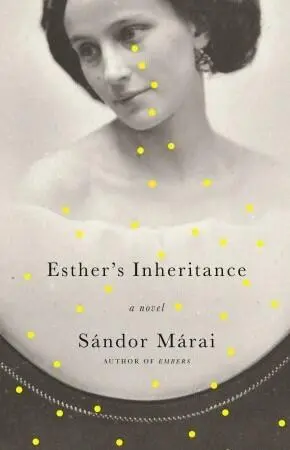
- Название:Esther's Inheritance
- Автор:
- Издательство:Knopf
- Жанр:
- Год:2008
- ISBN:нет данных
- Рейтинг книги:4 / 5. Голосов: 1
-
Избранное:Добавить в избранное
- Отзывы:
-
Ваша оценка:
Esther's Inheritance: краткое содержание, описание и аннотация
Предлагаем к чтению аннотацию, описание, краткое содержание или предисловие (зависит от того, что написал сам автор книги «Esther's Inheritance»). Если вы не нашли необходимую информацию о книге — напишите в комментариях, мы постараемся отыскать её.
Until a telegram arrives announcing that, after all these years, Lajos is returning with his children. The news brings both panic and excitement. While no longer young and thoroughly skeptical about Lajos and his lies, Esther still remembers how incredibly alive she felt when he was around. Lajos’s presence bewitches everyone, and the greatest part of his charm — and his danger — lies in the deftness with which he wields that delicate power. Nothing good can come of this: friends rally round, but Lajos’s arrival, complete with entourage, begins a day of high theater.
Esther’s Inheritance has the taut economy of Márai’s Embers, and presents a remarkable narrator who delivers the story as both tragedy and comedy on an intimate scale that nevertheless has archetypal power.
Esther's Inheritance — читать онлайн бесплатно полную книгу (весь текст) целиком
Ниже представлен текст книги, разбитый по страницам. Система сохранения места последней прочитанной страницы, позволяет с удобством читать онлайн бесплатно книгу «Esther's Inheritance», без необходимости каждый раз заново искать на чём Вы остановились. Поставьте закладку, и сможете в любой момент перейти на страницу, на которой закончили чтение.
Интервал:
Закладка:
Why do you bother with them! I thought. But I couldn’t help noticing that he kept an eye on the company. I didn’t even like his name, the rather common Béla. It meant nothing to me. I always have a strong reaction to names, liking or hating them. It is an unjustified, crude feeling. But it is just such feelings that determine our relationship to the world, our loves and hates. I couldn’t give him very much attention, since his mother completely occupied mine. Without any invitation whatsoever she gave me her life. The story was one long catalog of complaint, a shrill cry of accusation directed at authorities both earthly and heavenly, at men and women, at relatives and lovers, at children and husbands. The accusations were rendered in a flat, even voice, in smooth, round sentences, as if she were reciting a text she knew by heart. Everyone had deceived her, everyone was against her, and, in the end, they had all left her; that, at least, was what I gathered from her philippics. I occasionally shuddered: it was like being addressed by a lunatic. Then, without pausing, she got on to the subject of Lajos. She spoke cynically and confidentially. I couldn’t bear her manner. It humiliated me to think that Lajos required accomplices of this kind to call on me, that this person had some kind of rank. I stood up with Lajos’s gift, the lilac silk shawl, in my hand.
“We don’t know each other,” I said. “Perhaps we should not be speaking like this.”
“Oh,” she said calmly, quite indifferent to my concern. “We will have plenty of time to talk about it. We will get to know each other, dear Esther.”
She lit a cigarette and blew a long line of smoke, gazing so assuredly through the cloud at me it seemed she must have already arranged everything. It was all decided: she knew something I didn’t, and there was nothing I could do except give in.
13
T here are three conversations I should note here.
That was precisely how many took place that afternoon. Éva was first at my door, followed by Lajos, and lastly by the “officially invited” Endre. After lunch the guests dispersed. Lajos lay down to have a nap, as naturally as if he were at home and would not be diverted from his domestic habits. Gábor and the strangers set off in the car to see the church, the neighborhood, and the local ruins, returning only at dusk. Éva, however, came to my room straight after the meal. I stood with her by the window, cupped her face in my hands, and gazed at her a long time. She gazed back steadily with her clear blue eyes.
“You have to help us, Esther,” she said eventually. “Only you can help us.”
She had a sweet singsong voice, like a schoolgirl. She only reached up to my shoulder. I hugged her but then felt the whole scene was a little too sentimental, and was glad when she gently disengaged herself, moved to the sideboard, lit a cigarette, gave a light cough, and, as if freed from an embarrassing, slightly disingenuous situation, examined the objects and framed photographs arranged on the flat surface. This shelf, the upper half of the sideboard, was a sacred place for me, the kind of thing the Chinese think of as a household shrine, before which they bow and honor their ancestors. Everyone I loved or was close to me stood there in a long row, each of them looking at me. I went over to her and watched her eyes moving along them.
“That’s Mama,” she said quietly but with evident delight. “How beautiful she is. She must have been younger there than I am now.”
An eighteen-year-old Vilma gazed back at us, a little chubby, dressed in the garments of the time, in white lace with high black boots, her hair undone, curled, and combed over her brow, carrying flowers and a fan. The picture must have been for an occasion, since it was a touch self-conscious and unnatural. Only the dark, questioning eyes betrayed something of the later angry, passionate Vilma.
“Do you remember her?” I asked, and knew my voice was not quite steady.
“Vaguely,” she replied. “Someone comes into my room in the dark and leans over me with a warm familiar scent. That’s all I remember. I was three years old when she died.”
“Three and a half,” I say, flustered.
“Yes. But really I only remember you. You are always adjusting something on me, my dress or my hair, and you are always in my room, you always have something to do there. Then you too disappear. Why did you leave, Esther?”
“Hush,” I say. “Hush, Éva. You don’t yet understand.”
“Yet?…” she asked, and started to laugh in the same singsong way, the laugh a little forced, too drawn out, too theatrical. Everything she said seemed extraordinarily important, too carefully composed. “Are you still playing at being the little mama, Esther, dear?” she said, kindly, superior, and compassionate. And now it was she who, with an adult movement, put her arm round my shoulder, led me over to the couch, and sat me down.
This time we looked at each other like two women, women who know or guess each other’s secrets. Suddenly a hot flush of excitement ran through me. Vilma’s daughter! I thought. The daughter of Vilma and Lajos. I felt I was blushing with a jealousy that sprang from somewhere so deep it shocked me with its energy and power: it was as if a jealous voice were shouting in me. I didn’t want to listen to it. She could have been your daughter! was what the voice was crying. Your daughter, the meaning of your life. Why has she come back? Agitated, I bowed my head, burying my face in my hands. The significance of the moment balanced the shame I felt even as I was moving. I knew I was betraying my secret, that I was being watched by someone who was pitilessly observing my shame and discomfort; that the young woman who might have been my daughter had no sympathy and was not about to save me in this sorry situation. After an interval that seemed to be infinitely long I heard her mature, strange, self-aware, indifferent voice again.
“You shouldn’t have gone away, Esther. I know it can’t have been easy with Father. But you should have known you were the only one who might have helped him. And then there were Gábor and me. You simply left us to our fates. It was like abandoning two children at the gate of a house. Why did you do it?”
And when I remained silent, she calmly added:
“You did it out of revenge. Why look at me like that? You were wicked and acted out of revenge. You were the only woman who had any power over Father. You were the only woman he ever loved. No, Esther, that much I know, at least as well as you and Father. What happened between you? I have thought about it a long time. I had time to think, an entire childhood. Believe me, that childhood was not particularly happy. Do you know the details? I am quite prepared to tell you. I came here to tell you. And, at the end of my story, to ask you to help. I feel you owe us that much.”
“Anything,” I said, “I’ll do anything to help you.”
I straightened up. The difficult moment had passed.
“Look, Éva,” I went on, and now I too felt calm. “Your father is a really interesting, very talented man. But all those things you were talking about just now have become a little confused in his memory. You should be aware that your father is quick to forget. Please don’t think I am criticizing him. He can’t help it. That’s his nature…”
“I know,” she answered. “Father never remembers reality. He is a poet.”
“Yes,” I said, my heart a little lighter. “He might be a poet. Reality gets confused in his mind. That’s why you shouldn’t believe everything he says…his memory is poor. The time you are talking about was the most difficult, most unbearably painful, most complicated part of my life. You say revenge! What kind of word is that to use? Who taught you to use it? You know nothing. Everything your father says about that time is fantasy, pure fantasy. But I do remember the reality. It was rather different. I owe nothing to anyone.”
Читать дальшеИнтервал:
Закладка:
Похожие книги на «Esther's Inheritance»
Представляем Вашему вниманию похожие книги на «Esther's Inheritance» списком для выбора. Мы отобрали схожую по названию и смыслу литературу в надежде предоставить читателям больше вариантов отыскать новые, интересные, ещё непрочитанные произведения.



Обсуждение, отзывы о книге «Esther's Inheritance» и просто собственные мнения читателей. Оставьте ваши комментарии, напишите, что Вы думаете о произведении, его смысле или главных героях. Укажите что конкретно понравилось, а что нет, и почему Вы так считаете.