Pearl Buck - Kinfolk
Здесь есть возможность читать онлайн «Pearl Buck - Kinfolk» весь текст электронной книги совершенно бесплатно (целиком полную версию без сокращений). В некоторых случаях можно слушать аудио, скачать через торрент в формате fb2 и присутствует краткое содержание. Год выпуска: 2012, Издательство: Open Road Media, Жанр: Классическая проза, на английском языке. Описание произведения, (предисловие) а так же отзывы посетителей доступны на портале библиотеки ЛибКат.
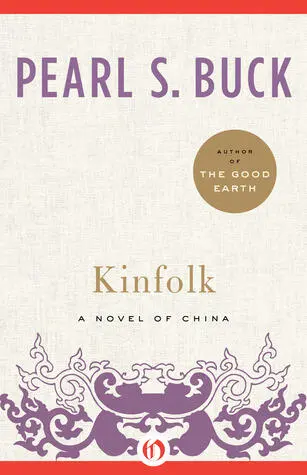
- Название:Kinfolk
- Автор:
- Издательство:Open Road Media
- Жанр:
- Год:2012
- ISBN:нет данных
- Рейтинг книги:4 / 5. Голосов: 1
-
Избранное:Добавить в избранное
- Отзывы:
-
Ваша оценка:
Kinfolk: краткое содержание, описание и аннотация
Предлагаем к чтению аннотацию, описание, краткое содержание или предисловие (зависит от того, что написал сам автор книги «Kinfolk»). Если вы не нашли необходимую информацию о книге — напишите в комментариях, мы постараемся отыскать её.
, a sharp dissection of the expatriate experience, Pearl S. Buck unfurls the story of a Chinese family living in New York. Dr. Liang is a comfortably well-off professor of Confucian philosophy, who spreads the notion of a pure and unchanging homeland. Under his influence, his four grown children decide to move to China, despite having spent their whole lives in America. As the siblings try in various ways to adjust to a new place and culture, they learn that the definition of home is far different from what they expected.
Kinfolk — читать онлайн бесплатно полную книгу (весь текст) целиком
Ниже представлен текст книги, разбитый по страницам. Система сохранения места последней прочитанной страницы, позволяет с удобством читать онлайн бесплатно книгу «Kinfolk», без необходимости каждый раз заново искать на чём Вы остановились. Поставьте закладку, и сможете в любой момент перейти на страницу, на которой закончили чтение.
Интервал:
Закладка:
Liu Chen turned red again. His skin was thin and clear and easily flushed, although it was dark. “No, no,” he said, “do not feel you must be polite. And please call me Chen.”
“I am not polite — I mean it,” James said.
“Then wait and see whether the others like me,” Chen said modestly.
By now they had reached the inner court. It was quiet here and strangely peaceful. The deserted house encircled them and under their feet the weeds grew high and sun-browned between the stones. A great twisted pine stood against the house, its branches so thick and widespreading that their weight had bowed the trunk and the tree looked like an old man carrying too heavy a burden. The sun had shone upon the pine all day and the needles were fragrant and the walls held the fragrance, for no wind could reach here. Chen threw himself on the wild grass under the tree and James sat down beside him. Twilight was still an hour away.
“You asked me about the Communists,” Chen said abruptly. “They have taken my own village which is three hundred miles to the northwest. Therefore I do know something about them.”
“Is your house safe?” James asked.
“Yes, for we are poor enough to be safe. My parents owned no land. They were tenants before the Communists came. Now they are landowners. Their landlord was the usual sort, short-tempered, greedy, but not more than many others. When the Communists came they did not kill him, for the people pleaded for him. They only strung him up by the thumbs and gave him a good beating and then allowed him as much land as he could work himself — no more. To my parents they gave a small farm. Now we are the landowners!” Chen laughed dryly.
James laughed. “I suppose you like the Communists.”
Chen sat up and wrapped his arms about his knees. His spiky black hair stood up on his forehead and his thick eyebrows drew down. “No,” he said, “no! Had I been only a peasant still, nothing more than the son of my father, I daresay I would have been happy enough, but I am something more. I am a doctor.”
“Do they want doctors?” James asked.
“They want them very much. They want them too much. They have offered me a great deal. But they cannot offer me enough.” These words Chen spoke in short sentences and his eyes were bitter. He tugged at a clump of grass between two stones and it came up root and all. Ants scurried out, terrified by the sudden light of day. “You know, there is very much that makes me angry at the hospital. I say this because I see it makes you angry, too. You don’t understand why our fellow doctors are so cold, do you?”
“No,” James said quietly. “That puzzles me very much. Kang, for instance, a superb doctor, but not caring whether people live or die. I say to myself, what is the use of being a doctor in that case?”
They were speaking Chinese, not the old slow involved speech of the past, but the quick terse tongue of the modern, energized by the languages of the West.
“So I say also,” Chen said solemnly. “And I am very angry with Kang and Su and Peng and all those men. They have no feeling for our own people. You cannot understand it, Liang, but I can. I have seen old scholars like them, too. There is so much you cannot understand. I can understand you because I was also in America, but I was there only for a few years. You will have to learn to know our people. You must begin with the simple ones. Yet most of us are simple.”
Chen cleared his throat and made his voice somewhat louder, almost as though he were about to begin an argument. “Liang, listen to me! These new men, Kang and Su and Peng and their like, they are not really very new. Their learning is new, but the men behave like the old ones. In my village there was an old scholar. Now why do I call him a scholar? He went up for the Imperial Examinations five times and after the first degree, he failed every time. Yet each time he came back more lordly than before. He could dine with no one except our landlord. The two of them went together. And when the local magistrate came to the village to examine the crops, then the three of them dined together. They were too good for the rest of us. And later when a warlord took our region, then there were four of them to dine together. And they were all too good for the rest of us, who were only the people. Scholar, landlord, magistrate, warlord — there you have the tyrants of the people. And we have them still. To go to a college in America does not change a man’s heart. It only gives him a new weapon, sharper than the old, to use against the people — if that be his heart.”
Chen spoke with deep passion and James was astounded. He had not heard Chen speak often in the gatherings which the doctors had together sometimes, and if he did speak it was only to make a joke at something or to point out some small foolish thing, such as a dog creeping under the table and trying not to be seen while it waited to snatch a bone. “Brothers,” he had said once when this happened at a feast of browned duck in a restaurant, “it is very hard on this poor dog that we are all dainty moderns and do not throw duck bones on the floor. For his sake let us this one time return to the ways of our ancestors.” With these words Chen had thrown the head of the duck, which he had been chewing, down upon the floor. The dog rushed for it and Kang had given it a kick that sent it howling away, but still clenching the duck head between its teeth. “Liu, don’t be a fool,” Kang had said in a surly voice. Chen had not spoken again all evening and no one had heeded his silence. Now all these words poured out of him.
“I cannot understand why you are not a Communist,” James said quietly. His heart was altogether with what Chen had said, but he wished to try him further.
Chen twisted an end of the pine branch near him and sniffed the scent loudly into his nostrils. “This pine must be five hundred years old,” he said. “Did you know, Liang, that our ancestors rewarded such trees with a title? Indeed it was so, exactly as though the tree were a human. They called them Duke this or Lord that. Well, so trees ought to be given praise to endure for five hundred years in this world! So you say I should be a Communist? I cannot be. I will tell you why. They wanted me to dip my hand in blood and swear something. Swear what? Nothing much — loyalty, brotherhood, eternal faith — all the usual oaths of a gang. But I have sworn my loyalties to all humanity and not to any part of it. I told them so and they wanted to shoot me. So I left by night. Now you see why I have no home.” Chen laughed too loudly and got to his feet. “Come, let us settle the matter of this house! Its owner lives next door — a good old man who smokes opium, and he will give you a quick bargain for cash.”
Chen walked away and James followed, surprised and interested in spite of his vague distrust. The fellow was confused and angry with life. There was no knowing what such a man could or would do before he was settled. But it was impossible not to like him. Walking slightly behind him James looked at his square shoulders and thick neck and upright jet-black hair. Chen walked with his hands in his pockets and these pockets belonged to a suit which he had devised for himself. The trousers were Western, but the dark blue material being cheap the garment had shrunk when washed so that his strong thighs seemed about to burst the seams. The coat was somewhat like a uniform except that it was bare of any ornament, and it buttoned in the front straight from hem to collar. The buttons were of ordinary white bone. There were many pockets on both sides, each of which held something and this gave thickness to Liu Chen’s thin but big frame.
They went out of the gate and down the length of the wall to another gate. Here Chen went in, and addressing a shabby manservant who sat on his heels against the wall, he asked for the master.
Читать дальшеИнтервал:
Закладка:
Похожие книги на «Kinfolk»
Представляем Вашему вниманию похожие книги на «Kinfolk» списком для выбора. Мы отобрали схожую по названию и смыслу литературу в надежде предоставить читателям больше вариантов отыскать новые, интересные, ещё непрочитанные произведения.
Обсуждение, отзывы о книге «Kinfolk» и просто собственные мнения читателей. Оставьте ваши комментарии, напишите, что Вы думаете о произведении, его смысле или главных героях. Укажите что конкретно понравилось, а что нет, и почему Вы так считаете.