Raja Rao - Collected Stories
Здесь есть возможность читать онлайн «Raja Rao - Collected Stories» весь текст электронной книги совершенно бесплатно (целиком полную версию без сокращений). В некоторых случаях можно слушать аудио, скачать через торрент в формате fb2 и присутствует краткое содержание. Год выпуска: 2014, Издательство: Penguin, Жанр: Классическая проза, на английском языке. Описание произведения, (предисловие) а так же отзывы посетителей доступны на портале библиотеки ЛибКат.
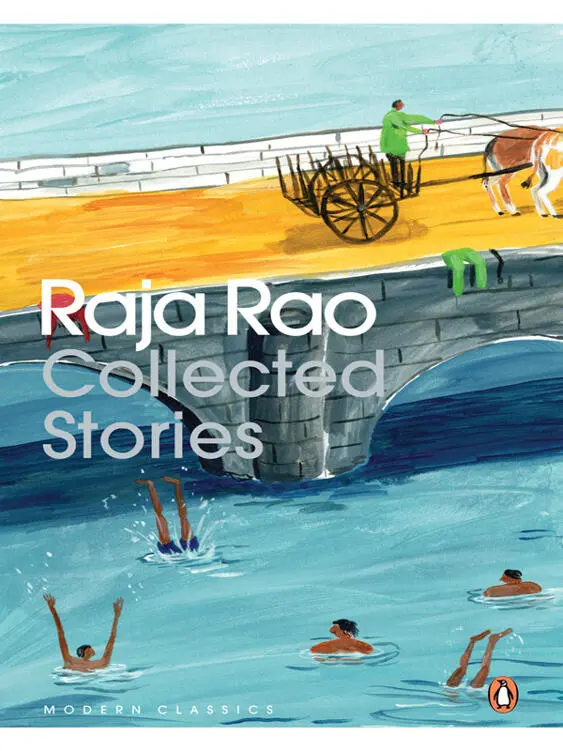
- Название:Collected Stories
- Автор:
- Издательство:Penguin
- Жанр:
- Год:2014
- ISBN:нет данных
- Рейтинг книги:5 / 5. Голосов: 1
-
Избранное:Добавить в избранное
- Отзывы:
-
Ваша оценка:
Collected Stories: краткое содержание, описание и аннотация
Предлагаем к чтению аннотацию, описание, краткое содержание или предисловие (зависит от того, что написал сам автор книги «Collected Stories»). Если вы не нашли необходимую информацию о книге — напишите в комментариях, мы постараемся отыскать её.
Collected Stories — читать онлайн бесплатно полную книгу (весь текст) целиком
Ниже представлен текст книги, разбитый по страницам. Система сохранения места последней прочитанной страницы, позволяет с удобством читать онлайн бесплатно книгу «Collected Stories», без необходимости каждый раз заново искать на чём Вы остановились. Поставьте закладку, и сможете в любой момент перейти на страницу, на которой закончили чтение.
Интервал:
Закладка:
‘Nothing, nothing at all. When I was passing by the lumber-room, Kanakapala pursued me, though I’d done nothing. Perhaps he was just chasing his prey. . ’
Seetharamu hurried to the lumber-room, scolded Kanakapala angrily; and the poor fellow lay there quiet, curled and flat, and with wide-open eyes. He seemed tame as a dog. Since then Kanakapala has never pursued anybody. Somehow Seetharamu seemed to have commanded him not to. Oh! that he should have faith in these people! But, my son, who can ever imagine that your own brothers are going to murder you so that they may have the money — and holy money too! — holy money that your grandfathers have offered to the gods?. . Well, but the world is changing. We are living in Kali Yuga. And don’t they say, for every million virtuous men there were in the first Yuga, every thousand in the second, every hundred in the third, there is but one now? Unrighteousness becomes the master, and virtue is being trodden down. Oh, when our grandfathers were alive, how happily we lived. We bought a khanda of rice for half a rupee, and seven seer s of ghee for a rupee. And now. . you must beat your mouth and yell. . Oh, to live in this poor, polluted world. .
‘Anyway, Ramakrishnayya died. You know, Kanakapala lay by his corpse till they took him away. And when they had lifted up the corpse, Kanakapala spat out poison once, twice, thrice. . That was how he showed his grief. And he never touched milk for three full days. Such was Kanakapala!
‘A week later the three brothers had begun to quarrel about the division of property. Each one said — though it is impossible to believe that Seetharamu could have said it — that he wanted the mango garden. They could not agree over it. First it was Surappa and Ranganna that had growled at each other. And when Seetharamu simply said: ‘Why quarrel over such small things?’ they both fell upon him — it must surely have been planned out — and beat him on the stomach and on the back. The old blind aunt went into the kitchen, and Sata ran about the house, pretending to cry and sob. That widow to sob! If she had a lover in her bed, she would not sob, hè? And nobody came to separate the fighting brothers. It was Kanakapala, who, strange to say, suddenly appeared and, slipping between the two aggressors and Seetharamu, tried to separate them. But when they continued he roped himself round the foot of Surappa who staggered and fell. Then Kanakapala frightened Ranganna with his spread hood, and Ranganna ran out breathlessly. . And Seetharamu lay on the floor, quiet, blank-eyed, and with no evil in his heart, while Kanakapala gently moved his tail about his face in friendly caress.
‘That was as you know the last quarrel they had at home. It was hardly a fortnight later that Seetharamu’s body was discovered in the Hemavathy. As to how it happened, everybody has his own opinion about it. My own is slightly different from that of others, because being their neighbour, and third cousin, I have more reasons to know these things than most people. Besides, I am an old woman, and I have seen so many domestic calamities that I can quite surmise how this could have happened too. Listen.
‘Now, you will perhaps call me wicked, maybe I am wicked. But tell me, how else can one explain the sudden death of Seetharamu if not by realizing that his two brothers hated him and, wanting the gold, drowned him in the river? Of course, people will tell you they were both lying sick at home, and nobody knows how Seetharamu, who went to Kanthapura to look after the peasants that were going to sow rice, should suddenly have disappeared. There is the boatman, Sidda. You know how at least two murders — of Dasappa of the oil-shop, and Sundrappa of the stream-fed-field — in both of them he was implicated. You know too how he beats his wife, and no child will ever approach him. Now, Sidda was to ply Seetharamu across the river, for the field lay on the Kanthapura side, and he says he never saw Seetharamu. If he had not seen Seetharamu, who else could have seen him, tell me? I myself saw Seetharamu passing by our door. And when I asked him where he was going, he told me clearly that he was going to Kanthapura to look after the sowing, as the two brothers were sick. Sick! I know what that sickness was! They looked hale and strong as exhibition bulls. They must simply have starved themselves to bear a pale face two days later. The evening before they were quite well, and if Big-House Subbayya is to be believed, they were talking to Sidda, a long, long time. The case is plain. Sidda pushed Seetharamu into the river. Any honest person in the village will believe it. But they are afraid of the Vision-House people. Besides, they want to have nothing to do with the police. And who does not know the Police Inspector has been duly bribed by them? I have myself seen the Police Inspector, a fat, vicious, green-looking brute, staying day after day in the Vision-House. . But nobody will accept this version. Maybe I am wicked. May God forgive me for my tongue! But, if I had no children, I will tell you what I would do, my son: I would poison these two brothers, and, drinking half a seer of warm milk with undisturbed contentment, I would go and drown myself in the river, happy. . very happy.
‘Poor Seetharamu!
‘After that the story is simple. One day when Sata kept feeding Kanakapala in the kitchen, the two brothers closed the sanctum door and began to dig. Kanakapala swung out and hurled his head against the door, hissing and rasping. But there was no answer. Furious he ran to the roof, and slipped into the eaves, but every chink and hole had been closed with cloth and coconut rind. He rushed back to the kitchen again but there was no one. He ran to the byre, spitting venom at every breath. . and there was no one. Then, frantic, helpless, repentant, he rushed out of the door and scampered up the hill. Entering the temple, he went round and round the god and goddess, once, twice, thrice, and curling himself at the foot of the Divine Couple, swallowed his tail, and died. For is it not said, a snake loves death better than an undutiful life?
‘The Vision-House people never found the gold. But with what libations have they now to wash away their sins. Child after child, new-born child, new-lisping child, new-walking child, young child, old child, school-going child, have met with mysterious, untimely deaths. And no woman in their family can ever bear a child for nine months and bring it forth, for the malediction of Naga is upon them. Never, never till seven times are they dead, and seven times are they reborn, can they wear out their sacrilegious act. . Oh, sinners, sinners!
‘And to this day there is not a woman, child or man in Kashipura that has not heard the money clinking in the earth, for holy gold moves from place to place, lest the wicked find it. And that same night Kanakapala appears in the dream of woman, child or man, frantic, helpless, repentant, and scampering up the hill, goes round the god and goddess, once, twice, thrice, and curling himself at the foot of the Divine Couple, swallows his tail — and dies.’
I too have dreamt of it, believe me — else I wouldn’t have written this story.
IN KHANDESH
‘Tom-Tom — Tom-tom — Tira-tira — Tira-tira — Tira-tira — Tom-tom— Tom-tom. . Listen, villagers, listen! Assemble ye all after midday meal — at the Patel’s. At the Patel’s — after midday meal — Tom-tom — Tom-tom — Tira-tira — Tiratira — Everyone — All— Important business — Important — Tom-tom — Tira-tira — Tom-tom— Tom-tom. . ’
Dattopant wallowed in his bed, dreamily. A terrible pain in the stomach had kept him awake late into the night. And then, what with the heavy monsters that rolled over his belly, the horse that galloped without neck or tail, the noise of the grandchild near him, the breathless flight in the air, funeral processions, death-drums, temples and rupees, and mimicking monkeys — he could not sleep. Every other wink he woke up, moaned, and turning away his head, threw his legs aside, and forced himself to sleep — but sleep would never come. Deep in the night he heard an owl hoot somewhere — somewhere very near. Was it from the coconut-tree? The neem-tree?. . No, it was from the roof. Death, said the elders, an owl on the tiles means certain death. . death before the wane of the evil moon. He would have liked to stand up and shout ‘Ram, Ram’ to frighten away the owl. But he felt tired and restless. After all, to wake up the whole house, make a noise, cry, moan. And move to another house. Where? And for six months too. He, his old wife, his two quarrelling sons, his haughty daughter-in-law, and the puling, whining, slobbering brats. No. This could never be of me. Perhaps the owl was only on the palm-tree. No, it was not on the roof. For sure, no! However, let’s say ‘Ram, Ram’, ‘Ram, Ram’. Sleep will soon come and then everything will be forgotten.
Читать дальшеИнтервал:
Закладка:
Похожие книги на «Collected Stories»
Представляем Вашему вниманию похожие книги на «Collected Stories» списком для выбора. Мы отобрали схожую по названию и смыслу литературу в надежде предоставить читателям больше вариантов отыскать новые, интересные, ещё непрочитанные произведения.









Обсуждение, отзывы о книге «Collected Stories» и просто собственные мнения читателей. Оставьте ваши комментарии, напишите, что Вы думаете о произведении, его смысле или главных героях. Укажите что конкретно понравилось, а что нет, и почему Вы так считаете.