Anna Kavan - Asylum Piece
Здесь есть возможность читать онлайн «Anna Kavan - Asylum Piece» весь текст электронной книги совершенно бесплатно (целиком полную версию без сокращений). В некоторых случаях можно слушать аудио, скачать через торрент в формате fb2 и присутствует краткое содержание. Год выпуска: 2001, Издательство: Peter Owen Publishers, Жанр: Классическая проза, на английском языке. Описание произведения, (предисловие) а так же отзывы посетителей доступны на портале библиотеки ЛибКат.
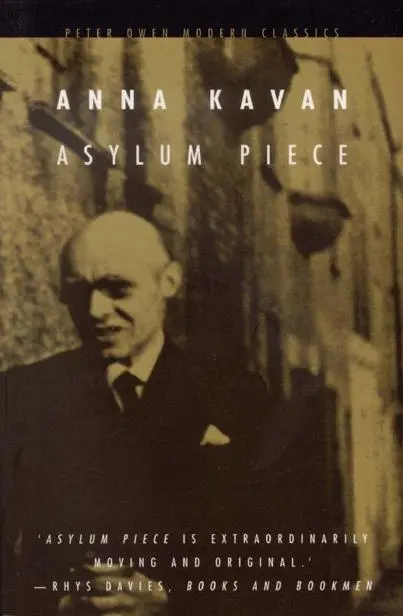
- Название:Asylum Piece
- Автор:
- Издательство:Peter Owen Publishers
- Жанр:
- Год:2001
- ISBN:нет данных
- Рейтинг книги:5 / 5. Голосов: 1
-
Избранное:Добавить в избранное
- Отзывы:
-
Ваша оценка:
Asylum Piece: краткое содержание, описание и аннотация
Предлагаем к чтению аннотацию, описание, краткое содержание или предисловие (зависит от того, что написал сам автор книги «Asylum Piece»). Если вы не нашли необходимую информацию о книге — напишите в комментариях, мы постараемся отыскать её.
by Kafka, a writer with whom Kavan is often compared, although her deeply personal, restrained, and almost foreign —accented style has no true model. The same characters who recur throughout — the protagonist's unhelpful "adviser," the friend and lover who abandons her at the clinic, and an assortment of deluded companions — are sketched without a trace of the rage, self-pity, or sentiment that have marked more recent accounts of mental instability.
Asylum Piece — читать онлайн бесплатно полную книгу (весь текст) целиком
Ниже представлен текст книги, разбитый по страницам. Система сохранения места последней прочитанной страницы, позволяет с удобством читать онлайн бесплатно книгу «Asylum Piece», без необходимости каждый раз заново искать на чём Вы остановились. Поставьте закладку, и сможете в любой момент перейти на страницу, на которой закончили чтение.
Интервал:
Закладка:
His glance now falls on a rowing boat moored a few yards away. Usually the boat is padlocked to an iron ring in the wall, but now it is only loosely secured by a knotted rope. He vaguely remembers seeing the gym mistress unfasten the padlock while he was sitting at tea. Perhaps some of the patients are going out for a row. Well, that does not interest him any more than the tennis. He raises his wide, bright, unstable eyes and sees, straight across the smooth water, the French coast with its mountains and its lower hills crested with countless poplars.
Immediately a new thought sequence springs to activity in his brain. ‘It’s high time I went home. I ought to get back to work or I shall be losing all my connections. A barrister can’t afford to take such long holidays, even if he has a rich wife —’ He tries to reckon up how many months he has spent in the clinic, but somehow the calculation eludes him, and this inability to concentrate on a simple question of dates increases his general discontent. ‘All the days are alike in this wretched place — One quite loses count of time,’ he thinks angrily. And then: ‘Why are they still keeping me here? I’m quite well — it’s not as if there ever was much wrong with me. I’d been overworking — I only needed a rest. Now I’m perfectly fit, and yet they still keep me hanging about — wasting my time.’ He scowls as he thinks of the doctors, of the evasive replies they give him when he suggests fixing a day for his departure. ‘Of course, it’s just a money-making concern: they’re all a lot of sharks trying to make as much out of us as they can.’
The mental picture of his wife now passes before him, a handsome young woman, rather plump, and beautifully dressed in black with pearls round her throat: it is she who is paying for him to stay at the clinic. An atrocious suspicion that often crosses his mind causes him to pick up a stone and hurl it viciously into the lake, startling the small fish out of their ceaseless voyaging. ‘No, it’s simply not possible — no one could be so wicked, so unscrupulous. I mustn’t allow myself to imagine such terrible things.’
All the same, he can no longer remain quietly sitting on the wall, but jumps up and takes a few restless paces in the direction of the rowing boat, above which he stands, tapping his foot against the iron ring to which the mooring rope is attached.
‘If only I could be certain what’s going on at home. If only I could get back,’ he says to himself, now for the first time admitting in his own mind that there exists some obstacle to his departure. A fantasy of leave-taking next occupies him: he imagines himself packing his luggage, going up to the chief doctor and demanding his money, his passport, booking a sleeper on the Paris train. ‘Yes, I’ll do it,’ he says aloud, twice, first with enthusiasm, then with dwindling conviction. But he does not move to put the plan into practice: something which he cannot, dare not, acknowledge, forbids him to make the attempt.
Instead, he begins to think nostalgically of his old life, of the gaiety of the city, of his work, and of his friends who will be so pleased to see him again. He looks across the lake at the mountains of Savoie, his own country: and it seems to him that only this negligible strip of water, which looks as smoothly solid as if one could walk over it, divides him from the fulfilment of his desires.
A sudden idea comes to him, and it is curious to observe the rapid change in his face which now all at once assumes a mischievous, crafty expression. He glances at the people sitting rather more than the width of the chateau away. Enervated by the hot afternoon, not a soul seems to have moved, not a soul is paying any attention to him. He stoops down and with hurried movements unfastens the knotted rope: then springs into the boat and hastily rows off. A few strong pulls carry him round a small promontory, out of sight of the chateau grounds. Smiling, with an almost roguish look, he rows on with powerful, regular strokes.
Soon he is far out from the land, alone in his boat in the midst of the practically colourless expanse of smooth water. About half a dozen other small boats are scattered over the lake. They are far away from him, but he is glad of their presence which means that his own boat will be less conspicuous from the shore. There is no breeze, it is very hot, the air shimmers with heat. Sweat rolls down Marcel’s face, but he does not mind; still smiling his roguish smile, he wipes the sweat out of his eyes and rows on. His bare, brown, muscular arms swing to an indefatigable rhythm. This man who could not find energy for a game of tennis is now quite happy toiling in the blind watery glare, gratified by his own strength.
It is further than he expected across the lake, but before very long the French coast is appreciably nearer, he can distinguish the windows of houses, then human figures, then dogs and chickens moving about. He rows parallel with the shore for a little way seeking a secluded landing place: he has the idea that it might be wiser not to land in a village where he could be questioned immediately. He has not formulated any plan of action as yet. So far, he has been occupied solely with the physical effort and with the elation he feels at his own enterprise.
Now he has found just the place to land, a curved beach like a diminutive bay, out of sight of all dwellings, with green grass banks rising steeply above. He brings the boat close to the shore but makes no attempt to disembark. He sits still, with the oars trailing in the water and the sweat slowly drying on his face which now begins to acquire a look of uncertainty. Why does he hesitate? All he has to do is to ground the boat, to jump out and climb up the bank into his own land. True, he has no passport and only a few coins of trifling value in his pockets: but still, he will be free, safe, among his own countrymen. He has only to explain his position to someone in authority and all will arrange itself satisfactorily: a telephone call will be put through to Paris, his railway fare will be advanced to him, he will be at home in the morning.
Yes, it all seems so simple, and yet he can’t bring himself to get out of the boat. What is it that prevents him from stepping ashore? What is it that tells him that it is safer not to think, safer to remain vague, to realize nothing? Dimly, through a haze of unreality, he envisages the gendarmes, the questions, the significant looks. But all these things are far-off, unimminent, cloudy. Much better not to think about them, much better not put things to the test, much better not risk having realization forced upon one.
All the archness, the volatileness, has vanished with the smile from his face. He now looks much older, worn and dejected. The spirit has quite gone out of him. He feels very tired. Slowly, wearily, with a deep sigh, his eyes empty and downcast, he takes hold of the oars and begins the laborious passage back to the other shore.
VIII
In the clinic, as in heaven, there are many mansions. The worst cases, and those requiring the most supervision, are lodged in a house called ‘La Pinède’ which stands some distance away from the main building. Metal scrolls guard the windows of this house and there is only one outer door that is always kept locked. An attendant is constantly on duty to unfasten and relock the door each time anyone passes through.
The attendant sits in a little room, white and bare as a nun’s cell, just to the left of the door. This morning quite a young girl is on duty there. She is bright and pleasant looking in her superlatively clean overall, she has put a bunch of flowers on the table where she sits with her English grammar, her note book and pencil. She is industrious, she means to get on in the world, and she studies her book with concentration. Nevertheless, she finds time to glance occasionally at the little bunch of wild cyclamen which she picked yesterday in the forest with a young man in whom she is interested. Everything about her is normal, cheerful, serene. It is difficult to associate the contented girl with the hidden unhappiness that surrounds her under this roof.
Читать дальшеИнтервал:
Закладка:
Похожие книги на «Asylum Piece»
Представляем Вашему вниманию похожие книги на «Asylum Piece» списком для выбора. Мы отобрали схожую по названию и смыслу литературу в надежде предоставить читателям больше вариантов отыскать новые, интересные, ещё непрочитанные произведения.










Обсуждение, отзывы о книге «Asylum Piece» и просто собственные мнения читателей. Оставьте ваши комментарии, напишите, что Вы думаете о произведении, его смысле или главных героях. Укажите что конкретно понравилось, а что нет, и почему Вы так считаете.