Sergei Lebedev - Oblivion
Здесь есть возможность читать онлайн «Sergei Lebedev - Oblivion» весь текст электронной книги совершенно бесплатно (целиком полную версию без сокращений). В некоторых случаях можно слушать аудио, скачать через торрент в формате fb2 и присутствует краткое содержание. Город: New York, Год выпуска: 2016, ISBN: 2016, Издательство: New Vessel Press, Жанр: Историческая проза, Современная проза, на английском языке. Описание произведения, (предисловие) а так же отзывы посетителей доступны на портале библиотеки ЛибКат.
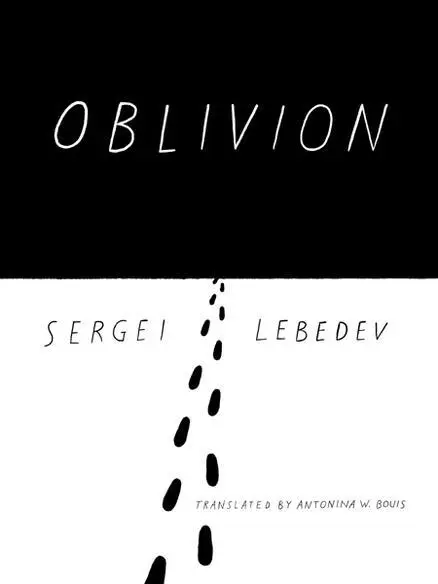
- Название:Oblivion
- Автор:
- Издательство:New Vessel Press
- Жанр:
- Год:2016
- Город:New York
- ISBN:978-1-939931-25-2
- Рейтинг книги:4 / 5. Голосов: 1
-
Избранное:Добавить в избранное
- Отзывы:
-
Ваша оценка:
Oblivion: краткое содержание, описание и аннотация
Предлагаем к чтению аннотацию, описание, краткое содержание или предисловие (зависит от того, что написал сам автор книги «Oblivion»). Если вы не нашли необходимую информацию о книге — напишите в комментариях, мы постараемся отыскать её.
Sergei Lebedev
Oblivion
Oblivion — читать онлайн бесплатно полную книгу (весь текст) целиком
Ниже представлен текст книги, разбитый по страницам. Система сохранения места последней прочитанной страницы, позволяет с удобством читать онлайн бесплатно книгу «Oblivion», без необходимости каждый раз заново искать на чём Вы остановились. Поставьте закладку, и сможете в любой момент перейти на страницу, на которой закончили чтение.
Интервал:
Закладка:
The words were about human life, but they seemed to be spoken by the area; two women dispatchers sat in their respective booths, kilometers apart from each other, at two sets of crossroads, and now, as there was a break, there were no trains running carrying ore, they were having a conversation over the loudspeakers. No one could eavesdrop because there was no one around; day after day they chatted and it seemed there was nobody closer—among friends and neighbors—than each other.
Maybe these conversations had been conducted for years, and had not changed; in rain and blizzard, in summer and winter, one woman said “he burned a hole in the pillowcase,” and it was always the same pillowcase and the same cigarette; and her friend said nothing in response, just listened.
The same ruins, the same gouged earth, lay around the embankment, and the women’s conversation did not clash with it, the way a conversation about domestic things would, referring to home—in the sense of walls, roof, hearth—amid the abandoned buildings. On the contrary, this was the only conversation possible here.
The voices carried from the loudspeakers up on posts, and it seemed that the words spoke themselves and there were no people at all, just a recording set on repeat in an empty dispatcher office.
It was muggy in the ravine, low clouds were caught on the mountain peaks; it was raining but it felt as if the drops were already flying and had not yet reached the ground. The ruts of the old road were overgrown, and the bridges across the river had been washed away; a narrow path trampled in the rut showed that people came here for mushrooms or berries. The river water was mountain water, too transparent, too clear—it will never slake your thirst, you have to add salt or acid; bilberries ripened in the thickets; the ulcers of the industrial zone were just a half kilometer away, but nature here was untouched, in another decade the old road would disappear under new birches.
The camp appeared after a turn; some of the houses were built out of river boulders, and now they looked like a parody of medieval architecture: two stories, hunkered down, without roofs, with narrow windows to keep in the heat. The wooden buildings had rotted or been burned down long ago, only the electric poles with crooked crossbeams remained, but the eye refused to see them as crosses, to take in the symbolism—they were just poles; it was the same with these buildings—I realized that someone seeing this without knowing it used to be a prison camp would never guess.
Neither the masonry, not the black spots where they used to dump coal, nor the abandoned carts on the slope, nor the adits, nothing in and of itself was evidence. Even the roll of barbed wire, in which a hare had once gotten caught—rodents gradually carried out the tiny bleached bones, as if they had been dumped from a plate—was just a roll of barbed wire. In order to unwind it, like you unwind a thread from a ball of wool, pulling out the entire past, the entire image of this place six decades ago, and not only the image but the essence of what had gone on here—you needed to know something about it, you needed some sort of guidance.
I went through the camp workshops, the trestle beds were still there, to the compressor room where rusty pipes stretched up to the adits leading into the mine; the only thing I found was a button, a homemade button carved out of a piece of tin can; a comprehensible and simultaneously useless object without clothes. The impression of the place was the same; it was a button: real, indubitable, yet torn from something more important, too small, hopelessly lost.
But the button in my hand reminded me of something; I remembered that I had stood in the mountains on this latitude but a thousand kilometers to the east, and I had seen the remains of this camp in the broad saddle of the pass, and the rusted pipes from the compressor room had stretched along the slopes.
The button had two holes made with an awl or nail; I remember the nail I had held in my hand then as evidence that a trace is always left, what remains is what held together the building of the past, and these things, as a special material, always live longer than the building itself. But now I held not a nail but a hole made by a nail; the situation had reversed itself. I began looking through the button, like miniature binoculars, and its two openings suddenly joined up with two spots, the openings of adits on the ravine slope.
I did not want to go up there; but every dark hole in the ground attracts you, as if it were the opening into the underside of the world, an addition to three-dimensionality. I also remembered the goal of this walk into the mountains: the adits were tunnels to the places they excavated the mineral that then yielded uranium.
The disfigured no man’s land, the disintegrating speech of two women on the railroad had not yet become even a recent memory, they were still part of the present moment, and the source of all this impoverishment, destitution, and privation beckoned the way a struck dog on the side of the road, flies in its exposed guts, catches your eye; it attracted your imagination by the honest openness of ugliness. To see not the consequences but the original cause; to see the belly of the collapse—to enter it!
I climbed up to the adits; once, they had been blocked by stones and crossed by welded rails; but the water dripping from them dug out a road, created collapses, and you could gain entry. I expected to find the center of danger, the source of the murk that filled the region; nothing of the kind. At first, being underground made no impression at all; then I realized that I was wrong to look for something noticeable; something else was more important, but what?
In abandoned adits where there are no currents, no drafts, the immobilized air gradually loses its flow and begins to resemble frozen colorless fog: each breath you take creates an emptiness, a hole, and in order to breathe a second time, you have to take a step.
Disintegrated air, decomposed: your voice sticks in it, light diffuses, and the watery dust from drops falling from the ceiling creates rainbows in the flashlight beam, as joyless as the wing of a dead butterfly.
The blackness had penetrated its very being, corroding it from within, the way rust corrodes iron: it falls apart at your touch. It seemed that every molecule, every atom was enveloped in black, could not see one another; you suddenly feel that the air is blind, the way a person can be blind from internal disarray: the coherence of the world is beyond his ability to see.
What I sought was what I was breathing in: I should have brought a respirator. No one had breathed this air for decades and it preserved everything, like virus strains in a test tube; not thoughts and voices, but the toxin of the era, the exhalation of destruction and decay. I was filling my lungs with something that should not be touched by man; my breath caught, as if I had seen that the meat I was eating was rotten and filled with maggots, even more repulsive than worms: the maggot turns into a worm inside your flesh.
I lit a cigarette, letting the strong tobacco disperse the miasma; no strange whispers, no sense of someone’s presence, only the air, empty, preserving nothing but decay, and time, for I realized that this tunnel was a cellar where the air remained from specific years gone by, numbered just like a prisoner.
Time did not stop here—the word stop implies a fixed moment when movement ends; it had never moved here at all, it stood like water in black caves where the movement is from striped fish. I thought that if this adit could be tipped like a bottle, the air and the time would flow out; they would mix with today’s time and recognize each other as past and present.
Coming back out into the light, I heard a helicopter. An Mi-8 from the local airport landed not far from the ruins of the stone barracks; people came out—not people, just splotches of color so bright and radiating that it hid the outline of their figures; yellow, red, violet, light blue, emerald, navy blue, and orange jackets, trousers, backpacks, and hats; they moved the way people do with cameras and video cameras, looking for the best angle for a shot and where to best pose for a photograph; they separated, mentally dividing up the valley with their angles, and no one looked at the ground. The wind carried English words; in the city I would have perceived it as foreign, but here in the ravine, it seemed even more alien, doubly strange, as if people who spoke a foreign language decided to imitate tropical birds.
Читать дальшеИнтервал:
Закладка:
Похожие книги на «Oblivion»
Представляем Вашему вниманию похожие книги на «Oblivion» списком для выбора. Мы отобрали схожую по названию и смыслу литературу в надежде предоставить читателям больше вариантов отыскать новые, интересные, ещё непрочитанные произведения.



Обсуждение, отзывы о книге «Oblivion» и просто собственные мнения читателей. Оставьте ваши комментарии, напишите, что Вы думаете о произведении, его смысле или главных героях. Укажите что конкретно понравилось, а что нет, и почему Вы так считаете.