Jonathan Foer - Here I Am
Здесь есть возможность читать онлайн «Jonathan Foer - Here I Am» весь текст электронной книги совершенно бесплатно (целиком полную версию без сокращений). В некоторых случаях можно слушать аудио, скачать через торрент в формате fb2 и присутствует краткое содержание. Год выпуска: 2016, Издательство: Hamish Hamilton, Жанр: Историческая проза, на английском языке. Описание произведения, (предисловие) а так же отзывы посетителей доступны на портале библиотеки ЛибКат.
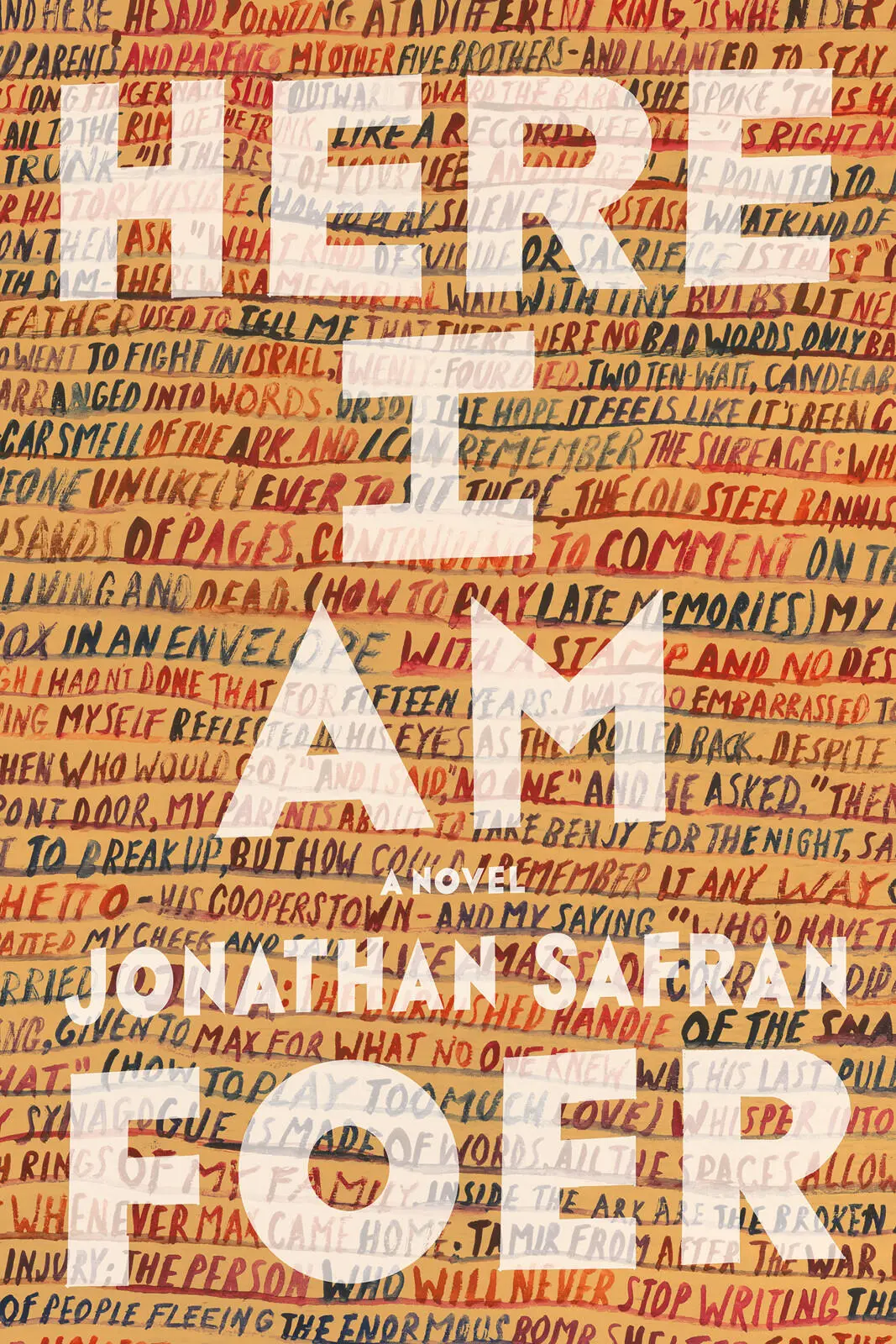
- Название:Here I Am
- Автор:
- Издательство:Hamish Hamilton
- Жанр:
- Год:2016
- ISBN:нет данных
- Рейтинг книги:5 / 5. Голосов: 1
-
Избранное:Добавить в избранное
- Отзывы:
-
Ваша оценка:
Here I Am: краткое содержание, описание и аннотация
Предлагаем к чтению аннотацию, описание, краткое содержание или предисловие (зависит от того, что написал сам автор книги «Here I Am»). Если вы не нашли необходимую информацию о книге — напишите в комментариях, мы постараемся отыскать её.
How do we fulfill our conflicting duties as father, husband, and son; wife and mother; child and adult? Jew and American? How can we claim our own identities when our lives are linked so closely to others’? These are the questions at the heart of Jonathan Safran Foer’s first novel in eleven years-a work of extraordinary scope and heartbreaking intimacy.
Unfolding over four tumultuous weeks in present-day Washington D.C.,
is the story of a fracturing family in a moment of crisis. As Jacob and Julia and their three sons are forced to confront the distances between the lives they think they want and the lives they are living, a catastrophic earthquake sets in motion a spiraling conflict in the Middle East. At stake is the very meaning of home — and the fundamental question of how much life one can bear.
Showcasing the same high-energy inventiveness, hilarious irreverence, and emotional urgency that readers and critics loved in his earlier work,
is Foer’s most searching, hard-hitting, and grandly entertaining novel yet. It not only confirms Foer’s stature as a dazzling literary talent but reveals a mature novelist who has fully come into his own as one of the most important writers of his generation.
Here I Am — читать онлайн бесплатно полную книгу (весь текст) целиком
Ниже представлен текст книги, разбитый по страницам. Система сохранения места последней прочитанной страницы, позволяет с удобством читать онлайн бесплатно книгу «Here I Am», без необходимости каждый раз заново искать на чём Вы остановились. Поставьте закладку, и сможете в любой момент перейти на страницу, на которой закончили чтение.
Интервал:
Закладка:
“Let me speak with him.”
“This isn’t about Benjy.”
“Oh my God, did something happen to Jacob and Max?”
“No. They’re fine.”
“Do you promise me?”
“You need to go home.”
VEY IZ MIR
Little was known, which made what little was known terrifying. An earthquake of magnitude 7.6 had struck at 6:23 in the evening, its epicenter deep under the Dead Sea, just outside the Israeli settlement of Kalya. Electricity was out in virtually all of Israel, Jordan, Lebanon, and Syria. It seemed that the most badly damaged areas were Salt and Amman in Jordan, as well as the West Bank city of Jericho, whose walls crumbled thirty-four hundred years before, many archaeologists have argued, not from Joshua’s trumpeting but from a massive earthquake.
First accounts were coming in from the Old City of Jerusalem: the Crusader-era Church of the Holy Sepulcher, the traditional burial place of Jesus and the holiest site in Christianity, which was badly damaged in a 1927 earthquake, had partially collapsed with an unknown number of tourists and clergymen inside. Synagogues and yeshivas, monasteries, mosques and madrassas, were in ruins. There was no news about the Temple Mount, either because there was no news or because those bearing it withheld it.
A civil engineer was being interviewed on NPR. The host, a sultry-voiced, probably short-and-bald Jew named Robert Siegel, began:
SIEGEL: We apologize, in advance, for the audio quality of this interview. Normally, when phone lines are down, we use cell phones. But cell service has been disabled as well, so Mr. Horowitz is speaking to us by satellite phone. Mr. Horowitz, are you there?
HOROWITZ: Yes, hello. I am here.
SIEGEL: Can you give us your professional assessment of what’s going on right now?
HOROWITZ: My professional assessment, yes, but I can also tell you as a human being standing here that Israel has endured a cataclysmic earthquake. Everywhere you look there is destruction.
SIEGEL: You are safe, though?
HOROWITZ: Safe is a relative term. My family is alive, and as you can hear, so am I. Some are safer. Some are less safe.
Why the fuck can’t Israelis just answer questions? Jacob wondered. Even then, in the midst of cataclysm — the word itself sounded like classic Israeli hyperbole — the Israeli couldn’t just give a straightforward, un-Israeli response.
SIEGEL: Mr. Horowitz, you are an engineer for Israeli civil services, is that correct?
HOROWITZ: An engineer, an adviser on government projects, an academic …
SIEGEL: As an engineer, what can you tell us about the potential effects of an earthquake of this magnitude?
HOROWITZ: It is not good.
SIEGEL: Could you elaborate?
HOROWITZ: Of the six hundred fifty thousand structures in Israel, fewer than half are equipped to deal with such an event.
SIEGEL: Are we going to see skyscrapers topple?
HOROWITZ: Of course not, Robert Siegel. They have been engineered to withstand even more than this. It’s the buildings between three and eight stories I’m most worried about. Many will survive, but few will be habitable. You have to realize that Israel didn’t have a building code until the late 1970s, and it’s never been enforced.
SIEGEL: Why is that?
HOROWITZ: We’ve had other things on our minds.
SIEGEL: The conflict.
HOROWITZ: Conflict? We should have been so lucky to have only one conflict. Most buildings are made of concrete — very rigid, unforgiving engineering. Buildings like Israelis, you might say. It’s served a booming population well, but couldn’t be worse-suited to the current situation.
SIEGEL: What about the West Bank?
HOROWITZ: What about it?
SIEGEL: How will its structures respond to such an earthquake?
HOROWITZ: You’d have to ask a Palestinian civil engineer.
SIEGEL: Well, we’ll certainly try to—
HOROWITZ: But since you’re asking me, I have to imagine it has been completely destroyed.
SIEGEL: I’m sorry, what has?
HOROWITZ: The West Bank.
SIEGEL: Destroyed?
HOROWITZ: All of the structures. Everything. There’s going to be a lot of fatality.
SIEGEL: In the thousands?
HOROWITZ: I’m afraid that as I speak these words, tens of thousands are already dead.
SIEGEL: And I am sure you want to get to your family, but before letting you go, could you offer some possibilities for how this will play out?
HOROWITZ: What time frame are you asking about? Hours? Weeks? A generation?
SIEGEL: Let’s start with hours.
HOROWITZ: The next few hours will be pivotal for Israel. It’s all about prioritizing now. Electricity is out countrywide, and will likely remain out, even in the major cities, for several days. As you can imagine, military needs will be the first priority.
SIEGEL: I’m surprised to hear you say that.
HOROWITZ: You are Jewish?
SIEGEL: I’m not sure why that’s relevant, but yes, I am.
HOROWITZ: I’m surprised that a fellow Jew would be surprised. But then, only an American Jew would question why being Jewish is relevant.
SIEGEL: You’re concerned for Israel’s safety?
HOROWITZ: You aren’t?
SIEGEL: Mr. Horowitz—
HOROWITZ: Israel’s tactical superiority is technological, and that has been greatly diminished by the quake. The destruction will cause desperation and unrest. And this will develop — either organically or deliberately — into violence. If it hasn’t already happened, we’re soon to see masses of people flooding the borders into Israel — from the West Bank, Gaza, Jordan, Lebanon, Syria. I don’t have to tell you that Syria already has a refugee problem.
SIEGEL: Why would they come to Israel, a country most in the Arab world view as a mortal enemy?
HOROWITZ: Because their mortal enemy has first-rate medical care. Their mortal enemy has food and water. And Israel is going to be presented with a choice: let them in, or don’t. Letting them in will require sharing limited and precious resourses. For others to live, Israelis will have to die. But not letting them in will involve bullets. And of course Israel’s neighbors will have a choice, too: take care of their citizens, or take advantage of Israel’s sudden vulnerability.
SIEGEL: Let’s hope the shared tragedy brings the region together.
HOROWITZ: Yes, but let’s not be naïve while we hope.
SIEGEL: And what about the long term? You mentioned the generational view?
HOROWITZ: Of course, no one can know what will happen, but what Israel is facing here is something far more threatening than ’67, or ’73, or even Iran’s nuclear threat. There is the immediate crisis of needing to secure the country, rescue citizens, get food and medical care to those who need it, repair the electricity, gas, water, and other utilities quickly and safely. Then there is also the work of rebuilding the country. This will be a generational challenge. And finally, and perhaps most daunting, will be the work of keeping Jews here.
SIEGEL: Meaning?
HOROWITZ: A young, ambitious, idealistic Israeli has many reasons to leave Israel. You have an expression, “The straw that broke the camel’s back.”
SIEGEL: Yes.
HOROWITZ: Thousands of buildings have fallen on the back.
JACOB: Vey iz mir.
Jacob hadn’t meant to say anything, and he certainly hadn’t meant to say vey iz mir . But then, no one ever means to say vey iz mir .
“This is bad,” Irv said, shaking his head. “Really, really bad in about a million ways.”
Jacob’s mind teleported to apocalyptic tableaux: the ceiling collapsed onto the trundle in Tamir’s old bedroom; women in wigs trapped under slabs of Jerusalem stone, the ruins of the ruins of Masada. He imagined the marble bench in Blumenberg Park, now shattered stone. It must be a catastrophe, he thought, but he meant it in two entirely different ways: that it certainly had to be, and that he wanted it to be. He couldn’t acknowledge the second meaning, but he couldn’t deny it.
Читать дальшеИнтервал:
Закладка:
Похожие книги на «Here I Am»
Представляем Вашему вниманию похожие книги на «Here I Am» списком для выбора. Мы отобрали схожую по названию и смыслу литературу в надежде предоставить читателям больше вариантов отыскать новые, интересные, ещё непрочитанные произведения.







Обсуждение, отзывы о книге «Here I Am» и просто собственные мнения читателей. Оставьте ваши комментарии, напишите, что Вы думаете о произведении, его смысле или главных героях. Укажите что конкретно понравилось, а что нет, и почему Вы так считаете.