Jonathan Foer - Here I Am
Здесь есть возможность читать онлайн «Jonathan Foer - Here I Am» весь текст электронной книги совершенно бесплатно (целиком полную версию без сокращений). В некоторых случаях можно слушать аудио, скачать через торрент в формате fb2 и присутствует краткое содержание. Год выпуска: 2016, Издательство: Hamish Hamilton, Жанр: Историческая проза, на английском языке. Описание произведения, (предисловие) а так же отзывы посетителей доступны на портале библиотеки ЛибКат.
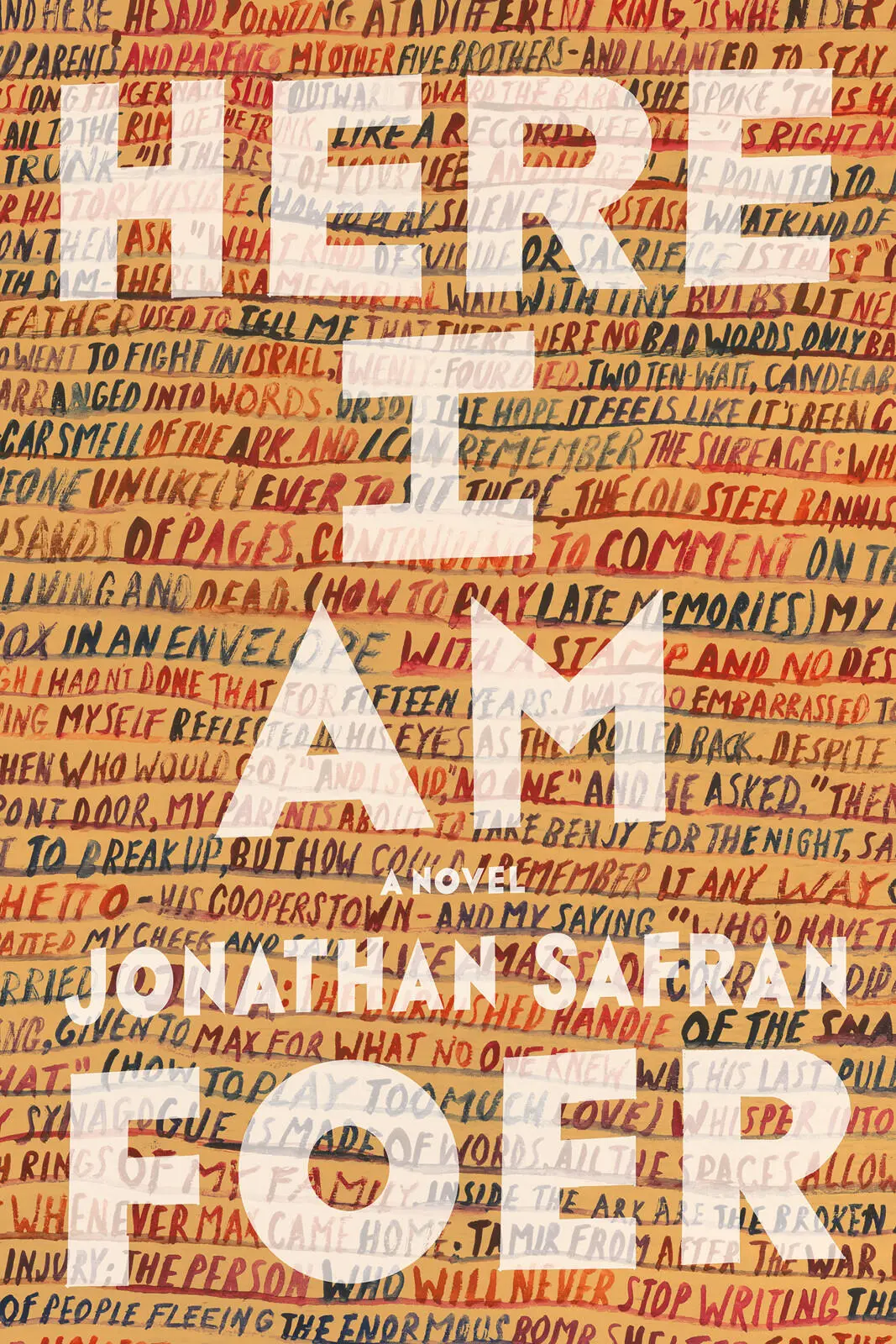
- Название:Here I Am
- Автор:
- Издательство:Hamish Hamilton
- Жанр:
- Год:2016
- ISBN:нет данных
- Рейтинг книги:5 / 5. Голосов: 1
-
Избранное:Добавить в избранное
- Отзывы:
-
Ваша оценка:
Here I Am: краткое содержание, описание и аннотация
Предлагаем к чтению аннотацию, описание, краткое содержание или предисловие (зависит от того, что написал сам автор книги «Here I Am»). Если вы не нашли необходимую информацию о книге — напишите в комментариях, мы постараемся отыскать её.
How do we fulfill our conflicting duties as father, husband, and son; wife and mother; child and adult? Jew and American? How can we claim our own identities when our lives are linked so closely to others’? These are the questions at the heart of Jonathan Safran Foer’s first novel in eleven years-a work of extraordinary scope and heartbreaking intimacy.
Unfolding over four tumultuous weeks in present-day Washington D.C.,
is the story of a fracturing family in a moment of crisis. As Jacob and Julia and their three sons are forced to confront the distances between the lives they think they want and the lives they are living, a catastrophic earthquake sets in motion a spiraling conflict in the Middle East. At stake is the very meaning of home — and the fundamental question of how much life one can bear.
Showcasing the same high-energy inventiveness, hilarious irreverence, and emotional urgency that readers and critics loved in his earlier work,
is Foer’s most searching, hard-hitting, and grandly entertaining novel yet. It not only confirms Foer’s stature as a dazzling literary talent but reveals a mature novelist who has fully come into his own as one of the most important writers of his generation.
Here I Am — читать онлайн бесплатно полную книгу (весь текст) целиком
Ниже представлен текст книги, разбитый по страницам. Система сохранения места последней прочитанной страницы, позволяет с удобством читать онлайн бесплатно книгу «Here I Am», без необходимости каждый раз заново искать на чём Вы остановились. Поставьте закладку, и сможете в любой момент перейти на страницу, на которой закончили чтение.
Интервал:
Закладка:
“I asked you a question,” Irv said, bringing Jacob back to the argument that only Irv was having.
“Did you?”
“Yes: Why? ”
“Why what ?”
“The what doesn’t even matter. The answer is the same to every question about us: Because the world hates Jews .”
Jacob turned to face Max. “You realize that genetics aren’t destiny, right?”
“Whatever you say…”
“In much the same way that I escaped the baldness that ravaged your grandfather’s head, you have a fighting chance of dodging the insanity that transformed a passable human into the man who married my mother.”
Irv gave a deep, dramatic exhale, and then, with the full force of his faux sincerity: “Would it be all right if I offered an opinion?”
Both Jacob and Max laughed at that. Jacob liked that feeling, that spontaneous father-son camaraderie.
“Listen, don’t listen, it’s up to you. But I want to get this off my chest. I think you’re wasting your life.”
“Oh, that’s all?” Jacob said. “I was bracing for something big.”
“I think you are an immensely talented, deeply feeling, profoundly intelligent person.”
“The zayde doth protest too much, methinks.”
“And you have made some very bad choices.”
“I’m guessing you have a specific choice in mind.”
“Yes, writing for that dumb TV show.”
“That dumb TV show is watched by four million people.”
“A: So what? B: Which four million?”
“And is critically acclaimed.”
“Those who can’t teach gym, acclaim.”
“And it’s my job . It’s how I support the family.”
“It’s how you make money. There are other ways to support a family.”
“I should be a dermatologist? That would be a good use of my talent, feeling, and intellect?”
“You should make something that befits your abilities and expresses your definition of substance.”
“I am .”
“No, you’re dotting the i ’s and crossing the t ’s of the epic dragon adventure of someone who isn’t fit to spit shine your hemorrhoids. You weren’t put on earth to do that.”
“And now you’re going to tell me what I was put on earth to do?”
“That’s exactly what I’m going to do.”
Jacob sang: “Somewhere in my youth, or childhood, I must have done something very bad.”
“As I was about to say—”
“High on his horse was my lonely dad, Irv, lay ee old lay ee old lay hee hoo.”
“You’re witty — we get it, Fraukenstein.”
“Bad advice, bad advice, bless my homeland for never.”
This time leaving no room to fill: “Jacob, you should forge in the smithy of your soul the uncreated conscience of your race.”
An underwhelmed “Wow.”
“Yes: wow.”
“Would you mind saying that once more, and projecting, for the cheap seats in my brain?”
“You should forge in the smithy of your soul the uncreated conscience of your race.”
“Didn’t the ovens at Auschwitz do that?”
“They destroyed. I’m talking about forging.”
“I appreciate your sudden vote of confidence in me—”
“I just stuffed the ballot box.”
“—but my soul’s smithy doesn’t get that hot.”
“That’s because you’re so desperate to be loved. Friction generates heat.”
“I don’t even know what that means.”
“It’s the same with the n-word business at Sam’s school.”
“We should probably leave Sam out of this,” Max suggested.
“It’s the same everywhere you look in your life,” Irv said. “You’re making the same mistake we’ve been making for thousands of years—”
“We?”
“—believing that if we can only be loved, we’ll be safe.”
“My conversation GPS is on the fritz. We’re back to the hatred of the Jews?”
“ Back to? No. You can’t return to something you’ve never left.”
“The show is entertainment .”
“I don’t believe that you believe that.”
“Well, that sounds like the end of our road.”
“Because I’m ready to give you more credit than you’re ready to give yourself?”
“Because as you’re often the first to point out, you can’t negotiate without a negotiating partner.”
“Who’s negotiating?”
“You can’t converse .”
“Really, Jacob. Let down your guard for a second and ask yourself: What is it with the ravenous need for love? You used to write such honest books. Honest and emotionally ambitious. Maybe they weren’t finding millions of readers. Maybe they weren’t making you rich. But they were making the world rich.”
“And you hated them.”
“Yes, that’s right,” he said, switching lanes without checking any of his mirrors, “I hated them. God forbid you should see my marginalia. But do you know who hates your show?”
“It isn’t my show.”
“Nobody. You’ve passed a lot of time for a lot of grateful zombies.”
“So this is an argument against television?”
“That’s another argument I could make,” he said, taking the airport exit. “But this is an argument against your show.”
“It isn’t my show.”
“So get a show.”
“But I have nothing left to offer the tooth fairy in exchange.”
“Have you tried?”
“Have I tried ?”
No one had tried harder. Not to get a show — it wasn’t yet the time for that — but to write one. For more than a decade Jacob had been breaking his soul’s back shoveling coal into the smithy. He’d devoted himself to the secret, utterly futile task of redeeming his people through language. His people? His family. His family? Himself. What self? And redeeming might not be quite the right word.
Ever-Dying People was exactly what his father thought he was hoping for — a shofar blast from a mountaintop. Or at least a silent cry from a basement. But if Irv had ever been given the chance to read it, he would have hated it — a far more expansive hatred than the one he felt for the novels. Jacob’s definition of substance could get pretty ugly, but more, there were some essential disagreements about whom the sharp point of the forged conscience should be turned on.
And there was a far bigger problem: the show would kill Jacob’s grandfather. Not metaphorically. It would literally commit grand-patricide. He who could survive anything would never survive a mirror. So Jacob held it close to his chest in a locked desk drawer. And the less able he was to share it, the more devoted he felt to it.
The show began with the beginning of the writing of the show. The characters in the show were the characters in the real Jacob’s life: an unhappy wife (who didn’t want to be described that way); three sons: one on the brink of manhood, one on the brink of extreme self-consciousness, one on the brink of mental independence; a terrified, xenophobic father; a quietly weaving and unweaving mother; a depressed grandfather. Should he one day share it and be asked how autobiographical it was, he would say, “It’s not my life, but it’s me.” And if someone — who else but Dr. Silvers? — were to ask how autobiographical his life was, he would say, “It’s my life, but it’s not me.”
The writing kept pace with the changing events in Jacob’s life. Or his life kept pace with the writing. Sometimes it was hard to tell. Jacob wrote about the discovery of his phone months before he even bought a second phone — psychology so double-left-handed it didn’t justify even one six-dollar minute with Dr. Silvers and was given several dozen hours. But it wasn’t just psychological. There were times when Julia would say or do things so eerily similar to what Jacob had written that he had to wonder if she’d read it. The night she discovered the phone, she asked, “Does it make you sad that we love the kids more than we love each other?” That exact line — those words in that order — had been in the script for months. Although they were Jacob’s.
Читать дальшеИнтервал:
Закладка:
Похожие книги на «Here I Am»
Представляем Вашему вниманию похожие книги на «Here I Am» списком для выбора. Мы отобрали схожую по названию и смыслу литературу в надежде предоставить читателям больше вариантов отыскать новые, интересные, ещё непрочитанные произведения.



Обсуждение, отзывы о книге «Here I Am» и просто собственные мнения читателей. Оставьте ваши комментарии, напишите, что Вы думаете о произведении, его смысле или главных героях. Укажите что конкретно понравилось, а что нет, и почему Вы так считаете.