Jonathan Foer - Here I Am
Здесь есть возможность читать онлайн «Jonathan Foer - Here I Am» весь текст электронной книги совершенно бесплатно (целиком полную версию без сокращений). В некоторых случаях можно слушать аудио, скачать через торрент в формате fb2 и присутствует краткое содержание. Год выпуска: 2016, Издательство: Hamish Hamilton, Жанр: Историческая проза, на английском языке. Описание произведения, (предисловие) а так же отзывы посетителей доступны на портале библиотеки ЛибКат.
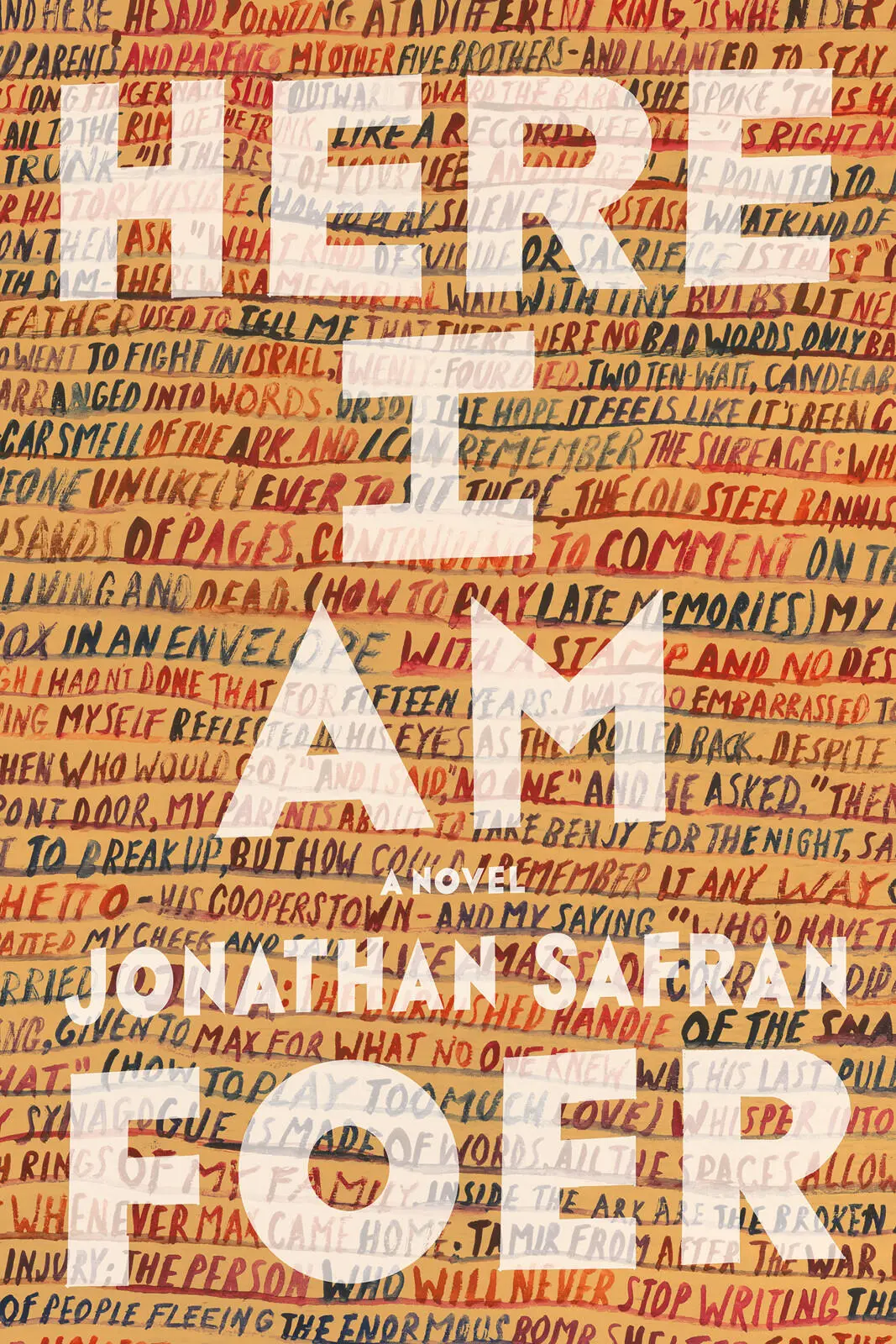
- Название:Here I Am
- Автор:
- Издательство:Hamish Hamilton
- Жанр:
- Год:2016
- ISBN:нет данных
- Рейтинг книги:5 / 5. Голосов: 1
-
Избранное:Добавить в избранное
- Отзывы:
-
Ваша оценка:
Here I Am: краткое содержание, описание и аннотация
Предлагаем к чтению аннотацию, описание, краткое содержание или предисловие (зависит от того, что написал сам автор книги «Here I Am»). Если вы не нашли необходимую информацию о книге — напишите в комментариях, мы постараемся отыскать её.
How do we fulfill our conflicting duties as father, husband, and son; wife and mother; child and adult? Jew and American? How can we claim our own identities when our lives are linked so closely to others’? These are the questions at the heart of Jonathan Safran Foer’s first novel in eleven years-a work of extraordinary scope and heartbreaking intimacy.
Unfolding over four tumultuous weeks in present-day Washington D.C.,
is the story of a fracturing family in a moment of crisis. As Jacob and Julia and their three sons are forced to confront the distances between the lives they think they want and the lives they are living, a catastrophic earthquake sets in motion a spiraling conflict in the Middle East. At stake is the very meaning of home — and the fundamental question of how much life one can bear.
Showcasing the same high-energy inventiveness, hilarious irreverence, and emotional urgency that readers and critics loved in his earlier work,
is Foer’s most searching, hard-hitting, and grandly entertaining novel yet. It not only confirms Foer’s stature as a dazzling literary talent but reveals a mature novelist who has fully come into his own as one of the most important writers of his generation.
Here I Am — читать онлайн бесплатно полную книгу (весь текст) целиком
Ниже представлен текст книги, разбитый по страницам. Система сохранения места последней прочитанной страницы, позволяет с удобством читать онлайн бесплатно книгу «Here I Am», без необходимости каждый раз заново искать на чём Вы остановились. Поставьте закладку, и сможете в любой момент перейти на страницу, на которой закончили чтение.
Интервал:
Закладка:
Jacob and Max got McNuggets for themselves, too. They almost never ate meat in the house — again, Julia’s decision — and fast food ranked just below cannibalism on the list of things not to be done. Neither Jacob nor Max missed McNuggets, but sharing something Julia disapproved of was a bonding experience. They pulled over at Fort Reno Park and made an impromptu picnic. Argus was loyal enough, and lethargic enough, to be trusted off-leash. Max stroked him as he swallowed McNugget after McNugget, telling him, “You’re a good dog. You’re good. You’re good.”
Pathetic as it felt, Jacob was jealous. Julia’s cruel comments — however accurate, however deserved — lingered painfully in his mind. He kept returning to the line “I don’t believe you’re there at all.” It was among the least specific, least pointed things she’d said in the course of their first fight about the phone, and a different person’s mind would probably have attached itself to something else. But that was what echoed: “I don’t believe you’re there at all.”
“I used to come here a lot when I was younger,” Jacob said to Max. “We’d sled down that hill.”
“Who was we ?”
“Usually friends. Grandpa might have taken me a couple times, though I don’t remember it. When it was warm, I’d come here to play baseball.”
“Games? Or just goofing around?”
“Mostly goofing. It was never easy to get a minyan. Sometimes. Maybe the last day of school before a break.”
“You’re good, Argus. So good.”
“When I got older, we’d buy beer from the Tenleytown Grocery — just over there. They never carded us.”
“What’s that mean?”
“You have to be twenty-one to buy beer legally, so usually places will ask for ID, like a driver’s license, to see how old you are. Tenleytown never did. So we all bought beer there.”
“You were breaking the law.”
“It was a different time. And you know what Martin Luther King said about just and unjust laws.”
“I don’t.”
“Basically, it was our moral responsibility to buy the beer.”
“Good Argus.”
“I’m kidding, of course. It is not good to buy beer before you’re of age, and please don’t tell Mom that I told you that story.”
“OK.”
“Do you know what a minyan is?”
“No.”
“Why didn’t you ask?”
“I don’t know.”
“It’s ten men over the age of thirteen. That’s what’s required for prayers to count at synagogue.”
“Sounds sexist and ageist.”
“Definitely both,” Jacob said, pulling a wildflower. “Fugazi used to play a free show here every summer.”
“What’s Fugazi ?”
“Only the greatest band ever to have existed, by any definition of great. Their music was great. Their ethos was great. They were just great.”
“What’s ethos ?”
“Guiding belief.”
“What was their ethos?”
“Don’t price-gouge your fans, don’t tolerate violence at shows, don’t make videos or sell merchandise. Do make music with anticorporate, antimisogynist, class-conscious messaging, and make it make your face melt.”
“You’re a good dog.”
“We should probably get going.”
“My ethos is ‘Find light in the beautiful sea, I choose to be happy.’”
“That’s a great ethos, Max.”
“It’s a line from a Rihanna song.”
“Well, Rihanna is wise.”
“She didn’t write the song.”
“Whoever wrote it.”
“Sia.”
“So Sia’s wise.”
“And I was just kidding.”
“Right.”
“What’s yours?”
“What?”
“Ethos.”
“Don’t price-gouge your fans, don’t tolerate violence at shows—”
“No, seriously.”
Jacob laughed.
“Seriously,” Max said.
“Let me think about it.”
“That’s probably your ethos.”
“That’s Hamlet’s ethos. You know Hamlet, right?”
“I’m ten, I’m not unborn.”
“Sorry.”
“Also, Sam’s reading it in class.”
“I wonder where Fugazi is now. I wonder if they’re still idealistic, whatever they’re doing.”
“You’re good, Argus.”
* * *
When they got to the vet’s office, they were led to an examining room in the back.
“In a weird way this reminds me of Great-Grandpa’s house.”
“That is weird.”
“All the photos of the dogs are kind of like the pictures of me, Sam, and Benjy. And the jar of treats is like the jar of hard candies.”
“And it smells like…”
“What?”
“Nothing.”
“What?”
“I was going to say death, but it didn’t feel like a nice thing to say, so I tried to keep it to myself.”
“What does death smell like?”
“Like this.”
“How do you even know?”
Jacob had never smelled a dead person. His three dead grandparents had died either before he was born or early enough in his childhood for him to have been protected from it. None of his colleagues or friends, or former colleagues or former friends, had died. Sometimes it amazed him that he’d managed to live forty-two years without proximity to mortality. And that amazement was always followed by the fear that the statistics would catch up with him and offer a lot of death at once. And he wouldn’t be ready.
The vet took half an hour to see them, and Max gave Argus treat after treat.
“Might not mix well with the McNuggets,” Jacob warned.
“You’re good. You’re so good.”
Argus brought out a different side of Max, a sweetness, or vulnerability, that usually faced away. Jacob thought about a day he spent with his father at the National Museum of Natural History when he was Max’s age. He had so few memories of time alone with his father — Irv worked long hours at the magazine, and when he wasn’t writing, he was teaching, and when he wasn’t teaching, he was socializing with important people, to confirm that he was an important person — but Jacob remembered that day.
They were facing a diorama. A bison.
“Nice,” Irv said, “right?”
“Really nice,” Jacob said, moved — shaken, even — by the extreme presence of the animal, how self-contained it was.
“None of this is by accident,” Irv said.
“What do you mean?”
“They go to lengths to re-create an accurate nature scene. That’s the point. But there are a lot of accurate scenes they could have chosen, right? The bison could have been galloping instead of standing still. He could have been battling, or hunting, or eating. There could have been two instead of one. They could have perched a small bird on his back. A lot of choices.”
Jacob used to love being taught by his father. It felt intoxicating, and safe. And it confirmed that Jacob was an important person in his father’s life.
“But the choices aren’t always made freely,” Irv said.
“Why not?”
“Because they have to hide what brought the animals here.”
“What do you mean?”
“Where do you think the animals come from?”
“Africa, or something?”
“But how do they end up in dioramas? Do you think they volunteer to be taxidermied? Are they roadkill that lucky scientists stumble upon?”
“I guess I don’t know.”
“They’re hunted.”
“Really?”
“And hunting isn’t clean.”
“It isn’t?”
“No one ever got something that didn’t want to be gotten without making a mess.”
“Oh.”
“Bullets leave holes, sometimes big ones. Arrows, too. And you don’t bring down a bison with a little hole.”
“I guess not.”
“So when they position the animals in the dioramas, they turn the holes and gashes and tears away from the viewer. Only the animals painted into the landscape get to see them. But remembering they’re there changes everything.”
Читать дальшеИнтервал:
Закладка:
Похожие книги на «Here I Am»
Представляем Вашему вниманию похожие книги на «Here I Am» списком для выбора. Мы отобрали схожую по названию и смыслу литературу в надежде предоставить читателям больше вариантов отыскать новые, интересные, ещё непрочитанные произведения.




Обсуждение, отзывы о книге «Here I Am» и просто собственные мнения читателей. Оставьте ваши комментарии, напишите, что Вы думаете о произведении, его смысле или главных героях. Укажите что конкретно понравилось, а что нет, и почему Вы так считаете.