Upton Sinclair - Dragons’s teeth
Здесь есть возможность читать онлайн «Upton Sinclair - Dragons’s teeth» весь текст электронной книги совершенно бесплатно (целиком полную версию без сокращений). В некоторых случаях можно слушать аудио, скачать через торрент в формате fb2 и присутствует краткое содержание. Жанр: Историческая проза, на английском языке. Описание произведения, (предисловие) а так же отзывы посетителей доступны на портале библиотеки ЛибКат.
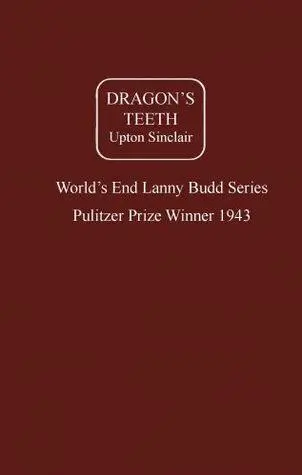
- Название:Dragons’s teeth
- Автор:
- Жанр:
- Год:неизвестен
- ISBN:нет данных
- Рейтинг книги:3 / 5. Голосов: 1
-
Избранное:Добавить в избранное
- Отзывы:
-
Ваша оценка:
Dragons’s teeth: краткое содержание, описание и аннотация
Предлагаем к чтению аннотацию, описание, краткое содержание или предисловие (зависит от того, что написал сам автор книги «Dragons’s teeth»). Если вы не нашли необходимую информацию о книге — напишите в комментариях, мы постараемся отыскать её.
Dragons’s teeth — читать онлайн бесплатно полную книгу (весь текст) целиком
Ниже представлен текст книги, разбитый по страницам. Система сохранения места последней прочитанной страницы, позволяет с удобством читать онлайн бесплатно книгу «Dragons’s teeth», без необходимости каждый раз заново искать на чём Вы остановились. Поставьте закладку, и сможете в любой момент перейти на страницу, на которой закончили чтение.
Интервал:
Закладка:
Really it wasn’t as bad as everybody had expected. People took it as a joke; the richest man in the country might happen to have only a few dimes in his pocket, and that was all he had, and his friends thought it was funny, and he had to laugh, too. But everybody trusted him, and took his checks, so he could have whatever he wanted, the same as before. Robbie didn’t miss a meal, nor did any other Budd. Meanwhile they listened to a magnificent radio voice telling them with calm confidence that the new government was going to act, and act quickly, and that all the problems of the country were going to be solved. The New Deal was getting under way.
The first step was to join Britain and the other nations off the gold standard. To Robbie it meant inflation, and that his country was going to see what Germany had seen. The next thing was to sort out the banks, and decide which were sound and in position to open with government backing. The effect of that was to move Wall Street to Washington; the government became the center of power, and the bankers came hurrying with their lawyers and their brief-cases. A harum-scarum sort of affair, in which all sorts of blunders were made; America was going to be a land of absurdities for many years, and the Robbie Budds would have endless opportunities to ridicule and denounce. But business would begin to pick up and people would begin to eat again—and not just the Budds.
Lanny didn’t have any trouble, for the French banks weren’t closed, and he had money to spare for his refugees. If Irma’s income stayed in hock they could go back to Bienvenu—the cyclone cellar, she called it. She had never had to earn any money in her life, so it was easy for her to take her husband’s debonair attitude to it. If she lost hers, everybody else would lose theirs, and you wouldn’t have any sense of inferiority. Really, it was rather exciting, and the younger generation took it as a sporting proposition. Irma would swing between that attitude and her dream of an august and distinguished salon; when Lanny pointed out to her the inconsistency of the two attitudes she was content to laugh.
VI
Rick came over to spend a few days with them; he was no longer so poor that he had to worry about a trip to Paris, and it was his business to meet all sorts of people and watch what was going on. A lame ex-aviator who would some day become a baronet, and who meanwhile had made a hit as a playwright, was a romantic figure, even though he was extreme in his talk. The ladies were pleased with him, and Irma discovered that she had what she might call a home-made lion; she would tell the smartest people how Lanny had been Rick’s boyhood chum, had taken him to conferences all over Europe and helped to plan and even revise his plays; also how she, Irma, had helped to finance The Dress-Suit Bribe, and was not merely getting her money back but a considerable profit. It was the first investment that had been her very own, and she could be excused for being proud of it, and for boasting about it to her mother and her several uncles.
Irma decided more and more that she liked the English attitude to life. Englishmen felt intensely, as you soon found out, but they were content to state their position quietly, and even to understate it; they didn’t raise their voices like so many Americans, or gesticulate like the French, or bluster like the Germans. They had been in the business of governing for a long time, and rather took it for granted; but at the same time they were willing to consider the other fellow’s point of view, and to work out some sort of compromise. Especially did that seem to be the case with continental affairs, where they were trying so hard to mediate between the French and the Germans. Denis de Bruyne said: "Vraiment, how generous they can be when they are disposing of French interests!"
The Conference on Arms Limitation was still in session at Geneva, still wrangling, exposing the unwillingness of any nation to trust any other, or to concede what might be to a rival nation’s advantage. Rick, the Socialist, said: "There isn’t enough trade to go round, and they can’t agree how to divide it." Jesse Blackless, the Communist, said: "They are castaways on a raft, and the food is giving out; they know that somebody has to be eaten, and who will consent to be the first?"
There was a lot of private conferring between the British and the French, and British officials were continually coming and going in Paris. Rick brought several of them to the palace for tea and for dancing, and this was the sort of thing for which Irma had wanted the palace; she felt that she was getting her money’s worth—though of course she didn’t use any such crude phrase. Among those who came was that Lord Wickthorpe whom she had met in Geneva last year. He had a post of some responsibility, and talked among insiders, as he counted Rick and the Budds. Irma listened attentively, because, as a hostess, she had to say something and wanted it to be right. Afterward she talked with Lanny, getting him to explain what she hadn’t understood. Incidentally she remarked: "I wish you could take a balanced view of things, the way Wickthorpe does."
"Darling," he answered, "Wickthorpe is a member of the British aristocracy, and is here to fight for the Empire. He’s got pretty much of everything he wants, so naturally he can take things easy."
"Haven’t you got what you want, Lanny?"
"Not by a darn sight! I want a better life for masses of people who aren’t in the British Empire, and for many in the Empire whom Wickthorpe leaves out of his calculations."
"But, Lanny, you heard him say: We’re all Socialists now. "
"I know, dear; it’s a formula. But they write their definition of the word, and it means that Wickthorpe will do the governing, and decide what the workers are to get. The slum-dwellers in the East End will go on paying tribute to the landlords, and the ryots in India and the niggers in South Africa will be sweated to make luxury for British bondholders."
"Oh, dear!" exclaimed the would-be salonnière. "Who will want to come to see us if you talk like that?"
VII
Lanny was interested in the point of view of these official persons, and sat in the splendid library of his wife’s rented home and listened to Rick discussing the Nazi movement with Wickthorpe and his secretary, Reggie Catledge, who was also his cousin. It was a point of view in no way novel to Lanny, his father having explained it when he was a very small boy. The governing classes of Britain made it a fixed policy never to permit one nation to become strong enough to dominate the Continent; regardless of which nation it might be, they would set themselves the task of raising some rival as a counterweight.
Wickthorpe disliked the Nazis and what they were doing, but he didn’t rave at them; he just said they were a set of bounders. He took it for granted that their fantastic promises had been made as a means of getting power. "Just politics," he said, and refused to be disturbed by the possibility that the bounders might mean what they said. The two Englishmen listened with interest to what Lanny had to tell about his meeting with Hitler, and asked him some questions, but at the end they were of the same opinion still.
"We’ve had so many wild men in our public life," said his lordship. "You and I are too young to remember how old John Burns used to rave in his speeches at Trafalgar Square, but my parents got up slumming parties to go and listen. Long afterward you could meet the old boy in the New Reform Club and hear him talk about it—in fact you could hardly get him to talk about anything else."
"He was a very strict teetotaler, but his face was as red as a turkey-cock’s wattles," added Catledge.
Читать дальшеИнтервал:
Закладка:
Похожие книги на «Dragons’s teeth»
Представляем Вашему вниманию похожие книги на «Dragons’s teeth» списком для выбора. Мы отобрали схожую по названию и смыслу литературу в надежде предоставить читателям больше вариантов отыскать новые, интересные, ещё непрочитанные произведения.








Обсуждение, отзывы о книге «Dragons’s teeth» и просто собственные мнения читателей. Оставьте ваши комментарии, напишите, что Вы думаете о произведении, его смысле или главных героях. Укажите что конкретно понравилось, а что нет, и почему Вы так считаете.