Upton Sinclair - Dragons’s teeth
Здесь есть возможность читать онлайн «Upton Sinclair - Dragons’s teeth» весь текст электронной книги совершенно бесплатно (целиком полную версию без сокращений). В некоторых случаях можно слушать аудио, скачать через торрент в формате fb2 и присутствует краткое содержание. Жанр: Историческая проза, на английском языке. Описание произведения, (предисловие) а так же отзывы посетителей доступны на портале библиотеки ЛибКат.
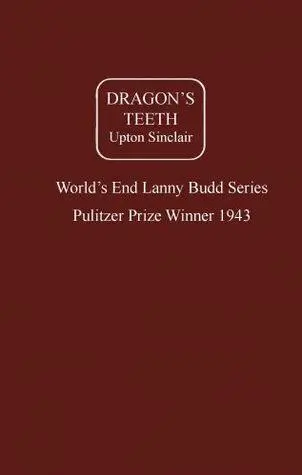
- Название:Dragons’s teeth
- Автор:
- Жанр:
- Год:неизвестен
- ISBN:нет данных
- Рейтинг книги:3 / 5. Голосов: 1
-
Избранное:Добавить в избранное
- Отзывы:
-
Ваша оценка:
Dragons’s teeth: краткое содержание, описание и аннотация
Предлагаем к чтению аннотацию, описание, краткое содержание или предисловие (зависит от того, что написал сам автор книги «Dragons’s teeth»). Если вы не нашли необходимую информацию о книге — напишите в комментариях, мы постараемся отыскать её.
Dragons’s teeth — читать онлайн бесплатно полную книгу (весь текст) целиком
Ниже представлен текст книги, разбитый по страницам. Система сохранения места последней прочитанной страницы, позволяет с удобством читать онлайн бесплатно книгу «Dragons’s teeth», без необходимости каждый раз заново искать на чём Вы остановились. Поставьте закладку, и сможете в любой момент перейти на страницу, на которой закончили чтение.
Интервал:
Закладка:
For more than twenty years this sensitive young Jew had consecrated himself to one special skill; he had made himself a slave to some pieces of wood, strips of pig’s intestine, and hairs from a horse’s tail. With such unlikely agencies Beethoven and Hansi contrived to express the richness, elegance, and variety of life. They took you into the workshop of the universe, where its miracles are planned and executed; the original mass-production process which turns out the myriad leaves of trees and the petals of flowers, the wings of insects and birds, the patterns of snow crystals and solar systems. Beethoven and Hansi revealed the operation of that machinery from which color and delicacy, power and splendor are poured forth in unceasing floods.
Lanny had made so many puns upon the name of his brother-in-law that he had ceased to think of them as such. There was nothing in the physical aspect of Hansi to suggest the robin, but when you listened to his music you remembered that the robin’s wings are marvels of lightness and grace, and that every feather is a separate triumph. The robin’s heart is strong, and he flies without stopping, on and on, to lands beyond the seas. He flies high into the upper registers, among the harmonic notes, where sensations are keener than any known upon earth. The swift runs of Hansi’s violin were the swooping and darting of all the birds; the long trills were the fluttering of the humming-bird’s wings, purple, green, and gold in the sunlight, hovering, seeming motionless; each moment you expect it to dart away, but there it remains, an enchantment.
IX
Hansi was playing the elaborate cadenza. No other sound in the auditorium; the men of the orchestra sat as if they were images, and the audience the same. Up and down the scale rushed the flying notes; up like the wind through the pine trees on a mountain-side, down like cascades of water, flashing rainbows in the sunshine. Beethoven had performed the feat of weaving his two themes in counterpoint, and Hansi performed the feat of playing trills with two of his fingers and a melody with the other two. Only a musician could know how many years of labor it takes to train nerves and muscles for such "double-stopping," but everyone could know that it was beautiful and at the same time that it was wild.
The second movement is a prayer, and grief is mixed with its longing; so Hansi could tell those things which burdened his spirit. He could say that the world was a hard and cruel place, and that his poor people were in agony. "Born to sorrow—born to sorrow," moaned the wood-winds, and Hansi’s violin notes hovered over them, murmuring pity. But one does not weep long with Beethoven; he turns pain into beauty, and it would be hard to find in all his treasury a single work in which he leaves you in despair. There comes a rush of courage and determination, and the theme of grief turns into a dance. The composer of this concerto, humiliated and enraged because the soldiers of Napoleon had seized his beloved Vienna, went out into the woods alone and reminded himself that world conquerors come and go, but love and joy live on in the hearts of men.
"Oh, come, be merry, oh, come be jolly, come one, come all and dance with me!" Lanny amused himself by finding words for musical themes. This dance went over flower-strewn meadows; breezes swept ahead of it, and the creatures of nature joined the gay procession, birds fluttering in the air, rabbits and other delightful things scampering on the ground. Hand in hand came young people in flowing garments. "Oh, youths and maidens, oh, youths and maidens, come laugh, and sing, and dance with me!" It was the Isadora rout that Lanny would always carry in his memory. When the storm of the orchestra drowned out Hansi’s fiddle, the listener was leaping to a mountain-top and from it to the next.
Others must have been having the same sort of adventure, for when the last note sounded they started to their feet and tried to tell the artist about it. Lanny saw that his brother-in-law had won a triumph. Such a sweet, gentle fellow he was, flushed from his exertions, but even thinner than usual, showing the strain under which he was living. People seemed to realize that here was one who was not going to be spoiled by adulation. He wasn’t going to enjoy himself and his own glory, he would never become blase and bored; he would go on loving his art and serving it. Nobody in that hall failed to know that he was a Jew, and that this was a time of anguish for his people. Such anti-Semitism as there was in Paris was not among the art-lovers, and to shout "Bravo!" at this young virtuoso was to declare yourself for the cause of freedom and human decency.
Lanny thought about the great composer, friend of mankind and champion of the oppressed. His concerto had been played badly in his own lifetime, and what a revelation it would have been to him to hear it rendered by a soloist and a conductor, neither having a score. But then Lanny thought: "What would Beethoven think if he could see what is happening in the land of his birth?" So the dreams of art fled, and painful reality took their place. Lanny thought: "The German soul has been captured by Hitler! What can he give it but his own madness and distraction? What can he make of it but an image of his distorted self?"
X
Hansi always wanted to be taken straight home after a performance; he was exhausted, and didn’t care for sitting around in cafes. He entered the palace and was about to go to his room, when the telephone rang; Berlin calling, and Hansi said: "That will be Papa, wanting to know how the concert went."
He was right, and told his father that everything had gone well. Johannes didn’t ask for particulars; instead he had tidings to impart. "The Reichstag building is burning."
"Herrgott!" exclaimed the son, and turned and repeated the words to the others.
"The Nazis are saying that the Communists set fire to it."
"But, Papa, that is crazy!"
"I must not talk about it. You will find the news in the papers, and do your own guessing. The building has been burning for a couple of hours, and they say that men were seen running through it with torches."
"It is a plot!" exclaimed Hansi.
"I cannot say; but I am glad that you are not here. You must stay where you are for the present. It is a terrible thing."
So Hansi did not go to bed for a long while. They sat and talked, and Lanny, who had friends on Le Populaire, called up that paper to get further details. It was believed that the great building was gutted, and the government was charging that it had been deliberately fired by emissaries of the Red International.
All four of the young people were familiar with that elaborate specimen of the Bismarck style of architecture, and could picture the scenes, both there and elsewhere in the city. "It is a frame-up," said Bess. "Communists are not terrorists." Lanny agreed with her, and Irma, whatever she thought, kept it to herself. It was inevitable that every Communist would call it a plot, and every Nazi would be equally certain of the opposite.
"Really, it is too obvious!" argued Hansi. "The elections less than six days away, and those scoundrels desperate for some means of discrediting us!"
"The workers will not be fooled!" insisted Bess. "Our party is monolithic."
Lanny thought: "The old phonograph record!" But he said: "It’s a terrible thing, as Papa says. They will be raiding Communist headquarters all over Germany tonight. Be glad that you have a good alibi."
But neither of the musicians smiled at this idea. In their souls they were taking the blows which they knew must be falling upon their party comrades.
XI
What happened in the Reichstag building on that night of February 27 would be a subject of controversy inside and outside of Germany for years to come; but there could be no doubt about what happened elsewhere. Even while the four young people were talking in Paris, the leader of the Berlin S.A., Count Helldorf, was giving orders for the arrest of prominent Communists and Socialists.
Читать дальшеИнтервал:
Закладка:
Похожие книги на «Dragons’s teeth»
Представляем Вашему вниманию похожие книги на «Dragons’s teeth» списком для выбора. Мы отобрали схожую по названию и смыслу литературу в надежде предоставить читателям больше вариантов отыскать новые, интересные, ещё непрочитанные произведения.







Обсуждение, отзывы о книге «Dragons’s teeth» и просто собственные мнения читателей. Оставьте ваши комментарии, напишите, что Вы думаете о произведении, его смысле или главных героях. Укажите что конкретно понравилось, а что нет, и почему Вы так считаете.