Upton Sinclair - Dragons’s teeth
Здесь есть возможность читать онлайн «Upton Sinclair - Dragons’s teeth» весь текст электронной книги совершенно бесплатно (целиком полную версию без сокращений). В некоторых случаях можно слушать аудио, скачать через торрент в формате fb2 и присутствует краткое содержание. Жанр: Историческая проза, на английском языке. Описание произведения, (предисловие) а так же отзывы посетителей доступны на портале библиотеки ЛибКат.
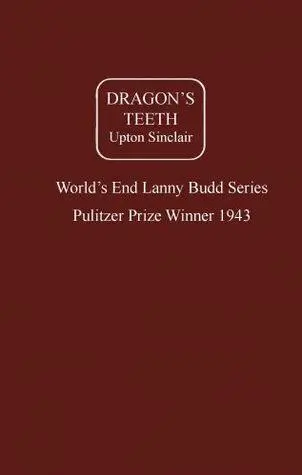
- Название:Dragons’s teeth
- Автор:
- Жанр:
- Год:неизвестен
- ISBN:нет данных
- Рейтинг книги:3 / 5. Голосов: 1
-
Избранное:Добавить в избранное
- Отзывы:
-
Ваша оценка:
Dragons’s teeth: краткое содержание, описание и аннотация
Предлагаем к чтению аннотацию, описание, краткое содержание или предисловие (зависит от того, что написал сам автор книги «Dragons’s teeth»). Если вы не нашли необходимую информацию о книге — напишите в комментариях, мы постараемся отыскать её.
Dragons’s teeth — читать онлайн бесплатно полную книгу (весь текст) целиком
Ниже представлен текст книги, разбитый по страницам. Система сохранения места последней прочитанной страницы, позволяет с удобством читать онлайн бесплатно книгу «Dragons’s teeth», без необходимости каждый раз заново искать на чём Вы остановились. Поставьте закладку, и сможете в любой момент перейти на страницу, на которой закончили чтение.
Интервал:
Закладка:
Kurt hadn’t changed much in the four years since Lanny had seen him. The war had aged him prematurely, but from then on he seemed to stay the same: a grave and rather silent man, who chose to speak to the world through his art. He worshiped the classic German composers, especially the "three B’s." Each of these had written a few four-hand piano compositions, and in the course of the years others of their works had been arranged in this form, so now there were more than a hundred such available. Lanny had ordered a complete collection from one of the dealers in Berlin; not often can one make a Christmas present which will give so much pleasure to a friend! The two of them wanted to sit right down and not get up even for meals. Irma couldn’t see how it was possible for human fingers to stand the strain of so much pounding; she couldn’t see how human ears could take in so many notes. She had to remind them of an engagement at the Schloss; whereupon Kurt leaped up at once, for Seine Hochgeboren must not be kept waiting, even for Bach, Beethoven, and Brahms.
In return for his pension and his home it was Kurt’s duty to play for his patron, and to assemble, rehearse, and conduct a small orchestra for special occasions such as this Christmas visit. He did this with scrupulous fidelity, as the young Haydn had done for the great Prince Esterhazy of Vienna. It wasn’t an onerous job, for of late years Seine Hochgeboren came only rarely. To his people living under the Poles he made a formal address, full of Christmas cheer, but also of quiet unbending faith that God would somehow restore them to their Fatherland. Deutsche Treue und Ehre acquired a special meaning when used by those living in exile.
That was what the National Socialist movement meant to Kurt Meissner. He and his young wife listened with eager attention while Lanny told about his meeting with Adolf Hitler; then Herr Meissner asked to have the story told to his family, and later on the lord of the Schloss wanted his friends to hear it. They questioned the visitor closely as to just what Adi’s program now was; and of course Lanny knew what was in their minds. Had the Ftihrer of the Nazis really dropped that crazy Socialist stuff with which he had set out on his career? Could he be depended upon as a bulwark against Bolshevism, a terror so real to the people on Germany’s eastern border? Would he let the landowners alone and devote himself to rearming the country, and forcing the Allies to permit the return of Stubendorf and the other lost provinces, the Corridor and the colonies? If the Germans in exile could be sure of these things, they might be willing to support him, or at any rate not oppose him actively.
IV
Kurt had composed a symphony, which he called Das Vaterland. He and his adoring wife had copied out the parts for an orchestra of twenty pieces, and Kurt had engaged musicians from the near-by towns, of course at the Graf’s expense. They had been thoroughly drilled, and now played the new work before a distinguished company on Christmas night. This was the high point of Lanny’s visit, and indeed of his stay in Germany. In his boyhood he had taken Kurt Meissner as his model of all things noble and inspiring; he had predicted for him a shining future, and felt justified when he saw all the hochgeboren Herrschaften of Kurt’s own district assembled to do him honor.
During the composer’s time in Bienvenu his work had been full of bitterness and revolt, but since he had come home he had apparently managed to find courage and hope. He didn’t write program music, and Lanny didn’t ask what the new work was supposed to signify; indeed, he would rather not be told, for the military character of much of the music suggested it was meant for the Nazis. It pictured the coming of a deliverer, it portrayed the German people arising and marching to their world destiny; at its climax, they could no longer keep in march tempo, but broke into dancing; great throngs of them went exulting into the future, endless companies of young men and maidens, of that heroic and patriotic sort that Heinrich Jung and Hugo Behr were training.
The music didn’t actually say that, and every listener was free to make up his own story. Lanny chose to include youths and maidens of all lands in that mighty dancing procession. He remembered how they had felt at Hellerau, in the happy days before the war had poisoned the minds of the peoples. Then internationalism had not been a Schimpfwort, and it had been possible to listen to Schubert’s C-major symphony and imagine a triumphal procession shared by Jews and Russians, by young men and maidens from Asia and even from Africa.
Irma was much impressed by the welcome this music received. She decided that Kurt must be a great man, and that Beauty should be proud of having had such a lover, and of having saved him from a French firing-squad. She decided that it was a distinguished thing to have a private orchestra, and asked her husband if it wouldn’t be fun to have one at Bienvenu. They must be on the lookout for a young genius to promote.
Lanny knew that his wife was casting around in her mind for some sort of career, some way to spend her money that would win his approval as well as that of to point out that this was a difficult thing to do, for it was better to have no salon at all than to have a second-rate one, and the eminent persons who frequent such assemblages expect the hostess not merely to have read their books but to have understood them. It isn’t enough to admire them extravagantly—indeed they rather look down on you unless you can find something wrong with their work.
Now Lanny had to mention that musical geniuses are apt to be erratic, and often it is safer to know them through their works. One cannot advertise for one as for a butler or a chef; and suppose they got drunk, or took up with the parlor-maid? Lanny said that a consecrated artist such as Kurt Meissner would be hard to find. Irma remarked: "I suppose they wouldn’t be anywhere but in Germany, where everybody works so hard!"
V
Among the guests they had met at the Schloss was an uncle of their host, the Graf Oldenburg of Vienna. The Meissners had told them that this bald-headed old Silenus was in financial trouble; he always would be, it having been so planned by the statesmen at Paris, who had cut the Austro-Hungarian Empire into small fragments and left a city of nearly two million people with very little hinterland to support it. The Graf was a gentleman of the old school who had learned to dance to the waltzes of the elder Strauss and was still hearing them in his fancy. He invited Irma and Lanny to visit him, and mentioned tactfully that he had a number of fine paintings. Since it was on their way home, Lanny said: "Let’s stop and have a look."
It was a grand marble palace on the Ringstrasse, and the reception of the American visitors was in good style, even though the staff ot servants had been cut, owing to an outrageous law just passed by the city administration—a graduated tax according to the number of your servants, and twice as high for men as for women! But a Socialist government had to find some way to keep going. Here was a city with great manufacturing power and nowhere to export its goods. All the little states surrounding it had put up tariff barriers and all efforts at a customs union came to naught. Such an agreement with Germany seemed the most obvious thing in the world, but everybody knew that France would take it as an act of war.
An ideal situation from the point of view of a young art expert with American dollars in the bank! The elderly aristocrat, his host, was being hounded by his creditors, and responded promptly when Lanny invited him to put a price on a small-sized Jan van Eyck representing the Queen of Heaven in the very gorgeous robes which she perhaps was now wearing, but had assuredly never seen during her sojourn on earth.
Читать дальшеИнтервал:
Закладка:
Похожие книги на «Dragons’s teeth»
Представляем Вашему вниманию похожие книги на «Dragons’s teeth» списком для выбора. Мы отобрали схожую по названию и смыслу литературу в надежде предоставить читателям больше вариантов отыскать новые, интересные, ещё непрочитанные произведения.







Обсуждение, отзывы о книге «Dragons’s teeth» и просто собственные мнения читателей. Оставьте ваши комментарии, напишите, что Вы думаете о произведении, его смысле или главных героях. Укажите что конкретно понравилось, а что нет, и почему Вы так считаете.