Jeff Shaara - The Frozen Hours
Здесь есть возможность читать онлайн «Jeff Shaara - The Frozen Hours» весь текст электронной книги совершенно бесплатно (целиком полную версию без сокращений). В некоторых случаях можно слушать аудио, скачать через торрент в формате fb2 и присутствует краткое содержание. Город: New York, Год выпуска: 2017, ISBN: 2017, Издательство: Ballantine Books, Жанр: Историческая проза, prose_military, на английском языке. Описание произведения, (предисловие) а так же отзывы посетителей доступны на портале библиотеки ЛибКат.
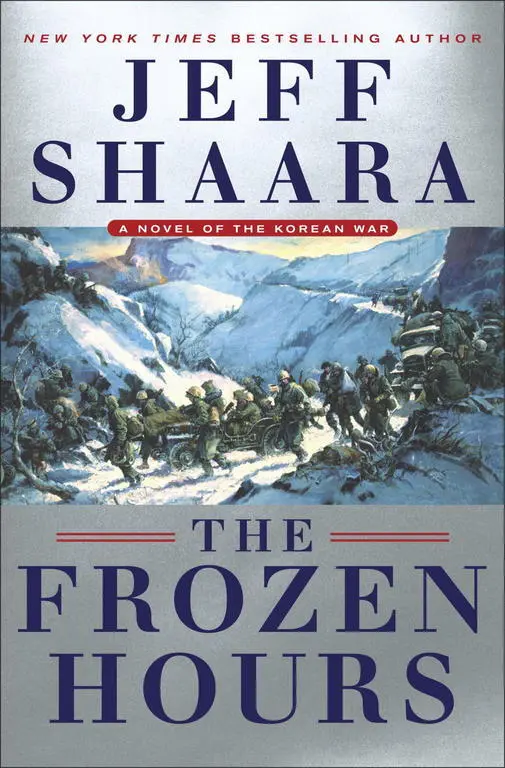
- Название:The Frozen Hours
- Автор:
- Издательство:Ballantine Books
- Жанр:
- Год:2017
- Город:New York
- ISBN:978-0-345-54922-8
- Рейтинг книги:3 / 5. Голосов: 1
-
Избранное:Добавить в избранное
- Отзывы:
-
Ваша оценка:
The Frozen Hours: краткое содержание, описание и аннотация
Предлагаем к чтению аннотацию, описание, краткое содержание или предисловие (зависит от того, что написал сам автор книги «The Frozen Hours»). Если вы не нашли необходимую информацию о книге — напишите в комментариях, мы постараемся отыскать её.
But several hundred thousand Chinese troops have entered Korea, laying massive traps for the Allies. In November 1950, the Chinese spring those traps. Allied forces, already battling stunningly cold weather, find themselves caught completely off guard as the Chinese advance around the Chosin Reservoir in North Korea. A force that once stood on the precipice of victory now finds itself on the brink of annihilation. Assured by General Douglas MacArthur that they would be home by Christmas, the soldiers and Marines fight for their lives against the most brutal weather conditions imaginable—and an enemy that outnumbers them more than six to one.
The Frozen Hours Written with the propulsive force Shaara brings to all his novels of combat and courage,
transports us to the critical moment in the history of America’s “Forgotten War,” when the fate of the Korean peninsula lay in the hands of a brave band of brothers battling both the elements and a determined, implacable foe.
The Frozen Hours — читать онлайн бесплатно полную книгу (весь текст) целиком
Ниже представлен текст книги, разбитый по страницам. Система сохранения места последней прочитанной страницы, позволяет с удобством читать онлайн бесплатно книгу «The Frozen Hours», без необходимости каждый раз заново искать на чём Вы остановились. Поставьте закладку, и сможете в любой момент перейти на страницу, на которой закончили чтение.
Интервал:
Закладка:
Madness.
Smith tried to erase the word, saw the government palace looming large in front of them. He rose up in the seat, could see a fleet of staff cars parked in a wide space, great black-and-green limousines transported from Tokyo. Around the parked cars stood guards in white gloves, crisp, clean army uniforms, also from Tokyo. The cars were a surprise, but the soldiers were there because Smith had not agreed with MacArthur’s request that the Marines furnish the manpower. It was one more instance of Smith standing up to Ned Almond, each time scraping a raw wound between them, what Smith knew could become a dangerous, career-ending feud. As the jeep drew closer to the wide compound, he could see the uniforms, starched and perfect, thought, Of course he’d dress them up for the occasion. I couldn’t have given him that, anyway. Where am I going to get white gloves out here?
There was a guard post at the entrance of the compound, a white-gloved MP stepping out with his hand raised, Puller’s driver braking the jeep to a halt. Smith could see that the man was a major, perfect uniform, shined black shoes. Puller rose up in his seat, said, “What the hell is this, Major?”
“Sorry, Colonel. Only official staff cars are allowed to enter the compound.”
“Major, my staff car’s in Japan. This is a combat zone. We don’t ride around on soft seats.”
“Sorry, sir. My orders said only staff cars. I can’t allow you to pass.”
Smith could feel Puller’s heat, said nothing, was wondering just what Puller would do. Puller said, “Listen, you oak tree. My boys captured this damn place. I don’t give a good goddamn what your orders are. Get the hell out of my way.”
“Sorry, Colonel. No entry today. My orders.”
Puller shouted to his driver, “Run him over!”
The jeep lurched ahead, Puller flopping down heavily on the seat, Smith pushed backward, nearly tumbling out of the jeep. The MP danced quickly aside, wide eyes, then began to follow, loud shouts. Smith watched the man until he gave up the chase, but Puller was still angry, looked back at Smith.
“We’ll stop on our way out, apologize to him, if you tell me to.”
Smith shook his head. “Nope. I’d have done the same thing you did.”
He knew that wasn’t true, saw the look on Puller’s face, that Puller knew better as well. Puller stabbed his pipe into his mouth, said to the driver, “Pull over there, Jones, behind that Cadillac. Maybe they’ll give you a parking ticket. That’ll be fun. You stay here, though. We might be in enough hot water already, and Private, you’re not dressed properly.”
“Thank you, sir.”
The man was clearly relieved to be left behind, and Smith thought, I wish I could join you. Puller slid out of the jeep, Smith and Craig behind him, and Craig said, “Colonel, maybe next time? Put your rank on the jeep.”
“Why? They make me wear this damn tin cap, they can see my bird quick enough.”
They walked past the grand cars, every one polished, some with whitewall tires, the guards seeming protective of their temporary posts. Puller said to Smith, “They have no idea what Marines look like. I’ll bet you don’t draw a single damn salute.”
They were inside quickly, and Smith felt very much out of place, Korean men in suits, a sea of perfect uniforms, nearly all of them army. He scanned the crowd, saw Almond, others, almost none of the army officers familiar. Except MacArthur.
He saw Murray now, with an aide, both men gravitating quickly toward Smith.
“Sir! Glad you made it. We seem to be the only Marines in attendance.”
Behind him, Smith heard a grunt from Puller, thought, Keep your head, Lewie.
At thirty-seven, Ray Murray was the youngest of Smith’s commanders, and as a lieutenant colonel, was outranked by both Puller and Litzenberg. But no one seemed concerned with the insignia on Murray’s shoulder. In World War II, he had earned a pair of Silver Stars and a Navy Cross, had as much combat experience as nearly any officer in Smith’s command. There were certainly no complaints how Murray had handled the Fifth Marines since they had come ashore at Inchon.
Smith scanned the crowd again, said, “We have seats for this thing, Ray?”
“Yes, sir. They’re starting to file into the assembly hall. I suppose we just follow the flow.” He acknowledged both Craig and Puller now, said, “Lewie, it’s been a tough couple of days.”
Puller grunted again.
“Your boys took Kimpo airfield in a blink. Damn fine work.” They followed the crowd into the hall, Smith in the lead. Behind him, he heard Puller again, a low voice to Murray. “I’ll be glad when we get this thing over with.”
Smith wasn’t sure what Puller meant, if he was more concerned with the liberation of Seoul, or what was about to happen right now.
“Gentlemen, if I may have your attention!” It was one of MacArthur’s aides, a booming voice from the stage. “Please be seated.”
They sat, the room growing quiet, and Craig leaned in close to him, said, “You don’t suppose he’s gonna start tossing out medals?”
“Shut up, Eddie.”
MacArthur rose to the stage now, and across from him, an old Korean, a slight curl to his back, the ravages of age. It was Syngman Rhee.
MacArthur spoke for a half hour, calling for prayer for the success of his men, for the liberation of the Korean capital, for the lives and well-being of every man in his command. During it all, Smith had detected what appeared to be tears streaming down MacArthur’s cheeks, a show of emotion that seemed oddly out of place. More than once he thought, This isn’t over yet. The city is still a very dangerous place. But still, the ceremony went on, MacArthur ending his remarks with the Lord’s Prayer, only to be followed by the United Nations representative, and a brief speech by the American ambassador, John Muccio. At last, Syngman Rhee took the stage, generous remarks of his own, concluding with the presentation of some kind of document for MacArthur, a gesture of gratitude that inspired another show of emotion.
Throughout the entire ceremony, the thumps of artillery fire punctuated the remarks, some of the impacts on buildings close enough that Smith could hear tumbling concrete. Many of the men in front of Smith reacted with nervous glances, quiet urgency in their hushed voices, Smith knowing that many of these men had never been under fire. By the end of the program, Smith was as eager as Puller and the others to leave, perhaps the only men in the room who understood that the job was still to be completed. It did not escape any of them that through all the talk, the official congratulations, the carefully orchestrated pomp, none of the speakers mentioned the Marines at all.
“I’ll be leaving for Tokyo in an hour. I’ve heard some uncomfortable reports, that things are dragging a bit. Let’s clean this up, shall we?”
MacArthur seemed distracted, scanned the departing crowd, a brief nod to a cluster of reporters waiting nearby.
Smith said, “We’re doing the best we can under the circumstances, sir. The enemy has a talent for defense, and my men are pushing through the city one house at a time.”
MacArthur seemed not to hear him, said, “Just get the job done. What did you think of our presentation? Quite a show.”
MacArthur had answered his own question, but Almond broke in, “Wonderful, sir. President Rhee is a wonderful man, most grateful to you for what we have accomplished here. Quite spry for such an old man.”
Almond’s words flowed like syrup, but Smith kept his eyes on MacArthur, tried not to show any reaction. MacArthur nodded slowly, seemed lost in thought for a moment, then said, “Seventy-five, he says. They nearly beat him to death in the war. Japanese tortured him. His hands are a mess. He loves us, of course, so we love him back. That’s how they think in Washington, you know. He hates Russians as much as we do, so we love him for it. We offer him bouquets and handshakes, those things that make congressmen and newspapermen so very happy.” He paused. “They know nothing of what I must do here. Nothing at all. And how they have doubted me!” MacArthur seemed to animate now, brought back to the moment. He looked hard at Smith. “They thought I was a fool. They thought we’d fall on our faces at Inchon.” He gestured toward the reporters waiting at the far end of the hall. “Now, look at them. Like schoolchildren, eager for today’s lesson. I shall give them one. They will listen, too. Write down every word. Not so those people in Washington. They do not understand what a war is, you know. To them, it’s budgeting and arguments over treaties. It’s why this country needs men in the field who know how to take command, who can make the decisions, all of the decisions.”
Читать дальшеИнтервал:
Закладка:
Похожие книги на «The Frozen Hours»
Представляем Вашему вниманию похожие книги на «The Frozen Hours» списком для выбора. Мы отобрали схожую по названию и смыслу литературу в надежде предоставить читателям больше вариантов отыскать новые, интересные, ещё непрочитанные произведения.



Обсуждение, отзывы о книге «The Frozen Hours» и просто собственные мнения читателей. Оставьте ваши комментарии, напишите, что Вы думаете о произведении, его смысле или главных героях. Укажите что конкретно понравилось, а что нет, и почему Вы так считаете.