Саймон Моуэр - Prague Spring
Здесь есть возможность читать онлайн «Саймон Моуэр - Prague Spring» весь текст электронной книги совершенно бесплатно (целиком полную версию без сокращений). В некоторых случаях можно слушать аудио, скачать через торрент в формате fb2 и присутствует краткое содержание. Город: London, Год выпуска: 2018, ISBN: 2018, Издательство: Little, Brown Book Group, Жанр: Историческая проза, на английском языке. Описание произведения, (предисловие) а так же отзывы посетителей доступны на портале библиотеки ЛибКат.
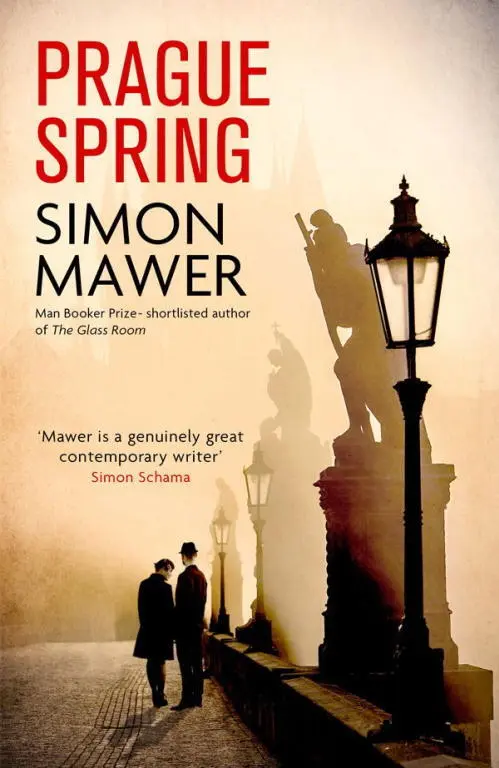
- Название:Prague Spring
- Автор:
- Издательство:Little, Brown Book Group
- Жанр:
- Год:2018
- Город:London
- ISBN:978-1-4087-1113-2
- Рейтинг книги:3 / 5. Голосов: 1
-
Избранное:Добавить в избранное
- Отзывы:
-
Ваша оценка:
Prague Spring: краткое содержание, описание и аннотация
Предлагаем к чтению аннотацию, описание, краткое содержание или предисловие (зависит от того, что написал сам автор книги «Prague Spring»). Если вы не нашли необходимую информацию о книге — напишите в комментариях, мы постараемся отыскать её.
In the summer of 1968, the year of Prague Spring with a Cold War winter, Oxford students James Borthwick and Eleanor Pike set out to hitchhike across Europe, complicating a budding friendship that could be something more. Having reached southern Germany, they decide on a whim to visit Czechoslovakia, where Alexander Dubček’s “socialism with a human face” is smiling on the world.
Meanwhile, Sam Wareham, First Secretary at the British embassy in Prague, observes developments in the country with a diplomat’s cynicism and a young man’s passion. In the company of Czech student Lenka Konečková, he finds a way into the world of Czechoslovak youth, with all its hopes and new ideas; now, nothing seems off-limits behind the Iron Curtain. But the great wheels of politics are grinding in the background; Soviet leader Leonid Brezhnev is making demands of Dubček, and the Red Army is massing on the borders.
This shrewd, engrossing, and sensual novel once again proves Simon Mawer is one of today’s most talented writers of historical spy fiction.
Prague Spring — читать онлайн бесплатно полную книгу (весь текст) целиком
Ниже представлен текст книги, разбитый по страницам. Система сохранения места последней прочитанной страницы, позволяет с удобством читать онлайн бесплатно книгу «Prague Spring», без необходимости каждый раз заново искать на чём Вы остановились. Поставьте закладку, и сможете в любой момент перейти на страницу, на которой закончили чтение.
Интервал:
Закладка:
‘The plot of July against Hitler,’ Horst explains.
‘My brother – Horst’s father – was brought before the Volksgerichtshof —’
‘— the Nazi People’s Court.’
‘And was sentenced to death. But he cheated them of that.’
Horst wears the expression of a mask – unwavering, as though his face were pressed out of papier-mâché and glued in place. ‘He hanged himself in his cell,’ he says. ‘I was six years old. My mother told me he had died in the war. It wasn’t until I was fourteen that I learned the truth.’
Frau Eckstein puts her knife and fork to rest as though to bring the discussion to a conclusion. ‘While Frau Weber clears the table, I think I will play something for you,’ she says, rising from her chair. Solemnly they follow her to the music room, like mourners going to view the deceased. One expects flowers round the coffin, relatives in black, guttering candles. Horst sits at the keyboard while Ellie and James take two chairs as instructed and wait in dutiful silence. Frau Eckstein hitches up her skirt and sits down, pulling the cello – the beloved Guadagnini – into the open embrace of her legs. Her nephew gives her a note on the piano and there is a moment of strange discord while she tunes her instrument. Then she settles. ‘Bach, of course,’ she announces. ‘The cello suite in C minor. The prelude.’
And she begins, making exact, articulate movements of hands and arm, like a craftsman assembling something out of intricate pieces of wood. But what emerges from this complex labour is not a thing but an ephemeral sound emanating from the body of the instrument like a human voice from the depths. The woman’s eyes are closed. Her head, her whole body, sways to the tempo of the music. It seems to James, who is entirely ignorant of these things, that she is drawing her bow across the raw, exposed surface of her nerves. And the whole room resonates to the cry.
When the piece comes to an end there is a silence louder than any of the extraneous sounds, louder than the shifting of a chair or the breathing of any of the listeners or the faint touch of her bow on the floor as she lays it down. She opens her eyes and looks at her audience. Ellie is in tears. ‘That was wonderful,’ she whispers, and it was, full of wonder even to James’s untutored ear.
‘How do you do that?’ He feels foolish as soon as the words are uttered, but the woman smiles kindly on him.
‘You know the Oxford joke about lawns? Professor Hubert told it to me when we were in your college: a tourist from America sees the lawn in an Oxford college and asks to the gardener how he can have a lawn like that. He would like one at his house back home. What is the secret? And the gardener says, well, you plants it and you waters it, and then you rolls it and you mows it for two hundred years…’
She does it quite well, even an attempt at the gardener’s accent. You rolls it and you mows it. They laugh.
‘So, it is almost like that with playing the instrument,’ she says. ‘Not two hundred years, of course, although this instrument itself has more than that, but many years and much playing. Every day for, perhaps, eight hours. It is not practice, it is study. Like you study the subject you do at university. Only for a lifetime.’
Attempting irony, James says, ‘That counts me out, then.’
‘You play no instrument?’
‘I fiddled about with the guitar for a bit. Strumming chords, not much more. R&B, pop, you know the kind of stuff.’
But she doesn’t really. She doesn’t know Rhythm and Blues. She knows of the Beatles – ‘some good harmonies’ – she knows about Elvis Presley. But not the Rolling Stones or the Animals or anything of that kind.
‘I think,’ Horst decides, clearly bored with the conversation, ‘that we go back to the dining room where Frau Weber has presented one of her excellent Apfelkuchen .’
And over the apple pie they talk of other things, of where Ellie and James are going, both in the next days and in life; and where Horst is going – into politics, as a member of the SPD and a devotee of its leader, Willy Brandt – although in the immediate future he is accompanying his aunt to Prague.
‘Prague?’
‘Tomorrow we are going.’
‘I have some master classes at the conservatoire,’ she explains. ‘And then a concert with the Czech Philharmonic Orchestra. It is something I have done for years now. This time it will be the Dvořák. Maybe’ – she smiles – ‘maybe it is always the Dvořák. But I will also play the Brahms Double Concerto with a young Russian violinist. The conductor will be Gennady Egorkin. Do you know Egorkin?’
‘By name,’ says Ellie.
‘He is celebrated,’ she says reprovingly, as though mere recognition of the name is not sufficient, ‘both for his conducting and his piano. One of the great musicians of our age. But he is known also for his – how do you say it? – outspokenness against the system. At the present time he cannot travel to the West, I believe, but to Czechoslovakia this is possible.’
‘Only yesterday we met some other musicians going to Prague,’ James says.
‘Who are these musicians? Perhaps I know them?’
‘I don’t think so. A group called the Ides of March.’
‘A chamber group?’
‘A rock group.’
Her face falls.
‘American,’ James explains. ‘Four of them. Long hair, Mexican moustaches, torn jeans. Guitars and drums.’
‘Oh.’ For a moment she looks downcast, but then she manages a glimpse of optimism. ‘Yet Prague is still a beautiful city, even with such people. One of the most beautiful cities in the world. And what is happening there now deserves our support, do you not think? Even the support of your Ides of March.’
Of course they agree. It is wonderful, really, the way the people are having their say. And how they are all behind Dubček and his allies. Even Ellie, who hasn’t yet worked out a way to brand the reformers as bourgeois lackeys of the capitalist world, agrees. Indeed, she waxes positively lyrical about Dubček’s socialists as she and James eat their strudel. Perhaps Czechoslovakia is showing the way to the future. Socialism with a human face. Isn’t that wonderful? An ideal. Something to believe in.
‘I don’t think so,’ says Frau Eckstein drily. ‘I think I have already seen too much of idealism and belief to have any faith in either.’
They leave the house into a night that has the chill of high places beneath a cloudless sky. The moon casts a bleak, monochrome light as they blow up their airbeds, lay out their sleeping bags and struggle to undress within the narrow confines of the tent. Ellie seems changed both by her confession in Strasbourg and by Frau Eckstein’s playing. There is something fragile about her, something tearful and dependent which is quite unlike the girl he thought he knew. They cling together like a couple adrift after a shipwreck. ‘Isn’t she wonderful?’ she says, speaking of Frau Eckstein. ‘Isn’t she just the most beautiful woman?’ Her head is nestled against his neck. For the first time ever, he feels that she has some kind of dependence on him.
‘You’re in love with her.’
She punches him lightly in the ribs. ‘With her music.’
‘It was all right.’
‘ All right ? The music was judging you, you weren’t judging the music.’
‘I said it was all right.’
‘It is not enough to find it all right. You’ve got to find it,’ she pauses, considering, ‘transcendent.’
‘I don’t even know what transcendent means.’
‘Uplifting. Outlifting. Is there such a word? Taking you out of yourself, out of the world. Transporting you out of the material world and into something beyond.’
Читать дальшеИнтервал:
Закладка:
Похожие книги на «Prague Spring»
Представляем Вашему вниманию похожие книги на «Prague Spring» списком для выбора. Мы отобрали схожую по названию и смыслу литературу в надежде предоставить читателям больше вариантов отыскать новые, интересные, ещё непрочитанные произведения.




Обсуждение, отзывы о книге «Prague Spring» и просто собственные мнения читателей. Оставьте ваши комментарии, напишите, что Вы думаете о произведении, его смысле или главных героях. Укажите что конкретно понравилось, а что нет, и почему Вы так считаете.