Саймон Моуэр - Prague Spring
Здесь есть возможность читать онлайн «Саймон Моуэр - Prague Spring» весь текст электронной книги совершенно бесплатно (целиком полную версию без сокращений). В некоторых случаях можно слушать аудио, скачать через торрент в формате fb2 и присутствует краткое содержание. Город: London, Год выпуска: 2018, ISBN: 2018, Издательство: Little, Brown Book Group, Жанр: Историческая проза, на английском языке. Описание произведения, (предисловие) а так же отзывы посетителей доступны на портале библиотеки ЛибКат.
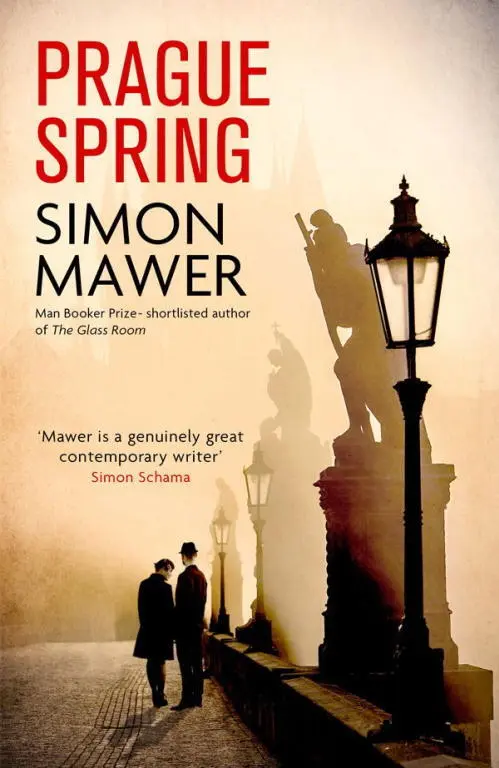
- Название:Prague Spring
- Автор:
- Издательство:Little, Brown Book Group
- Жанр:
- Год:2018
- Город:London
- ISBN:978-1-4087-1113-2
- Рейтинг книги:3 / 5. Голосов: 1
-
Избранное:Добавить в избранное
- Отзывы:
-
Ваша оценка:
Prague Spring: краткое содержание, описание и аннотация
Предлагаем к чтению аннотацию, описание, краткое содержание или предисловие (зависит от того, что написал сам автор книги «Prague Spring»). Если вы не нашли необходимую информацию о книге — напишите в комментариях, мы постараемся отыскать её.
In the summer of 1968, the year of Prague Spring with a Cold War winter, Oxford students James Borthwick and Eleanor Pike set out to hitchhike across Europe, complicating a budding friendship that could be something more. Having reached southern Germany, they decide on a whim to visit Czechoslovakia, where Alexander Dubček’s “socialism with a human face” is smiling on the world.
Meanwhile, Sam Wareham, First Secretary at the British embassy in Prague, observes developments in the country with a diplomat’s cynicism and a young man’s passion. In the company of Czech student Lenka Konečková, he finds a way into the world of Czechoslovak youth, with all its hopes and new ideas; now, nothing seems off-limits behind the Iron Curtain. But the great wheels of politics are grinding in the background; Soviet leader Leonid Brezhnev is making demands of Dubček, and the Red Army is massing on the borders.
This shrewd, engrossing, and sensual novel once again proves Simon Mawer is one of today’s most talented writers of historical spy fiction.
Prague Spring — читать онлайн бесплатно полную книгу (весь текст) целиком
Ниже представлен текст книги, разбитый по страницам. Система сохранения места последней прочитанной страницы, позволяет с удобством читать онлайн бесплатно книгу «Prague Spring», без необходимости каждый раз заново искать на чём Вы остановились. Поставьте закладку, и сможете в любой момент перейти на страницу, на которой закончили чтение.
Интервал:
Закладка:
Frau Eckstein almost apologises as they climb out of the car. ‘It is perhaps not as ancient as your Oxford colleges, but it is old, perhaps the oldest in this area. The sixteenth century. You may look if you wish.’
They dump their rucksacks on the edge of the lawn and follow the woman into her domain, feeling more and more like Hansel and Gretel in thrall to their captor. Inside there is the resinous scent of wood, the murmur of flexing floorboards, a sensation of quiet, considered age. They duck beneath beams and edge around posts. The stairs are like companionways, the floors like decking. The whole building creaks and shifts around them like a sailing ship under way through the tides of history. Occasional gaps between the floorboards give glimpses into the room below. ‘That does not make it a very private place,’ Frau Eckstein observes, laughing to signal the little pleasantry. ‘But the bathroom is at least of the twentieth century.’
And indeed, amongst all the woodwork, the bathroom gleams like a pathology lab. There is a white bath, and a bidet with its vague suggestion of sexual impropriety, and a shower cabinet that might be suitable for beaming you up to some orbiting star ship. But when they return to the ground floor it is to the pièce de résistance : the music room.
They stand at the door and peer in. The interior is redolent with beeswax. A grand piano stands at the centre like a coffin on a catafalque. Cellos, half a dozen cellos, some cased, some naked, gather round like solemn mourners. Photographs of the dead decorate the walls like saints in a chancel. One shows a balding, stout figure and is inscribed with a flourish de Birgit con cariño, Pablo . ‘Casals,’ Frau Eckstein remarks with a careless wave of one hand. Another frame encompasses the austere, aquiline face of Paul Tortelier. ‘We were very close,’ she explains, picking the picture up and gazing at it fondly. ‘At the conservatoire in Paris.’ She replaces it with loving care and indicates another, which shows a younger version of herself, rather stern, rather beautiful, sewn into a long, flared dress and standing beside a moustachioed man with piercing eyes. ‘Toscanini.’ And another – ‘Furtwängler’ – before she looks at Ellie and James with careful eyes, as though measuring them up for something, the cooking pot perhaps. ‘Do you enjoy the cello?’
‘I love the cello,’ Ellie says. ‘I saw Jacqueline du Pré playing the Elgar at the Royal Festival Hall. She was wonderful.’
The woman sighs, a fraction impatient. ‘Ah, Jackie, dear Jackie. Great talent but rather too much emotion, I fear. Emotion will always find you out in the end.’ She touches one of the instruments. ‘This is my Guadagnini. Perhaps I will play it for you after supper. Would you like that?’
Of course they would, even if, in James’s case, they really wouldn’t, because the whole stuff of classical music, the seriosity of it, the long gowns and stiff collars and tailcoats, bores him. Guadagnini? What the fuck does that mean?
‘But first you must make yourselves comfortable. You must pitch your tent, must you not? Before it gets dark. I am sorry I cannot offer you a room, but with Horst here, you see we have no place. It is not a big house. But it is a bit like being children again, no? Pitching your tent on the lawn, I mean.’
Ellie seems delighted at another little point of contact. ‘I used to do that with my brother!’
‘Of course you did. Everyone does.’ Which somehow makes it less remarkable. ‘And you must use the bathroom if you wish. This, I remember, is the bad thing of camping, that you often have no bathroom.’
So they pitch their tent in the dusk, keeping their voices low to avoid being overheard, giggling like children as they crawl around inside the tent and try to sort things out. What do they think of their hostess?
A sharp old witch.
Rather beautiful. A kindly witch.
Did you see her fingers? Lobster claws. All that cello-playing.
And what was that Gwadaninny business?
Guadagnini . The cello maker. Second only to Stradivarius. Don’t you know anything ? It’s probably worth hundreds of thousands.
Not as much as Horst, I’ll bet. Von Eberhafen , no less.
Prussian?
Nazi?
What was she doing during the war, do you think?
Playing to the troops, I suppose.
And Horst? Strutting around eastern Poland shooting Jews in the neck?
He’d only have been about ten.
Hitler Youth, then. Longing to get into action and shoot Jews in the neck.
They take turns to use the bathroom. The kindly witch has put out towels for them. ‘Make yourselves at home,’ she says, seeing James climbing the stairs. ‘Dinner will be ready in half an hour. Is that all right? Just come in and find us in the dining room.’
The dining room is on the opposite side of the hall from the music room, a wood-panelled cigar box of a space with a tiled stove in one corner and wall lamps that mimic gas lights. They sit at a polished slab of wood while a small, silent woman – ‘This is Frau Weber’ – brings food in from the kitchen. Conversation is awkward and incidental – how lovely the house, how beautiful the dining room, how fine the setting.
‘We had only gas lighting until after the war,’ Frau Eckstein explains, ‘but when my husband came back we decided to move finally into the twentieth century.’
Her husband? Suddenly there is a human shape amongst the inanimate shadows in the corners of the room. Where is her husband? And where has he returned from, with his ideas of finally joining the twentieth century?
‘Your husband?’ James asks.
‘My husband is not alive now. He was sent to the Eastern Front and the Russians took him prisoner. He did not come back until 1952 and then he was no longer’ – she pauses and considers carefully what words to use – ‘the same. Physically. So he did not live many more years. But at least he died in freedom.’
Horst reaches across the table and takes his aunt’s hand. In his precise, perfectly enunciated English, he explains. ‘Onkel Julius was a courageous man. A doctor of medicine of great learning who did not like the National Socialist ideas of science. That was why he was sent to the Russian front.’
‘But it was also why he survived being a prisoner,’ his aunt adds. ‘Because it was a skill that the Russians valued. So he survived in the camps as a doctor and at last he came home.’
There is a silence while they contemplate this, the kind of silence you wish someone would break. James offers himself up as a sacrificial lamb: ‘My father was in the army. During the war. The Royal Army Service Corps. RASC.’
‘I am sure he was also a brave man.’
‘I don’t know about that. They used to say Run Away Someone’s Coming.’
Frau Eckstein looks puzzled. ‘I do not understand. Did your father run away?’
Ellie giggles. Lamely, James explains. ‘Royal Army Service Corps, R-A-S-C. Run Away Someone’s Coming. It’s a joke.’
‘Ah, an English joke.’
‘Ironic English humour,’ Horst adds.
Frau Eckstein does not attempt a smile. ‘I expect he did his duty,’ she decides, ‘just as my husband did. That was all that most Germans wanted to do. The sadness is that now their courage cannot be acknowledged by the nation, only by their families and friends. Do you see what I mean? Great Britain can celebrate in public while we can only weep in private. Both my husband and my brother—’
‘That is, my father,’ said Horst.
‘— they died for what? A country that no longer even exists.’ She thinks for a moment, then looks as though she has made up her mind. ‘Do you know what my brother did? Of course you do not. How could you? My brother was a member of the so-called Kreisauer Kreis . How would you say that? The Kreisau Circle? This was a group which met to plan for a Germany after National Socialism, for when the country would be finished with the Hitler regime. They were arrested, many of them, after the…’ She hesitates. For the first time her otherwise impeccable English lets her down and she glances at her nephew for help. ‘ Das Attentat vom zwanzigsten Juli .’
Читать дальшеИнтервал:
Закладка:
Похожие книги на «Prague Spring»
Представляем Вашему вниманию похожие книги на «Prague Spring» списком для выбора. Мы отобрали схожую по названию и смыслу литературу в надежде предоставить читателям больше вариантов отыскать новые, интересные, ещё непрочитанные произведения.





Обсуждение, отзывы о книге «Prague Spring» и просто собственные мнения читателей. Оставьте ваши комментарии, напишите, что Вы думаете о произведении, его смысле или главных героях. Укажите что конкретно понравилось, а что нет, и почему Вы так считаете.