Саймон Моуэр - Prague Spring
Здесь есть возможность читать онлайн «Саймон Моуэр - Prague Spring» весь текст электронной книги совершенно бесплатно (целиком полную версию без сокращений). В некоторых случаях можно слушать аудио, скачать через торрент в формате fb2 и присутствует краткое содержание. Город: London, Год выпуска: 2018, ISBN: 2018, Издательство: Little, Brown Book Group, Жанр: Историческая проза, на английском языке. Описание произведения, (предисловие) а так же отзывы посетителей доступны на портале библиотеки ЛибКат.
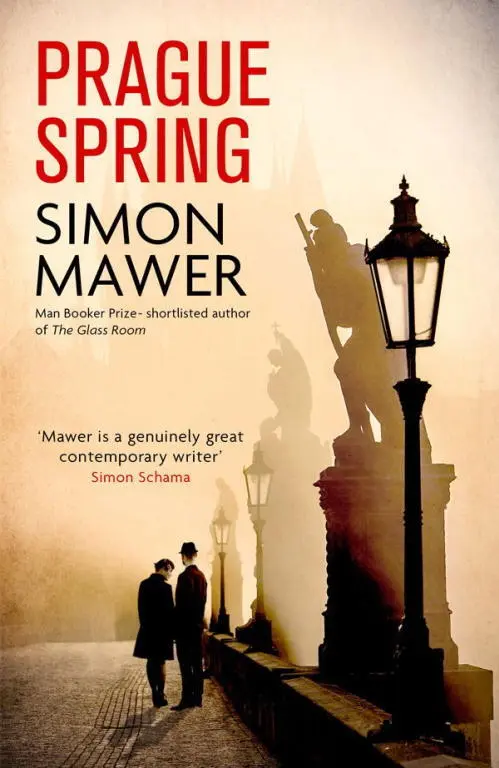
- Название:Prague Spring
- Автор:
- Издательство:Little, Brown Book Group
- Жанр:
- Год:2018
- Город:London
- ISBN:978-1-4087-1113-2
- Рейтинг книги:3 / 5. Голосов: 1
-
Избранное:Добавить в избранное
- Отзывы:
-
Ваша оценка:
Prague Spring: краткое содержание, описание и аннотация
Предлагаем к чтению аннотацию, описание, краткое содержание или предисловие (зависит от того, что написал сам автор книги «Prague Spring»). Если вы не нашли необходимую информацию о книге — напишите в комментариях, мы постараемся отыскать её.
In the summer of 1968, the year of Prague Spring with a Cold War winter, Oxford students James Borthwick and Eleanor Pike set out to hitchhike across Europe, complicating a budding friendship that could be something more. Having reached southern Germany, they decide on a whim to visit Czechoslovakia, where Alexander Dubček’s “socialism with a human face” is smiling on the world.
Meanwhile, Sam Wareham, First Secretary at the British embassy in Prague, observes developments in the country with a diplomat’s cynicism and a young man’s passion. In the company of Czech student Lenka Konečková, he finds a way into the world of Czechoslovak youth, with all its hopes and new ideas; now, nothing seems off-limits behind the Iron Curtain. But the great wheels of politics are grinding in the background; Soviet leader Leonid Brezhnev is making demands of Dubček, and the Red Army is massing on the borders.
This shrewd, engrossing, and sensual novel once again proves Simon Mawer is one of today’s most talented writers of historical spy fiction.
Prague Spring — читать онлайн бесплатно полную книгу (весь текст) целиком
Ниже представлен текст книги, разбитый по страницам. Система сохранения места последней прочитанной страницы, позволяет с удобством читать онлайн бесплатно книгу «Prague Spring», без необходимости каждый раз заново искать на чём Вы остановились. Поставьте закладку, и сможете в любой момент перейти на страницу, на которой закончили чтение.
Интервал:
Закладка:
‘Sounds posh.’
‘How could I help it?’ she asks, as though it had been some kind of indignity that her parents subjected her to.
They leave the tram at the end of the line and walk through the last, characterless suburbs. On the south side of the city, other hitchhikers stand like anglers on the banks of a river waiting for a bite. Some hold up cards with their intended destinations, as though these might attract their prey. James knows what to do here – walk upstream and take whatever is coming just to get away from the crowd. And soon enough Ellie lands a catch, a Peugeot driven by a young man in a grey suit who might be a travelling salesman. ‘Namur?’ he asks.
‘Namur ça va ,’ Ellie replies because it is okay; almost anywhere in the general direction of south is okay. They clamber in, triumphant, and set off. Dull, terrace houses, a supermarket and a filling station give way to farmland. A sign announces Waterloo and shortly a great mound rises like a Neolithic tumulus out of the farmland ahead. People are gathered at the summit beneath the statue of a lion. ‘You want to see?’ the driver asks.
He parks the car amongst the tourist coaches. There’s a memorial stone telling anyone who bothers to read that La Butte du Lion was constructed by some king or other to celebrate the fact that his son, Prince someone or other, was wounded during the battle.
‘Typical imperialist crap,’ Ellie decides. ‘No one gives a shit about the slaughter of common soldiers, but they built a bloody great monument like this because Prince William got knocked off his horse.’
‘You’re judging the past by the standards of the present.’
‘No, I’m not. I’m judging it by the standards of the Enlightenment and the French Revolution.’
‘So you’d bring the guillotine back?’
‘Some people deserve the guillotine.’
Arguing, they climb the steps up the side of the mound while people coming down push past. Up on the top, in the shadow of the pedestal, a cool breeze blows. An information board gives the layout of the battle. It is weather-beaten like the battlefield itself, the colours faded, the names – Napoleon, Wellington, Blücher and all the others – partly worn away. They look from the board to the landscape before them, to the shallow slopes of farmland that at the time meant such a lot. A mile deep and a couple of miles wide, that’s all; a few square miles of open fields and scattered woods, with an occasional farm. James tries to picture the chaos of an early nineteenth-century battle: drifting palls of musketry smoke; the scythe of canister shot; comic opera uniforms; horses plunging and whinnying. Europe tearing herself to pieces, as she always seems to do.
They go back down, arguing the merits and demerits of Napoleon. Was he a little Hitler? Or a great civiliser of Europe? Revolutionary or dictator? About Wellington Ellie has no doubt: duke, prime minister, reactionary bastard. He’d have gone to the guillotine, and deserved it.
The driver listens to their argument as they drive back to the main road. ‘Who gives a shit?’ he says.
13
Namur. Bastions, ramparts, the slippery flow of a great river. Beneath the city walls they stop to buy a newspaper and write postcards. James notices that Ellie’s postcard home is addressed solely to her father. A bleak missive: We’re fine. Hope Mother is OK. Love, Ellie. The newspaper runs stories about the war in Vietnam, about disturbances in France, about dictatorial colonels in Greece. A long editorial asks whether Russian forces will invade Czechoslovakia as they did twelve years ago in Hungary.
Beyond Namur the countryside changes. No longer the dull flats of Flanders but now a crumple in the continent’s mantle that gives rolling hills and woods. Their lift drops them in the main square of Marche, an ordinary little town where they find a brasserie with tables outside under the trees. They sit in the afternoon sun and drink dark, slightly sweet beer. The map shows that they have done almost one hundred and fifty miles.
After buying bread and charcuterie they set off in evening sunshine along the road to Bastogne. The countryside has a mellow, timeless quality to it, spacious and open, as though no one could do it any harm. Towards seven o’clock they stop at a farmhouse and Ellie is pushed towards the door to communicate with the natives. ‘ Bonsoir, Madame ,’ she says to the woman who answers her knock. ‘ On fait l’autostop vers l’Italie. S’il vous plaît, avez-vous un endroit où on peut mettre la tente? ’
The woman’s face is stolid as a potato. She turns and calls to someone inside.
‘What did you say?’ James asks.
‘Is there somewhere we can pitch a tent?’
The woman turns back. ‘ Une canadienne? ’
James is indignant. ‘Canadian? No! Je suis English. Anglais !’
This brings laughter. ‘Shut up, James,’ Ellie says. ‘ Oui, Madame. Seulement une canadienne. ’ There’s a brief discussion, a waving of arms and a pitying smile in James’s direction accompanied by laughter from the woman. At that moment a little girl emerges from the shadows of the house and, with great solemnity, leads them round the back. ‘ Voilà la cerisaie ,’ she announces in a piping voice, pointing beyond outhouses to where there’s an orchard, placid in the evening sunshine, the trees laden with fruit. Cherries. A cherry orchard.
Ellie dumps her rucksack on the ground. ‘How very literary,’ she says. ‘Or is that lost on you?’
‘Everything’s lost on me. What was all that about being Canadian?’
‘A canadienne is a tent, you berk.’
‘How the hell do you know that ?’
‘Camping,’ Ellie admits reluctantly. ‘With the Guides. We went to a jamboree in Vence in the south of France.’
‘You were a Girl Guide ? For fuck’s sake! And you told me all that crap about camping on the lawn with your brother.’
‘That was true. The tent on the lawn was true.’
‘But you never mentioned the Guides, or jamborees or anything like that. What were you? Brown Owl?’
‘That’s Brownies.’
‘It’s all the same. Bloody silly games. How does a Girl Guide light her fire?’ He dumps his rucksack beside hers and looks at her questioningly. ‘Well?’
‘I don’t know. How does a Girl Guide light her fire?’
‘She rubs against a Boy Scout.’
‘Ha ha.’
He unrolls the tent in the long grass beneath the trees: a strip of bright nylon with rings and cords and zips attached.
‘Orange,’ Ellie observes disparagingly, as though orange is a colour that has long been out of fashion in the tentage world. Naff, maybe.
James tosses a small bundle of aluminium poles onto it. ‘Go on then – show us how you do it.’
‘You think I can’t?’
‘Show me.’
In a few minutes, beneath the grave eyes of the little girl and with disconcerting skill, Ellie has the tent pitched. Cautiously she unzips the entrance and peers in. ‘Am I meant to get in there with you ?’
‘Wasn’t it like that with the Boy Scouts? You get inside the tent and they get inside you.’
‘Don’t be so crude. I didn’t sleep a wink on the bloody ferry, and now this.’
‘This is all right. You can sleep like a baby, in my arms.’ He pulls out his sleeping bag and unrolls it inside the tent. Called by the woman, the little girl has disappeared. They are left alone with their paltry meal and their tent. Fando and Lis. On the road to Tar.
‘We haven’t got anything to drink,’ Ellie complains.
James pulls two bottles of beer out of the side pocket of his rucksack. They have foil round the neck, like miniature champagne bottles. ‘Here you are. I got them on the ferry.’ He glances at the label. ‘Stella Artois. Never heard of it. Not the kind of thing a red-blooded Englishman would be happy with, but beggars can’t be boozers.’
Читать дальшеИнтервал:
Закладка:
Похожие книги на «Prague Spring»
Представляем Вашему вниманию похожие книги на «Prague Spring» списком для выбора. Мы отобрали схожую по названию и смыслу литературу в надежде предоставить читателям больше вариантов отыскать новые, интересные, ещё непрочитанные произведения.


Обсуждение, отзывы о книге «Prague Spring» и просто собственные мнения читателей. Оставьте ваши комментарии, напишите, что Вы думаете о произведении, его смысле или главных героях. Укажите что конкретно понравилось, а что нет, и почему Вы так считаете.