Саймон Моуэр - Prague Spring
Здесь есть возможность читать онлайн «Саймон Моуэр - Prague Spring» весь текст электронной книги совершенно бесплатно (целиком полную версию без сокращений). В некоторых случаях можно слушать аудио, скачать через торрент в формате fb2 и присутствует краткое содержание. Город: London, Год выпуска: 2018, ISBN: 2018, Издательство: Little, Brown Book Group, Жанр: Историческая проза, на английском языке. Описание произведения, (предисловие) а так же отзывы посетителей доступны на портале библиотеки ЛибКат.
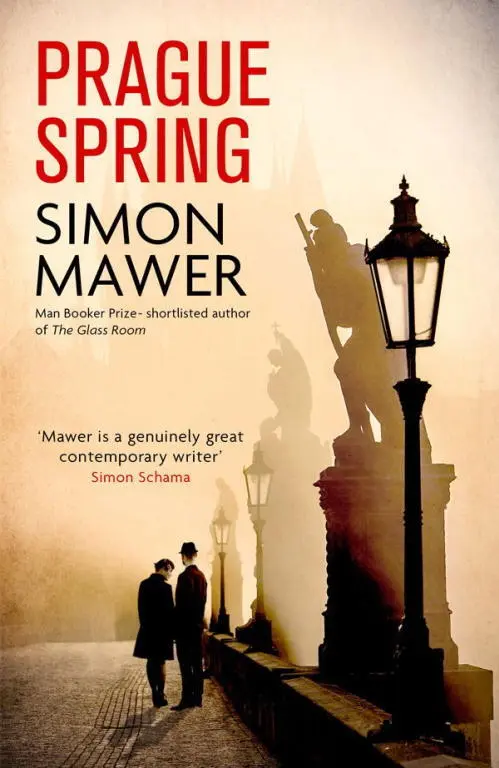
- Название:Prague Spring
- Автор:
- Издательство:Little, Brown Book Group
- Жанр:
- Год:2018
- Город:London
- ISBN:978-1-4087-1113-2
- Рейтинг книги:3 / 5. Голосов: 1
-
Избранное:Добавить в избранное
- Отзывы:
-
Ваша оценка:
Prague Spring: краткое содержание, описание и аннотация
Предлагаем к чтению аннотацию, описание, краткое содержание или предисловие (зависит от того, что написал сам автор книги «Prague Spring»). Если вы не нашли необходимую информацию о книге — напишите в комментариях, мы постараемся отыскать её.
In the summer of 1968, the year of Prague Spring with a Cold War winter, Oxford students James Borthwick and Eleanor Pike set out to hitchhike across Europe, complicating a budding friendship that could be something more. Having reached southern Germany, they decide on a whim to visit Czechoslovakia, where Alexander Dubček’s “socialism with a human face” is smiling on the world.
Meanwhile, Sam Wareham, First Secretary at the British embassy in Prague, observes developments in the country with a diplomat’s cynicism and a young man’s passion. In the company of Czech student Lenka Konečková, he finds a way into the world of Czechoslovak youth, with all its hopes and new ideas; now, nothing seems off-limits behind the Iron Curtain. But the great wheels of politics are grinding in the background; Soviet leader Leonid Brezhnev is making demands of Dubček, and the Red Army is massing on the borders.
This shrewd, engrossing, and sensual novel once again proves Simon Mawer is one of today’s most talented writers of historical spy fiction.
Prague Spring — читать онлайн бесплатно полную книгу (весь текст) целиком
Ниже представлен текст книги, разбитый по страницам. Система сохранения места последней прочитанной страницы, позволяет с удобством читать онлайн бесплатно книгу «Prague Spring», без необходимости каждый раз заново искать на чём Вы остановились. Поставьте закладку, и сможете в любой момент перейти на страницу, на которой закончили чтение.
Интервал:
Закладка:
We , he thinks. What exactly is this collective? Does it even exist outside the limits of this journey? And in the spirit of scientific exploration he decides to attempt to find out, turning towards her and taking that hand and ducking down to kiss her on the mouth. There is a moment’s hesitation, just the fragile touch of her lips, and then she moves towards him and her mouth opens and for a moment there is the vibrant dance of her tongue against his.
She pulls back and moves away, turning back to the sea, her face in profile.
‘What does that mean?’ he asks.
‘It doesn’t mean anything. It just is.’
‘Isn’t it a signifier?’ The word seems to startle her. Maybe he isn’t meant to know things like that.
‘What on earth have you been reading? Derrida?’
‘Some crap about semiotics.’
‘Well, if anything it’s a floating signifier. It means everything and nothing. What you want it to mean.’
‘I want it to mean you really fancy me.’
‘But maybe that’s not what it does mean.’ She laughs and gives him a little consoling nudge in the chest. ‘Come on, we’d better go inside and find somewhere to sleep.’
12
A Flemish dawn insinuates itself into the early morning. Ellie peers, bug-eyed from lack of sleep, through the salted window of the lounge. There’s a smear of sea and vague shapes of coastline and harbour. ‘Where in God’s name are we?’ she wonders out loud.
‘Zeebugger,’ says James. They take turns to guard their rucksacks while the other goes to wash in the overcrowded bathrooms. The ferry docks with a clanging of steel and a blast of ship’s siren.
Outside on deck the air is cold. It has a different quality from the air they left behind at Dover, a strange hint of foreign, a sense that they are on the edge of a continent that stretches to the Mediterranean, to the Urals, to Finisterre. No longer marooned on an island, encompassed by an island’s limitations. Here, anything is possible. But is that sensation just an illusion? After all, there’s nothing much to see, just the industrial desert of Zeebrugge that lies all around the docks like children’s toys abandoned across a concrete playground. Could be anywhere. Thames estuary. Merseyside. Tyneside.
Ellie huddles against him for warmth, which is good. He puts his arm around her and smells her hair. A warm, maternal scent that doesn’t quite match the girl herself, who is brittle and filial. Below deck engines are being started. On the quayside men are waving instructions. Foot passengers begin to file off the ferry like the infantry of an invading army, each trooper bowed beneath the burden of his or her backpack. All that is missing is the weaponry.
‘Foreign soil,’ James says portentously as he steps down off the gangway. Not really true. Foreign concrete, more like. ‘The first time,’ he adds.
‘The first —?’
‘— time abroad. That’s right.’
‘I don’t believe it—’
‘We ’aven’t all got t’brass you ’ave,’ he says, putting on his phoney Yorkshire accent to amuse her. They stump along a quay, past vehicles are already queuing to drive on once the ferry had been emptied.
‘Look,’ Ellie says pointing. ‘Ringo.’
‘Ringo?’
‘There.’ In the queue of cars is a VW Beetle bearing the name on the bonnet. A face watches them from the driver’s seat as they walk past. A pretty little girly face. Blonde and blue-eyed and rosebud-mouthed. ‘Ringo. For a Beetle. Now is that funny, or just naff?’
‘What’s naff?’
Ellie affects surprise. ‘Don’t you know anything? You are, my dear, you are. So where do we go now?’
‘South,’ he says, not caring if he is naff, feeling, for the moment, like Ernest Shackleton but without the icebergs – an explorer making his first, tentative steps in unexplored territory, although a slow plod through the purlieus of Zeebrugge, passed by overloaded cars bearing GB stickers on their rear ends, doesn’t quite match Antarctica.
‘Why’s no one stopping?’ Ellie demands petulantly.
‘Because they’re bloody full. Can’t you see? And they’re English, which means they’re on holiday, which means they’re not going to pick up hitchers in a foreign country.’
They pause to examine the map that they bought in Dover. ‘We’re here,’ he says, pointing. ‘And that’s where we want to be, at the Ostend to Brussels road.’
Ellie launches into a silly game, ratcheting up her accent to sound like an army officer in a 1950s war film, stabbing the map with a spiky finger. ‘We are he-are and Jerry is they-are.’
‘Piss off,’ he tells her. She sulks. He folds the map away and they plod on through the early morning, Ellie stumping on ahead as though she isn’t with him. He watches her, liking her and loathing her at the same time; a strange combination of emotions. Spoilt brat, is what he loathes. What he likes is more difficult to explain – something about the sharp flights of her mind, her knowledge and her self-confidence. On the ferry she told him something about the weeks she spent in Paris last May, sleeping on someone’s floor, going out during the daytime to throw cobblestones at the CRS and spending the evenings at a student bar with music and beer and hash. She was even arrested and spent a night in a police cell with half a dozen other girls. In the morning she was let go because she was British and they didn’t want the bother of dealing with the embassy. That Ellie seems like an emissary from another continent, far from Yorkshire, far from England even.
The countryside south of Zeebrugge is flat and dull, smeared with rain, named with Zs and Ks: Dudzele, Zuienkerke, and the hip Koolkerke. Only ‘Bruges’ is familiar. ‘Let’s go to Bruges,’ Ellie calls over her shoulder. ‘I’ve heard it’s lovely.’
‘I thought we were going to Italy. If we stop off at every place that—’
‘All right, all right.’
Cars pass by full of smiling families off on their continental hols, but the one that does stop isn’t one of them. The driver is on his own, an undistinguished man as grey as the morning. He winds the window down. ‘ Autostop ?’ he asks.
‘Er… no,’ James answers.
‘Yes!’ shouts Ellie, running back. ‘Yes! We’re doing autostop . Autostop means hitching, you idiot.’
‘I thought it meant our car had broken down.’
Gratefully they clamber into the car.
‘Where you go?’ the driver asks.
‘To Italy. And Greece.’
He laughs, as though Italy and Greece are figments of the imagination, like the land of Cockaigne. ‘I only go to Oostkamp. I drop you on the Brussels road. Maybe there someone take you to Italy.’
In the car they examine the map again, Ellie leaning over the front seat and reaching out to trace a line past Bruges, past Brussels towards Luxembourg and the Rhine. She looks up with a sudden grin, as though a single lift of no more than a few miles has made all the difference. Her face, rubbed plain by lack of sleep, is suddenly immensely desirable. Not a spoilt brat at all. ‘Hey,’ she says, looking at James with that intensity of gaze that she has, ‘we’re on our way. And you’re really not naff.’
Throughout that morning they move through the Flanders landscape, elated by their successes, stunned by tiredness, and, in James’s case, thrilled by the novelty: foreign road signs, foreign place names, foreign cafés and shops. Even the design of houses. How could you make something different out of a row of terrace houses constructed of bricks and mortar? Yet the Flemish had achieved that very thing.
On the outskirts of Brussels they take a tram with a conductor sitting behind a desk just inside the door, dealing out tickets with a mangled stump of a hand and complaining about life to anyone who will listen and many who won’t. Around them people talk in a blizzard of French, and, to James’s surprise, Ellie talks back at them. ‘Skiing holidays,’ she tells him by way of explanation. ‘And summers in Juan-les-Pins.’
Читать дальшеИнтервал:
Закладка:
Похожие книги на «Prague Spring»
Представляем Вашему вниманию похожие книги на «Prague Spring» списком для выбора. Мы отобрали схожую по названию и смыслу литературу в надежде предоставить читателям больше вариантов отыскать новые, интересные, ещё непрочитанные произведения.






Обсуждение, отзывы о книге «Prague Spring» и просто собственные мнения читателей. Оставьте ваши комментарии, напишите, что Вы думаете о произведении, его смысле или главных героях. Укажите что конкретно понравилось, а что нет, и почему Вы так считаете.