Derek Robinson - War Story
Здесь есть возможность читать онлайн «Derek Robinson - War Story» весь текст электронной книги совершенно бесплатно (целиком полную версию без сокращений). В некоторых случаях можно слушать аудио, скачать через торрент в формате fb2 и присутствует краткое содержание. Город: London, Год выпуска: 2011, ISBN: 2011, Издательство: Quercus, Жанр: Историческая проза, prose_military, на английском языке. Описание произведения, (предисловие) а так же отзывы посетителей доступны на портале библиотеки ЛибКат.
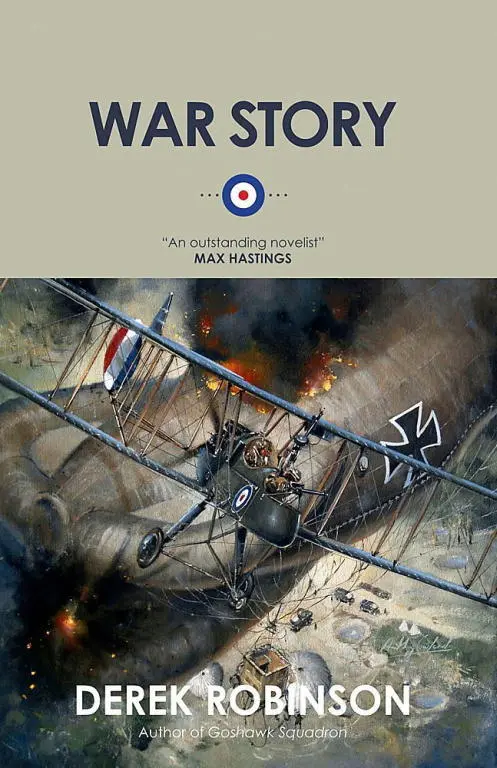
- Название:War Story
- Автор:
- Издательство:Quercus
- Жанр:
- Год:2011
- Город:London
- ISBN:978-0-857388-483-0
- Рейтинг книги:4 / 5. Голосов: 1
-
Избранное:Добавить в избранное
- Отзывы:
-
Ваша оценка:
War Story: краткое содержание, описание и аннотация
Предлагаем к чтению аннотацию, описание, краткое содержание или предисловие (зависит от того, что написал сам автор книги «War Story»). Если вы не нашли необходимую информацию о книге — напишите в комментариях, мы постараемся отыскать её.
Five days later, he crash-lands at his destination, having lost his map, his ballast and every single plane in his charge. To his C.O. he’s an idiot, to everyone else—especially the tormenting Australian who shares his billet—a pompous bastard.
This is 1916, the year of the Somme, giving Paxton precious little time to grow from innocent to veteran.
War Story — читать онлайн бесплатно полную книгу (весь текст) целиком
Ниже представлен текст книги, разбитый по страницам. Система сохранения места последней прочитанной страницы, позволяет с удобством читать онлайн бесплатно книгу «War Story», без необходимости каждый раз заново искать на чём Вы остановились. Поставьте закладку, и сможете в любой момент перейти на страницу, на которой закончили чтение.
Интервал:
Закладка:
“Indubitably.” Paxton nodded briskly.
Brazier looked at him, but Paxton had finished. Brazier made a note.
O’Neill said: “I saw a Hun about a mile away, Halberstadt I think, but I couldn’t catch it.”
“Indubitably.” Paxton nodded briskly. This time they both looked at him but he had nothing to add. Brazier made another note.
“Cruised around for a bit,” O’Neill said. “Saw a Hun much higher than me, Albatros maybe, couldn’t get up to him.”
“Indubitably.” Paxton nodded briskly.
“Sounds like the Hun’s come out to play at last,” Brazier remarked.
“One wonders,” Paxton said.
“Then a bit later, I saw a Hun below me,” O’Neill said. “Looked too much like a decoy. Left it alone.”
“Indubitably.” Paxton nodded briskly.
“And besides I was getting low on fuel.”
Paxton said nothing. Brazier looked at him. “Forgotten your lines?” he asked.
“Oh, indubitably,” Paxton said, and nodded slowly.
“I take it you didn’t open fire,” Brazier said.
“No risk of that,” Paxton said. He gave the adjutant a sly smile and took O’Neill’s arm. “Come along, old chap,” he said. “I’ll get you a nice cup of cocoa.”
O’Neill shook him off. “Not much archie,” he told Brazier. “Cloud was too thick.”
“Indubitably,” Paxton said.
They were halfway back to the billet when Paxton noticed that O’Neill was not whistling. Paxton began whistling a tearaway version of Jesu, Joy of Man’s Desiring. To his surprise O’Neill joined in. He whistled a different part of the melody and did it as badly as ever. Thus they were both whistling, after a fashion, as they entered the hut.
Kellaway was writing a letter. “Isn’t it great?” he said. “Dando just told me I can fly again. He says my head’s in pukka shape. At least I think it was Dando.” He frowned.
“You’ll enjoy flying,” Paxton said. “It’s so relaxing. I’ve nearly finished reading Treasure Island.”
“He was so relaxed he nearly finished breathing,” O’Neill said.
“Every time I looked up there was a different Hun,” Paxton told Kellaway. “First I saw a big blue one, but he didn’t fancy the colour. Then I saw a red one, but it was the wrong shape. Then I saw a very pretty speckled one, but it must have been going in the wrong direction or something. Anyhow, it didn’t suit him. He’s hard to please. Fussy.”
“It was Dando,” Kellaway said. “I wrote his name down.”
O’Neill was cleaning his nails with a penknife. “He thinks the Huns line up to be shot down. He’s a fairy in a fairy tale.”
“Very, very fussy,” Paxton said. “He must have been spoiled rotten when he was a kid, don’t you think?”
“There’s a rumour going around about a Russian squadron just landed at St. Omer,” Kellaway said. “D’you believe it?”
“Indubitably,” Paxton said.
“Keep that up and I’ll give you my fist to suck,” O’Neill said. He took his towel and went out.
“What’s wrong with him?” Kellaway asked.
“He’s got the runs. He was certainly running hard today.”
“They must be Russians because they smell of vodka,” Kellaway said. “That’s what I heard. D’you think they’ll come here?”
“Only if they want to be bored to death.”
Next day the weather was perfect and all flying orders were cancelled. Instead, Colonel Bliss came down from Brigade HQ to speak to the squadron.
The battle for Verdun, he said, was fizzling out. Frankly, it was a shambles down there, more bodies than either side could count. The French urgently wanted a British attack, pronto, to take the remaining pressure off Verdun before the frog troops started to mutiny.
So the Royal Flying Corps had two new jobs. We had to keep the German Air Force pinned down behind their own Lines so they couldn’t snoop on our preparations. This squadron (and many others) could expect to fly a lot of Deep Offensive Patrols in future – five, ten, fifteen miles beyond the trenches. We were going to show the Hun who was boss.
Bliss saw some long faces in his audience, and he hurried on. The other job, he said, was trench-strafing. When the British infantry went over the top, the Flying Corps would go with them, harrying the Hun from his hole. Obviously this called for expert low-level flying, so the Corps Commander had had a dummy stretch of Hun trenches dug, with plenty of smoke and bangs to make everything thoroughly realistic. Hornet Squadron would practise there this afternoon.
Bliss offered his congratulations on recent kills, and Cleve-Cutler led him away to his office for a drink.
“Fifteen sodding miles,” Goss said. “That’s deeply offensive all right.”
“It’s too far,” Mayo said.
“It’s safer than being over the Front,” Piggott told them. “Much less archie.”
“It’s halfway to bloody Berlin! What if something goes wrong?”
“Don’t worry,” Goss said. “The wind will blow you the rest of the way.” That brought laughter, but it was brief and nervous. The prevailing west wind was no joke. Almost every patrol over the enemy lines ended up having to labour home into a headwind. Hun patrols, on the other hand, got blown home. It was a swindle.
“I don’t know what you’re bitching about,” Gerrish said. “You might as well complain about falling into twenty feet of water instead of ten feet, or five. You get just as wet, either way.”
“Come off it, Plug,” Mayo said. “Fifteen miles with a dicky engine? Losing height? Huns taking turns to polish you off? That’s a long trudge, that is. No thanks.”
“Orders is orders,” Ogilvy said.
“I can’t count up to fifteen,” Mayo said.
“That’s funny, I can’t get up to ten,” Goss said.
“I meant ten,” Mayo said. “Come to think of it, I meant five.”
Gerrish was not amused. He said: “The last squadron I was in, we had a pilot who didn’t go where he was sent. Next time, his flight commander flew behind him with his finger on the trigger.”
“The adj would approve of that,” Ogilvy said.
Paxton said: “Did he pull the trigger?”
Gerrish turned and stared. “None of your damned business,” he said.
Paxton stared back. Gerrish’s anger had made him angry, and he enjoyed the sensation. “Just trying to improve my mind,” he said.
“I went to Cambridge, you know,” Charlie Essex said. “I can count up to five with one hand tied behind my back.”
They played cricket until lunch, and then killed time with cards and newspapers, waiting for orders. At three o’clock the trench-strafing exercise was cancelled. “It seems that some bright spark thought it would be a good idea if the trench were under actual artillery fire while strafing took place,” Cleve-Cutler told them. “Two aeroplanes got badly damaged by shrapnel or blast, and one got blown to bits, before they decided it was a bit too realistic.”
“How can they be so stupid?” Piggott demanded.
“Centuries of practice, old boy,” Cleve-Cutler said.
The adjutant disapproved of Foster’s bell-tent and of the noises that came from it, and he told Cleve-Cutler so. “I don’t care what school he went to,” Brazier said,”he’s not entitled to behave like a gypsy. The men won’t respect him for it. No respect means no discipline.”
“He’s still a very good flight commander. That hasn’t changed.”
“Something’s changed. I remember once I had a chap in Madras who suddenly dyed his hair green and said his mother was the Queen of Sheba. Thoroughly competent officer, but he had to go.”
Cleve-Cutler shook his head. “Pilots are different. In my last squadron we had a brilliant pilot, but when he wasn’t flying he was the most feckless brat you could imagine. His idea of fun was to go for a walk and throw stones at people.”
Читать дальшеИнтервал:
Закладка:
Похожие книги на «War Story»
Представляем Вашему вниманию похожие книги на «War Story» списком для выбора. Мы отобрали схожую по названию и смыслу литературу в надежде предоставить читателям больше вариантов отыскать новые, интересные, ещё непрочитанные произведения.




Обсуждение, отзывы о книге «War Story» и просто собственные мнения читателей. Оставьте ваши комментарии, напишите, что Вы думаете о произведении, его смысле или главных героях. Укажите что конкретно понравилось, а что нет, и почему Вы так считаете.