Derek Robinson - A Splendid Little War
Здесь есть возможность читать онлайн «Derek Robinson - A Splendid Little War» весь текст электронной книги совершенно бесплатно (целиком полную версию без сокращений). В некоторых случаях можно слушать аудио, скачать через торрент в формате fb2 и присутствует краткое содержание. Город: London, Год выпуска: 2013, ISBN: 2013, Издательство: MacLehose Press, Жанр: Историческая проза, prose_military, на английском языке. Описание произведения, (предисловие) а так же отзывы посетителей доступны на портале библиотеки ЛибКат.
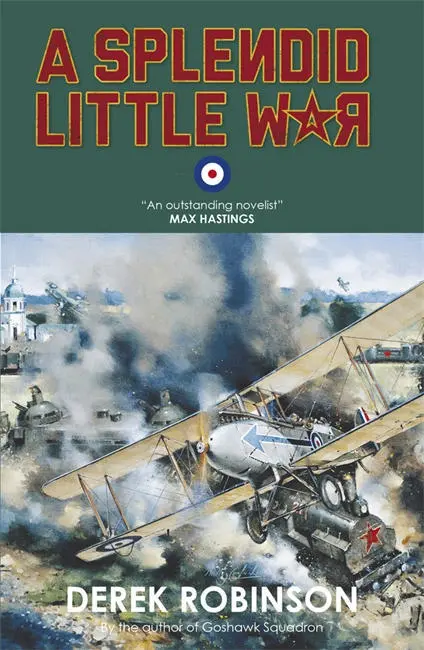
- Название:A Splendid Little War
- Автор:
- Издательство:MacLehose Press
- Жанр:
- Год:2013
- Город:London
- ISBN:978-0-85705-229-2
- Рейтинг книги:4 / 5. Голосов: 1
-
Избранное:Добавить в избранное
- Отзывы:
-
Ваша оценка:
A Splendid Little War: краткое содержание, описание и аннотация
Предлагаем к чтению аннотацию, описание, краткое содержание или предисловие (зависит от того, что написал сам автор книги «A Splendid Little War»). Если вы не нашли необходимую информацию о книге — напишите в комментариях, мы постараемся отыскать её.
By 1919, White Russians were fighting the Bolsheviks (Reds) for control of their country, and Winston Churchill (then Minister for War) wanted to see Communism ‘strangled in its cradle’. So a volunteer R.A.F. squadron, flying Sopwith Camels and DH9 bombers, went there to duff up the Reds. ‘There’s a splendid little war going on,’ a British staff officer told them. ‘You’ll like it.’ Looked like fun.
But the war was neither splendid nor little. It was big and it was brutal, a grim conflict of attrition, marked by cruelty, betrayal and corruption. Before it ended, the squadron wished that both sides would lose. If that was a joke, nobody was laughing.
“A Splendid Little War” tests the pilots’ gallows humour in a world of armoured trains and elegant barons, gruesome religious sects and anarchist guerrillas, unreliable allies and pitiless enemies. The comedy of this war, if it exists, is very bleak. Derek Robinson is at once our finest living comic novelist and a master of military fiction. Biggles was never like this.
A Splendid Little War — читать онлайн бесплатно полную книгу (весь текст) целиком
Ниже представлен текст книги, разбитый по страницам. Система сохранения места последней прочитанной страницы, позволяет с удобством читать онлайн бесплатно книгу «A Splendid Little War», без необходимости каждый раз заново искать на чём Вы остановились. Поставьте закладку, и сможете в любой момент перейти на страницу, на которой закончили чтение.
Интервал:
Закладка:
“It’s worse than influenza,” she said. “And no cure in sight.”
The new identification plates got two cheers. The trains still had to wait in sidings, but less frequently. There were detours around track repairs. Still, their average speed was much better. By nightfall they were in Kupyansk; by noon next day they entered Kharkov. Four hundred kilometres from Taganrog, the drivers said. Very good indeed.
Parts of the city were still burning, but Denikin’s armies had already gone ahead, advancing fast, aiming for Kursk, only 240 kilometres to the north. Once they took Kursk they would be halfway to Moscow.
Tsaritsyn had been a sideshow; this was the real war. The squadron had been trundling along on these trains for over a week, while the Bolos were going backwards at a rate of knots. Everyone wanted to clobber them while the clobbering was good. Wragge pressed on.
An hour out of Kharkov progress fell to a walking pace. The track had been damaged; repair gangs were at work; all traffic was switched to one line. Even at walking pace the trains swayed and jolted. Soon they had a good view of an armoured train lying drunkenly half off the tracks. The locomotive had one giant rosette of a shell-hole in its boiler and much of the train was burnt-out. No fire could destroy the gun barrels and they made a show of pointing everywhere. “Ours or theirs?” Brazier asked.
“Probably theirs,” Borodin said. “I think I see the remains of half a red star.”
“The whole thing took a pounding.”
“My guess is a lucky shot wrecked the engine. They didn’t want us to capture the train, so they blew it up. Then they destroyed a length of track to slow down our pursuit. Standard tactics.”
They limped past the end of the wreck. The footnotes of battle lay all around: broken artillery pieces; the mounds of fresh graves, some with makeshift wooden crosses, most without; wagons that had shed their wheels but kept their dead horses between the shafts. There were plenty of dead horses, very visible with their black and bloated bodies. A haze of flies hovered around each horse.
“It’s always the same,” Borodin said. “You can smell a battlefield from miles away by the rotting horseflesh.”
Brazier didn’t care. It would take a regiment a month to dig enough holes to bury these horses. What interested him was the why and the how of war. “This was a minor rearguard action,” he said. “The Reds tried to make a stand and failed. Not strong enough.”
“That’s the curse of being on the retreat. Never enough of anything. Soldiers on the run throw their rifles away. I’ve seen it happen.”
“Men will stand and fight if you shoot a few. I saw that happen, too.”
Wragge joined them. “We’re being watched,” he said. He handed Brazier a pair of binoculars and pointed overhead. The adjutant opened a window and searched. He grunted and gave them to Borodin. “Too much dazzle for my old eyes,” he said.
“He’s been wandering around up there for fifteen minutes,” Wragge said. “If he’s one of ours, what’s his game? And if he’s not, it’s bad news.”
“Too high to identify,” Borodin said. “But he’s obviously snooping.”
“If we get strafed we could be wiped out. Can you pass word to the driver? First good siding he sees, pull in. Let’s get the machines off the trains. It’s time you learned how to fly a Camel. There’s a spare you can have. Practise first. It’s a tricky little beast.”
“Thanks awfully,” Borodin said.
The battlefield had been left far behind by the time they rolled into a siding. The grassland alongside it was level enough to make an airfield, once a few anthills had been flattened. The ground crews began unloading the aeroplanes. Lacey rigged his aerials. “Find where Denikin’s mob is,” Wragge said. “Tell them we’re here. Where’s the war? Find anything .”
The watchful high-flying aeroplane had gone. Chef was serving tea. Kid, the mascot, found a patch of giant buttercups and enjoyed some real food at last. The trains would not be moving again today. The afternoon was perfect for a walk, sun sinking, not too hot, and the countryside was inviting. There were gentle hills, patches of woodland, probably a river. The train had passed a meandering stream, just the sort of thing, Dextry said, he had swum in as a boy in County Cork. Maynard said the countryside reminded him of Dorset. Jessop said it resembled parts of Buckinghamshire. Borodin said it looked a lot like Russia. They set off.
“I can see smoke,” Jessop said. “Smoke means a farm. For a cake of soap they’ll give us a pound of butter.”
“Unusual,” Borodin said. “A farmhouse doesn’t need a big fire in this weather.”
“Maybe they’re smoking a ham. Butter and ham. Yummy,”
Maynard broke into a trot and bowled an imaginary ball, a good length, just clipping the off stump. “Run the mower over this lot,” he said. “Get the heavy roller on the batting strip. You’ve got a decent cricket pitch.”
“Too decent for Russians, I’m afraid,” Borodin said. “We like a sport where you can cheat.”
“Decent cricket’s had its day,” Jessop said. “ Indecent cricket, that’s the answer. Men and women, stark naked. Mixed teams. Yum-yum.”
“Better yet, forget the cricket altogether,” Dextry said. “Naked leapfrog.”
Maynard changed the subject. “I hear you’re our new flight leader.”
“Am I?” Dextry said. “Excellent choice. I’m the best-looking.”
“If you’re leading, we’re totally lost,” Jessop said.
“Never mind, Junk. It’s like Pass The Parcel in this squadron. You’re next.”
It was a pleasant stroll. The meadows were lush and sprinkled with wildflowers. They found the river, startled a heron, and watched its heavy wings beat slowly until it curved out of sight behind a tree.
“Reminds me of an FE2b,” Jessop said. “Pusher propeller, slow as treacle, lovely view of Huns licking their lips.”
“I crashed mine,” Dextry said. “Best thing I ever did for the Corps.” The conversation developed into a search for the worst aeroplane of the war, on either side. The river turned away and they walked on, aiming for the smoke, and angered a dozen crows, which rose in a black rage. They had been feeding on the carcase of a cow. The horns said it had to be a cow. There was little else left.
“Sloppy farming,” Maynard said. “Dead stock shouldn’t be left lying.”
They moved on, and maddened four more gangs of crows working over four more carcases.
“This is worse than sloppy,” Dextry said. “It’s bizarre.”
By now they were in sight of the smoke, and it wasn’t a farm: it was a village. “I don’t recommend going in,” Borodin said. “There’s nothing for us here.”
“We’ve come this far,” Dextry said. They went on.
It had been a typical Russian village, squat and unexciting, and now most of it was in ruins, destroyed by the fire that was still smoking. The airmen soon stopped looking: one body was much like another, slashed or battered or burnt.
“They’re all dead,” Maynard said.
“Not all,” Borodin said. “Stay here.”
A man was watching them. His skin and clothes were so dirty that he almost blended in with the blackened ruins. He was thin and frightened, ready to run. Borodin stopped when he was twenty feet away; they had a conversation. Borodin came back.
“He was at the river, fishing, when Nestor Makhno’s men came and took all the food. That was a week ago, maybe two. He can’t be sure. They killed a few old people for no reason. Just practising their anarchy. Later the Red Army came, hungry and angry of course. No food. Killed half the village. Then Denikin’s Whites came, like the Reds, looking for food. This chap hid in the woods. They killed the other half and burned the village. Who exactly slaughtered the cattle, nobody knows and it doesn’t matter now.”
Читать дальшеИнтервал:
Закладка:
Похожие книги на «A Splendid Little War»
Представляем Вашему вниманию похожие книги на «A Splendid Little War» списком для выбора. Мы отобрали схожую по названию и смыслу литературу в надежде предоставить читателям больше вариантов отыскать новые, интересные, ещё непрочитанные произведения.





Обсуждение, отзывы о книге «A Splendid Little War» и просто собственные мнения читателей. Оставьте ваши комментарии, напишите, что Вы думаете о произведении, его смысле или главных героях. Укажите что конкретно понравилось, а что нет, и почему Вы так считаете.