Louisa Hall - Trinity
Здесь есть возможность читать онлайн «Louisa Hall - Trinity» весь текст электронной книги совершенно бесплатно (целиком полную версию без сокращений). В некоторых случаях можно слушать аудио, скачать через торрент в формате fb2 и присутствует краткое содержание. Город: New York, Год выпуска: 2018, ISBN: 2018, Издательство: Ecco, Жанр: Историческая проза, на английском языке. Описание произведения, (предисловие) а так же отзывы посетителей доступны на портале библиотеки ЛибКат.
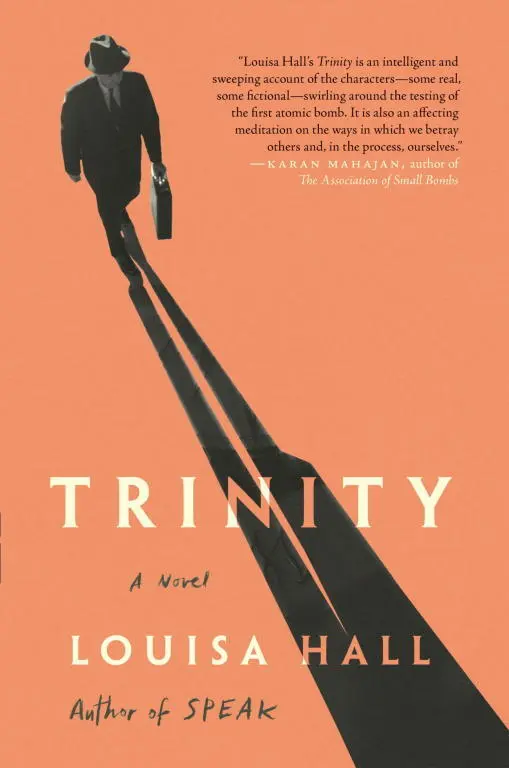
- Название:Trinity
- Автор:
- Издательство:Ecco
- Жанр:
- Год:2018
- Город:New York
- ISBN:978-0-06-285196-3
- Рейтинг книги:4 / 5. Голосов: 1
-
Избранное:Добавить в избранное
- Отзывы:
-
Ваша оценка:
Trinity: краткое содержание, описание и аннотация
Предлагаем к чтению аннотацию, описание, краткое содержание или предисловие (зависит от того, что написал сам автор книги «Trinity»). Если вы не нашли необходимую информацию о книге — напишите в комментариях, мы постараемся отыскать её.
J. Robert Oppenheimer was a brilliant scientist, a champion of liberal causes, and a complex and often contradictory character. He loyally protected his Communist friends, only to later betray them under questioning. He repeatedly lied about love affairs. And he defended the use of the atomic bomb he helped create, before ultimately lobbying against nuclear proliferation.
Through narratives that cross time and space, a set of characters bears witness to the life of Oppenheimer, from a secret service agent who tailed him in San Francisco, to the young lover of a colleague in Los Alamos, to a woman fleeing McCarthyism who knew him on St. John. As these men and women fall into the orbit of a brilliant but mercurial mind at work, all consider his complicated legacy while also uncovering deep and often unsettling truths about their own lives.
In this stunning, elliptical novel, Louisa Hall has crafted a breathtaking and explosive story about the ability of the human mind to believe what it wants, about public and private tragedy, and about power and guilt. Blending science with literature and fiction with biography, Trinity asks searing questions about what it means to truly know someone, and about the secrets we keep from the world and from ourselves.
Trinity — читать онлайн бесплатно полную книгу (весь текст) целиком
Ниже представлен текст книги, разбитый по страницам. Система сохранения места последней прочитанной страницы, позволяет с удобством читать онлайн бесплатно книгу «Trinity», без необходимости каждый раз заново искать на чём Вы остановились. Поставьте закладку, и сможете в любой момент перейти на страницу, на которой закончили чтение.
Интервал:
Закладка:
By then, more and more of our friends had been fired. And Alice wanted to hold on to that job, so we had no choice but to learn how to eat dinner like friends. We learned to never walk home together. We learned not to touch each other so often.
By then she was drinking so much her hands trembled when she held the paintbrush, but I was so preoccupied with my own anger that I didn’t think to take her away. If I hadn’t been so concerned with myself, I could have flown her down to Rio. I could have shown her the beach. I could have pointed out the billboard over my parents’ apartment, with the black woman cooking alongside her white lover, two women smiling so brightly you knew they’d use that juicer forever.
But we didn’t go. And Alice stopped painting, and then she felt so dull she started taking the train up to New York, where she could surround herself with old students and remember why they admired her.
Or that’s the kind of reasoning I’d kick into gear if I ever got tired of walking. So then I’d get up from the rock. I’d move uphill, toward the blazing blue sky. I knew what was behind me. Somewhere in the depths of the valleys, under the canopies of the banana leaves, streams were babbling away. Wet black snakes were drawing signs in the mud of the stream banks, and ground doves in the thick ferns were murmuring innuendo.
I climbed up to the tops of the hills. I kept to the exposed parts of the island, the hillsides cleared to grow crops. Sometimes, I came across the ruins of the old sugar plantations. Hawks circled in the sky overhead, their shadows crossing the foundations of fallen plantation houses.
But I kept my eyes angled up. I tried not to think. And when I was too tired to walk anymore, I’d head back toward the hotel. Then I’d keep my eyes on the path until I’d reached the clipped hotel garden grounds, where the banana trees had been chopped down and the overgrowth had been contained, and every day the gardener was out mowing the lawn, or spraying the bougainvillea that cascaded over the walls, or lying on his back underneath the enormous king-sized agaves, pruning them down, lopping off big blue-green succulent fins and throwing them behind him onto a tarp heavy with the corpses of dolphins.
I WASN’T SURE ALICE AND I WOULD LAST THROUGH THAT SUMMER.
For weeks on end, she kept painting that dying plant, and I kept the sound of my footsteps in my ears, trying not to think about how I’d feel if she left.
Then one day I came back to the hotel and they’d pulled in the potted palms and rolled down the tin shutters over the windows.
For a moment I thought they’d decided to pack up the whole place, as though the hotel were a movie set they’d decided to strike, but then I realized we’d lasted the summer.
Somehow we’d made it to hurricane season. Then there was some comfort in the fact that the weather finally matched the mood Alice had been trying to hide. It almost seemed as though now, finally, we were approaching that time when everything would be out in the open.
For weeks, the sky was dark as a bruise, and I waited for the hammer to drop. The ocean was whitecapped and restless, and then Alice gave up that painting she’d been failing at all summer long.
A day later, the plant died. I put it in the corridor and someone took it away.
Then Alice started spending more time in bed. I tried not to hover. In that weather, I couldn’t go out for walks in the hills, so sometimes I’d pace up and down the corridors of the hotel. Sometimes I went by myself to have a drink at the bar. I was reading a history of the island, and I’d sit by myself in the dim light of one of those little red lamps and read about the slave revolt.
After a bad drought and a worse hurricane season, Akwamu slaves began to escape and go into hiding. In November they emerged and took over the island, killing scores of Danish plantation owners.
For a few months, it was the first slave revolt in the New World that succeeded. They were free until the following spring, when the Danes who escaped came back to the island with reinforcements from Martinique.
Seeing armed ships arriving in scores, many of the freed slaves shot themselves with the same guns they’d used to revolt. When the Danes stormed the island, they found dozens of dead former slaves. Those who hadn’t killed themselves went into hiding, but by August, the militia had hunted them all down and killed them.
The slave trade continued for another hundred years after that. In 1848, the remaining slaves were finally set free. In the 1920s, the United States bought the island, and now the descendants of the freed slaves worked as gardeners, or clerks, or played in the scratchy band the hotel sometimes hired to keep us entertained through long afternoons while the tin shutters were rolled over the windows.
DURING THE FIRST REALLY VIOLENT STORM, A DOG FOUND ITS WAYto the hotel. He dragged his shivering gray body behind a potted palm and huddled there until the manager ordered the clerk to drive him back out. Two gardeners were pulling him over the marble when Alice happened to walk out of the restaurant.
She brought him up to the room. She toweled him off and named him Dog, and from then on, he followed her wherever she went. When she slept, he was a gray puddle by her side of the bed. When we stood in the corridor and talked about our plans for the day, he sat on one of her feet. When she took a shower, he placed himself on the bath mat to watch her.
At first, I felt annoyed by the intrusion of this new presence in our hotel room. But after a few days I was used to it, and watching the two of them walk off down the corridor, I felt relieved, as if Dog were doing my job.
It was as if I’d transformed the worst part of myself into a little gray creature, and sent it padding along after Alice.
Then I gave up on following her. I spent more time alone, reading at the bar, or exploring different wings of the hotel, and one day I came back to the room and Alice had flung open the shutters.
It was late afternoon, in a quiet hour between two blasts of a storm, and the air was the color of topaz. The storm hit again around nine, and Alice stayed up all night. In the morning, she’d covered a whole canvas with paint.
Throughout the rest of the season, she was painting all the time. She turned her attention to scenes outside the hotel room, and then we got along better. The little hotel room seemed to expand. By the time hurricane season had passed, and the clouds had broken apart and moved on, revealing a new beach, and a new ocean, that room could have been the whole island.
LATER WE EVEN MADE A FEW FRIENDS. IT WAS IVAN AND DORIS JADANwho introduced us to Chester and Kitty. We were at a dinner party on the patio outside their house, and as soon as I met them, I remembered the stories Nancy had told.
They were pale, that much was true. And Chester was extraordinarily thin. But all night, at that dinner, I watched them for evidence of the lunacy Nancy described, and I just couldn’t see it.
We sat on the patio and watched the sun set over the water. Doris made seafood soup from fish Ivan pulled in from his pot, and while we ate, Ivan went on one of his jags about the ignominy of life under the Soviet regime.
Then he mentioned that, during the war, the NKVD had an ongoing file on Chester. That’s where the name Chester came from: it was the code name the NKVD gave him. We laughed about that, and I said he actually looked like a Chester, and suddenly, though she’d been silent before, Kitty emitted a hoarse, throaty laugh.
Then she tapped out her cigarette. She said she’d have liked to marry a person named Chester.
After that, all night, we were calling him Chester. He seemed to enjoy it. It was as if he was more at ease answering to a code name.
Читать дальшеИнтервал:
Закладка:
Похожие книги на «Trinity»
Представляем Вашему вниманию похожие книги на «Trinity» списком для выбора. Мы отобрали схожую по названию и смыслу литературу в надежде предоставить читателям больше вариантов отыскать новые, интересные, ещё непрочитанные произведения.








Обсуждение, отзывы о книге «Trinity» и просто собственные мнения читателей. Оставьте ваши комментарии, напишите, что Вы думаете о произведении, его смысле или главных героях. Укажите что конкретно понравилось, а что нет, и почему Вы так считаете.