Louisa Hall - Trinity
Здесь есть возможность читать онлайн «Louisa Hall - Trinity» весь текст электронной книги совершенно бесплатно (целиком полную версию без сокращений). В некоторых случаях можно слушать аудио, скачать через торрент в формате fb2 и присутствует краткое содержание. Город: New York, Год выпуска: 2018, ISBN: 2018, Издательство: Ecco, Жанр: Историческая проза, на английском языке. Описание произведения, (предисловие) а так же отзывы посетителей доступны на портале библиотеки ЛибКат.
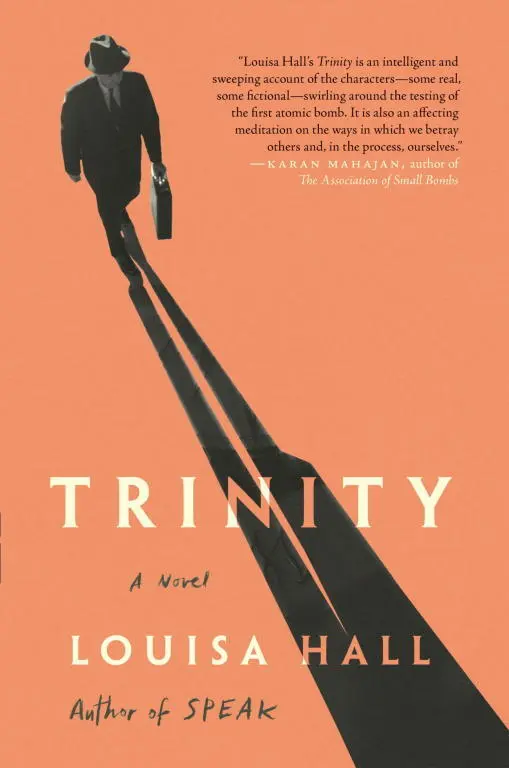
- Название:Trinity
- Автор:
- Издательство:Ecco
- Жанр:
- Год:2018
- Город:New York
- ISBN:978-0-06-285196-3
- Рейтинг книги:4 / 5. Голосов: 1
-
Избранное:Добавить в избранное
- Отзывы:
-
Ваша оценка:
Trinity: краткое содержание, описание и аннотация
Предлагаем к чтению аннотацию, описание, краткое содержание или предисловие (зависит от того, что написал сам автор книги «Trinity»). Если вы не нашли необходимую информацию о книге — напишите в комментариях, мы постараемся отыскать её.
J. Robert Oppenheimer was a brilliant scientist, a champion of liberal causes, and a complex and often contradictory character. He loyally protected his Communist friends, only to later betray them under questioning. He repeatedly lied about love affairs. And he defended the use of the atomic bomb he helped create, before ultimately lobbying against nuclear proliferation.
Through narratives that cross time and space, a set of characters bears witness to the life of Oppenheimer, from a secret service agent who tailed him in San Francisco, to the young lover of a colleague in Los Alamos, to a woman fleeing McCarthyism who knew him on St. John. As these men and women fall into the orbit of a brilliant but mercurial mind at work, all consider his complicated legacy while also uncovering deep and often unsettling truths about their own lives.
In this stunning, elliptical novel, Louisa Hall has crafted a breathtaking and explosive story about the ability of the human mind to believe what it wants, about public and private tragedy, and about power and guilt. Blending science with literature and fiction with biography, Trinity asks searing questions about what it means to truly know someone, and about the secrets we keep from the world and from ourselves.
Trinity — читать онлайн бесплатно полную книгу (весь текст) целиком
Ниже представлен текст книги, разбитый по страницам. Система сохранения места последней прочитанной страницы, позволяет с удобством читать онлайн бесплатно книгу «Trinity», без необходимости каждый раз заново искать на чём Вы остановились. Поставьте закладку, и сможете в любой момент перейти на страницу, на которой закончили чтение.
Интервал:
Закладка:
It was as if he’d been told in advance that I’d make a good match: that my parents had a house on Cape May and a tennis court in the backyard. As if, given those details, he’d decided before showing up that no matter what I happened to look like, no matter which flaws he discovered in my character, he’d inevitably manage to like me.
I wondered about that while I sat beside him at the table, keeping my flippers pinned to my sides. And the more he seemed to miss the true facts of my physical form, the more hollow and hungry I felt, and when the waiter brought out the bread, I grabbed myself a whole fistful.
I felt Kathy watching. Her nostrils were beginning to flare. So then I returned the bread to my side plate.
Meanwhile, her boyfriend started talking about how the whole point of bombing campaigns was to shatter enemy morale. He said we’d been so successful in our campaign in Korea that every last trace of North Korean civilization had been reduced to heaps of smoldering rubble. North Korean leadership, he said, had instructed its remaining population to start tunneling underground in order to solve the shortage of housing.
And there I sat like a good dolphin, overflowing in my seat beside that handsome roommate, who still hadn’t managed to notice my fatness. He seemed to be sitting beside me in a state of perfect contentment, and after a while, it was simply too much to bear. Then my hunger took over. I heaved my fins up from my sides and cut an enormous bloody bite of my steak.
There I was, a dolphin cutting her steak. I knew it was a ridiculous sight, but I didn’t care. By then the rebellious streak had kicked in, and even though Kathy was poking me under the table, I just kept eating.
The straighter Kathy sat up, the more I slouched like a slob. The more daintily she nibbled her cod, the more bloody steak I stuffed into my snout.
Then I ordered a bourbon. I didn’t even like bourbon. I just ordered it with the same glee I usually felt when I’d given a character an interesting trait.
Still, however, the roommate managed not to notice. When my bourbon arrived, he was still smiling, and treating me very politely, as if he wasn’t at all disappointed with the manner in which I’d started behaving.
Then I almost laughed, because I realized that nothing was real. This was a purely literary adventure. Kathy and I were only two differing protagonists, one thin and one fat, one good and one bad, perfect opposites of each other.
I SHOULD MENTION, AT THIS POINT, THAT I HAD A TWIN SISTER.
This has to do with Robert, I promise.
Before we get to that story he told me, I need to establish that my poor mother had suffered the indignity of bearing twin daughters.
Despite her refinement, and the fact that she spoke perfect French and was skilled in the art of flower arrangement, she conceived twins, and it was when that news was delivered that my father’s mother, who suspected my mother of putting on airs, laughed and brought her down a few pegs by saying, “My dear, only sheep carry twins.”
It sometimes can’t be countenanced, these bodies we go around with, like chattel.
Despite her perfect French, my mother was inflicted with the indignity of carrying twins, so you can understand why she was later so concerned that her little girls should be slender.
And it wasn’t her fault that I was always so hungry, or that beside my sister, in photographs of our ballet class, I always looked so stout in my tutu. And it certainly wasn’t my mother’s fault that I hated ballet and took to secretly writing, and that rather than writing attenuated little ladylike sonnets, I wanted to cram it all into a novel.
It was nobody’s fault but my own that I was so fat and insistent, which meant that my sister had to get thinner and thinner in order to compensate for my fatness, so that by the time I got to Rosemont, where I ate too much and wrote novels, my sister was at home wasting away, having given up college and everything else to dedicate herself to the art of her thinness.
I’M GETTING TO ROBERT, DON’T WORRY.
My sister pursued the precise art of her thinness with the cool, detached serenity of the most gifted artists.
All day, while she moved through her routines, her eyes seemed to be fixed on a point just beyond the visible world. In the morning, she made her bed very neatly. At night, she spent a long time calmly moisturizing her hands.
She had many routines of that kind, which she pursued while I was at Rosemont.
She spent hours in the library, where she conducted the majority of her research. Otherwise, she spent a lot of time in the car with my mother. By then, she looked simultaneously like a very young girl and a very old woman. Placidly examining her well-preserved hands, she waited while my mother ran errands. Otherwise, she rested in our childhood bedroom, and during those years I thought I despised her.
WHAT I WANT TO MAKE CLEAR—AND THIS, I PROMISE, IS RELATED TORobert—is that our roles seemed to have been predestined.
We had no control of the system.
It was an archetypical issue, bigger than just me and my sister.
It was an issue represented on cave walls. My sister was Persephone married to Hades. I was Persephone over the summer.
All summer, I ate the fat fruit, and to atone for my greed, my sister chastised herself through the winter. She remained in the penitent dark, while I ran around in the wheat, enjoying that golden splendiferous season when swans rape pretty girls on the hillsides.
We were stuck, in other words, in the hands of a myth.
It took us up in its sway well before we were conscious that it was at work. On Sundays, for instance, when we went to church, my sister’s exemplary socks stayed pulled up to her knees, and mine always sagged down to my ankles.
When my sister kneeled down to pray, she kept her eyes closed like a saint. But mine kept popping open, some voice inside my head commanding me to disobey, to open my eyes and watch the more obedient people.
With their eyes closed, they prayed for those fallen members of our congregation, slain overseas, and watching them pray, I always felt hungry.
Sometimes, on the way out of church, a member of the floral committee would stop my mother to talk, then look down at me and my sister in our matching camel-hair coats. “What beautiful girls,” she’d say, or “Such pretty children.”
And my sister took the compliment well, gazing off into the distance as if she hadn’t heard it, like Mary in a Renaissance painting, inexplicably mournful already, though Jesus is still only a fat little baby.
My sister took those compliments well, and beside her, sweating in my camel-hair coat, I felt nothing but the demands of my hunger.
ONCE, WHEN I WAS MAYBE ELEVEN, A FEW WEEKS AFTER THE WARended with the bombings of Hiroshima and Nagasaki, my parents threw a victory party.
Their friends all came over, and we celebrated with firecrackers on the hill behind the tennis court.
A few weeks after that, I came down to have breakfast before heading to school and happened upon a newspaper my father had left on the table.
By then, I guess, stories had begun to come out about the extent of the damage caused by the A-bombs: the steadily growing numbers of dead, the diseases and starvation and homelessness and birth defects.
And there must have been a feature article about the damage that day, because the photograph on the front page showed a row of bodies in a Japanese hospital room, all of them emaciated, prone on thin mats, many of their limbs badly burned. It was over a month after the bombings, and there they were still, lying in pools of blood and pus, and I only glanced at it for a moment before I felt too ill to look anymore.
Читать дальшеИнтервал:
Закладка:
Похожие книги на «Trinity»
Представляем Вашему вниманию похожие книги на «Trinity» списком для выбора. Мы отобрали схожую по названию и смыслу литературу в надежде предоставить читателям больше вариантов отыскать новые, интересные, ещё непрочитанные произведения.








Обсуждение, отзывы о книге «Trinity» и просто собственные мнения читателей. Оставьте ваши комментарии, напишите, что Вы думаете о произведении, его смысле или главных героях. Укажите что конкретно понравилось, а что нет, и почему Вы так считаете.