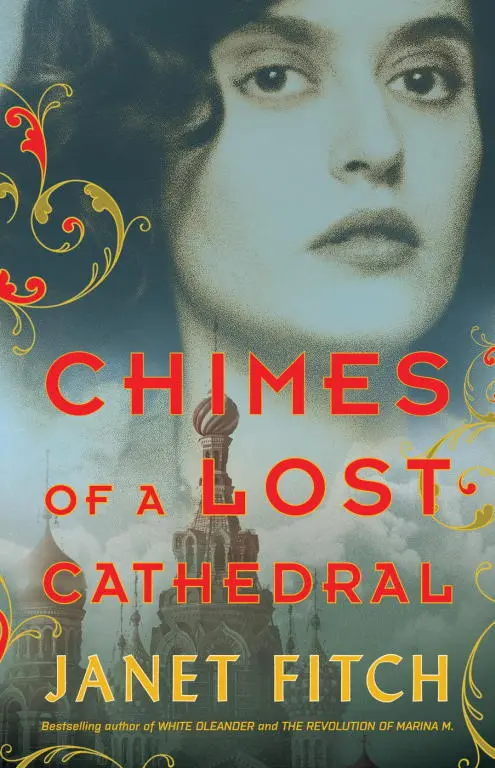
Джанет Фитч - Chimes of a Lost Cathedral
Здесь есть возможность читать онлайн «Джанет Фитч - Chimes of a Lost Cathedral» весь текст электронной книги совершенно бесплатно (целиком полную версию без сокращений). В некоторых случаях можно слушать аудио, скачать через торрент в формате fb2 и присутствует краткое содержание. Город: New York, Год выпуска: 2019, ISBN: 2019, Издательство: Little, Brown and Company, Жанр: Историческая проза, на английском языке. Описание произведения, (предисловие) а так же отзывы посетителей доступны на портале библиотеки ЛибКат.
- Название:Chimes of a Lost Cathedral
- Автор:
- Издательство:Little, Brown and Company
- Жанр:
- Год:2019
- Город:New York
- ISBN:978-0-316-51006-6
- Рейтинг книги:5 / 5. Голосов: 1
-
Избранное:Добавить в избранное
- Отзывы:
-
Ваша оценка:
Chimes of a Lost Cathedral: краткое содержание, описание и аннотация
Предлагаем к чтению аннотацию, описание, краткое содержание или предисловие (зависит от того, что написал сам автор книги «Chimes of a Lost Cathedral»). Если вы не нашли необходимую информацию о книге — напишите в комментариях, мы постараемся отыскать её.
After the events of The Revolution of Marina M., the young Marina Makarova finds herself on her own amid the devastation of the Russian Civil War—pregnant and adrift in the Russian countryside, forced onto her own resourcefulness to find a place to wait out the birth of her child. She finds new strength and self-reliance to fortify her in her sojourn, and to prepare her for the hardships and dilemmas still to come.
When she finally returns to Petrograd, the city almost unrecognizable after two years of revolution, the haunted, half-emptied, starving Capital of Once Had Been, she finds the streets teeming with homeless children, victims of war. Now fully a woman, she takes on the challenge of caring for these civil war orphans, until they become the tool of tragedy from an unexpected direction.
But despite the ordeal of war and revolution, betrayal and privation and unimaginable loss, Marina at last emerges as the poet she was always meant to be.
Chimes of a Lost Cathedral finishes the epic story of Marina’s journey through some of the most dramatic events of the last century—as a woman and an artist, entering her full power, passion, and creativity just as her revolution reveals its true direction for the future.
Chimes of a Lost Cathedral — читать онлайн бесплатно полную книгу (весь текст) целиком
Ниже представлен текст книги, разбитый по страницам. Система сохранения места последней прочитанной страницы, позволяет с удобством читать онлайн бесплатно книгу «Chimes of a Lost Cathedral», без необходимости каждый раз заново искать на чём Вы остановились. Поставьте закладку, и сможете в любой момент перейти на страницу, на которой закончили чтение.
Интервал:
Закладка:
Out the window, the bells of the Preobrazhensky Church began chiming vespers, then farther off, St. Panteleimon, and the Church of the Spilled Blood. Kazan Cathedral, and St. Isaac’s replied. I found the bottle of vodka—prerevolutionary—and poured out a glass and saluted them all. Nikolai Stepanovich. Vechnaya pamyat’. I was sure he’d died with valor. He’d lived his freedom openly, and they’d killed him for it. I’d admired him, his quixotic position, but was this really what Gorky had in mind for me when he’d said to go home and live as if I were free?
I refilled my glass and toasted Nadezhda and Vladimir, then Blok, and Pasha. I reread that sickening list and kept stopping at Gumilev. Something was off about it, the way they described him. Former nobleman, philologist… board of Universal Literature… So many things could have been said about the man: Poet. Belle-lettrist. His foreign connections, positions on the boards of the House of Arts, the Poets’ Guild, the House of Writers. He’d been born at Kronstadt, for God’s sake. But none of that was mentioned. Only Universal Literature. I’d thought at first: that’s what happened when your enemy wrote your obituary. But one had to read Pravda like a poem. What wasn’t said was always as important as what was. That Universal Literature was a shiver in the air.
Gorky’s crown jewel, his most treasured idea. In saying Universal Literature, they meant Gorky.
Now I was seeing a second picture. Gorky hadn’t especially liked Gumilev, but would never have allowed them to shoot a poet, any poet, without a tremendous fight, and for Gumilev he would have gone all out. For whatever reason, Gorky had not been able to prevent Gumilev’s execution.
I saw it.
A case was being assembled against Gorky and all he represented, everyone he protected.
The sound of chimes, dying in the twilight.
I prayed he’d left by now. Yet without Gorky, we were all on the run. What chance did we have if the Bolsheviks terminated the House of Arts and Universal Literature? No protection, no work… We’d be blown to the four directions, to disappear like the last grains in the drought-stricken Volga.
I peered out the curtain into the darkening square. Below, the man in the straw hat smoked in the shadow of a tree. Why did they have to keep watching the flat if Kolya already had a driver who knew his every move? Why wasn’t that enough? How I hated this cat-and-mouse game. I couldn’t stand to be locked up again. And to think that Papa had stood a year of solitary confinement. That cell, the weight of the walls, the moisture, the dark, I would go mad. It terrified me to consider whom I might implicate under duress. I thought of the list of the executed. Varvara had told me she wouldn’t be there to save me.
I thought of Genya waving his red banner like a windup toy. He had thought I was the naive one, explaining that the death of the sailors was inevitable. What did he think of his masters now?
Oh, what were they doing at the House of Arts? I should be there. Were there protests? A defiant evening of Gumilev’s poetry? Or would they be hunkered down, speaking in whispers, waiting for the next blow. I had to see Anton. Neither of us had liked Gumilev and yet from now on to say Gumilev would mean literature, culture, a Russia we’d hoped we could live in. I thought of Anton’s agitation today on the street. This must have been what they were talking about.
But how could I contact him? They would certainly be watching the House of Arts today. They might have informers. One of Gumilev’s students, perhaps, a wide-eyed hanger-on. No, I couldn’t go there, trailing the contagion of my own political cloud, like typhoid. And what about Gorky? With Moura gone, oh Lord.
I heard the automobile outside, the slamming of the car door. Thank God, he was home. But he lingered downstairs, chatting up the driver. He couldn’t turn it off for a second, could he? He had to charm any and everyone. Finally, I heard him clambering up the stairs, ran to meet him, pink cheeked and smiling, clutching a bunch of big-headed roses and a bottle of champagne. His flushed, grinning face. “They’ve offered Sir Graham a copper mine. Near Chelyabinsk. A sure thing. Get dressed, we’re celebrating.”
“They shot Gumilev,” I said.
“Who?” He set his gifts in the kitchen, handed me the roses.
In the future we’d say roses when we meant slaughter, when we meant blood.
“The poet Gumilev. I told you, they arrested him. Right out of the House of Arts. And they searched my room, remember? They shot him.”
“Poor devil.” He set two pink coupes on the counter and was already removing the metal net from the cork, unwinding the foil sleeve. He popped the cork, and the champagne spilled out. “Hand me that glass, quick!” I handed him one, and the bubbling liquid poured in. He handed it to me, licked the spillage off his hand, took the bottle and the other glass out to the table by the windows. I stared at that paper of roses, and left them where they were.
I stood over Kolya where he’d sat down at the table and kicked off his shoes.
“They shot him, Kolya. Sixty-one people!” I picked up the paper and thrust it at him. “I could have been on that list.”
“But you weren’t. Here’s to good timing, and Englishmen.”
I simply stood there. Was it Gumilev I was weeping for, or myself? “They’re watching the house. Your driver’s Cheka. This isn’t a joke.”
“Drink.” He lifted my glass to my lips. I drank, watching him over the rim. “They’re not going to arrest you. What matters to them right now is the restoration of the rail line and copper for Lenin’s electrification of Russia.” He took off his straw hat and his beautiful pale jacket, smoothed out his chestnut hair. “Listen. You and me, we’re not Gumilevs. This is a different game altogether.” He toasted himself and drained his glass, caught the hem of my slip and tried to pull me over to him, but I brushed his hand away.
“You’re wrong. They can play two games at the same time. Three.” I wondered what the man in the street could see of this. I turned off the lamp. “If Sir Graham wanted mining concessions, why would he care about me, some girl poet he never met? He might even be willing to sacrifice Kolya Shurov, and chalk it up to the cost of doing business.”
My love smiled that smile that said he had a secret, that he knew things. “Trust me,” he said. “Sir Graham’s interest in this deal includes Kolya Shurov.”
“What do you have on him?” I said. “Murder?”
He grabbed my wrist and pulled me onto his lap. “That’s top secret and classified.”
I drank the rest of my glass, let him pour me another. I hooked my arm around his neck, drew him close. His smell made me want to kiss him, to forget all this, but I could not. Was I drunk? Not drunk enough. “Listen to me, Kolya. I want a visa. A passport. Passage to England. Before you sign the deal.” My own words surprised me. But now that I’d said them, I saw that was exactly what I wanted. To fly, to go somewhere I could take a breath. Where I could live without looking over my shoulder, where I could use my real name.
“Why before? This deal’s a triumph,” he said, pouring another glass. “I’m sorry they shot your friend. But this is the future.”
I tipped up his chin so he could see how serious I was. “Once it’s signed, we’re all expendable. Especially me.”
He grinned. “Believe me, the only one who cares about you is me. Of course they’re watching the flat. I’m acting for an English industrialist. Of course they want to know where I go, who I meet. But they’re not going to do anything about it.”
Читать дальшеИнтервал:
Закладка:
Похожие книги на «Chimes of a Lost Cathedral»
Представляем Вашему вниманию похожие книги на «Chimes of a Lost Cathedral» списком для выбора. Мы отобрали схожую по названию и смыслу литературу в надежде предоставить читателям больше вариантов отыскать новые, интересные, ещё непрочитанные произведения.










Обсуждение, отзывы о книге «Chimes of a Lost Cathedral» и просто собственные мнения читателей. Оставьте ваши комментарии, напишите, что Вы думаете о произведении, его смысле или главных героях. Укажите что конкретно понравилось, а что нет, и почему Вы так считаете.