Джанет Фитч - Chimes of a Lost Cathedral
Здесь есть возможность читать онлайн «Джанет Фитч - Chimes of a Lost Cathedral» весь текст электронной книги совершенно бесплатно (целиком полную версию без сокращений). В некоторых случаях можно слушать аудио, скачать через торрент в формате fb2 и присутствует краткое содержание. Город: New York, Год выпуска: 2019, ISBN: 2019, Издательство: Little, Brown and Company, Жанр: Историческая проза, на английском языке. Описание произведения, (предисловие) а так же отзывы посетителей доступны на портале библиотеки ЛибКат.
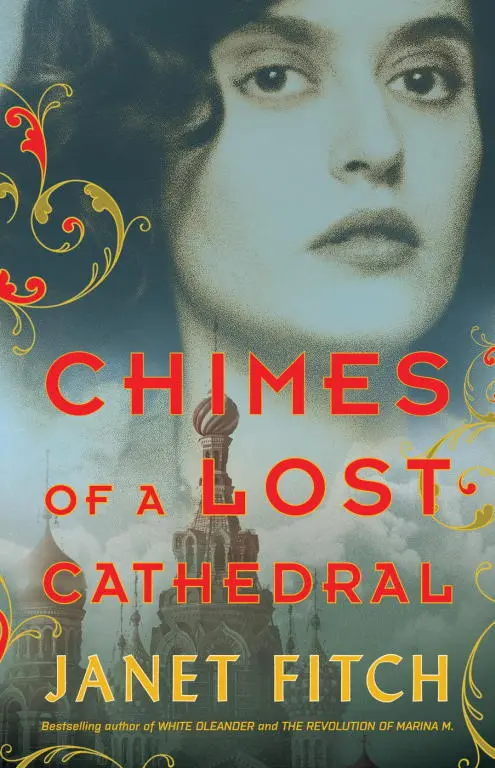
- Название:Chimes of a Lost Cathedral
- Автор:
- Издательство:Little, Brown and Company
- Жанр:
- Год:2019
- Город:New York
- ISBN:978-0-316-51006-6
- Рейтинг книги:5 / 5. Голосов: 1
-
Избранное:Добавить в избранное
- Отзывы:
-
Ваша оценка:
Chimes of a Lost Cathedral: краткое содержание, описание и аннотация
Предлагаем к чтению аннотацию, описание, краткое содержание или предисловие (зависит от того, что написал сам автор книги «Chimes of a Lost Cathedral»). Если вы не нашли необходимую информацию о книге — напишите в комментариях, мы постараемся отыскать её.
After the events of The Revolution of Marina M., the young Marina Makarova finds herself on her own amid the devastation of the Russian Civil War—pregnant and adrift in the Russian countryside, forced onto her own resourcefulness to find a place to wait out the birth of her child. She finds new strength and self-reliance to fortify her in her sojourn, and to prepare her for the hardships and dilemmas still to come.
When she finally returns to Petrograd, the city almost unrecognizable after two years of revolution, the haunted, half-emptied, starving Capital of Once Had Been, she finds the streets teeming with homeless children, victims of war. Now fully a woman, she takes on the challenge of caring for these civil war orphans, until they become the tool of tragedy from an unexpected direction.
But despite the ordeal of war and revolution, betrayal and privation and unimaginable loss, Marina at last emerges as the poet she was always meant to be.
Chimes of a Lost Cathedral finishes the epic story of Marina’s journey through some of the most dramatic events of the last century—as a woman and an artist, entering her full power, passion, and creativity just as her revolution reveals its true direction for the future.
Chimes of a Lost Cathedral — читать онлайн бесплатно полную книгу (весь текст) целиком
Ниже представлен текст книги, разбитый по страницам. Система сохранения места последней прочитанной страницы, позволяет с удобством читать онлайн бесплатно книгу «Chimes of a Lost Cathedral», без необходимости каждый раз заново искать на чём Вы остановились. Поставьте закладку, и сможете в любой момент перейти на страницу, на которой закончили чтение.
Интервал:
Закладка:
“You need help,” I said after he’d hung up. “Why did Moura go?”
“I wanted her to,” he said. “I wanted to get her out of this before it gets any worse.” He screwed a cigarette into his black holder, lit it. “So what were you doing with a Kronstadt sailor?”
“A lover.”
He nodded. “And how did you meet him?”
“I was teaching at their club on the Admiralty docks. Gumilev gave me the class.”
He winced. “And people knew—about the sailor?”
I thought of the eyes watching us as I brought him through the House of Arts. The way he would sit in the canteen with Kuzmin, waiting for me. “It wasn’t a secret. But he was from the Petropavlovsk. On their committee.”
He closed his eyes, massaged his broad forehead with his fingers, along the ridge of his brow. “Luck has not been your friend,” he said. “Is there anywhere safe you can go? A school friend in the suburbs? Cousin in the country?”
Cousin in the country.
It’s starting to look like a picture.
The air left the room as I realized with a sickening jolt that I could not return to the House of Arts. I was done there. Done as a poet, a member of that blessed fraternity. Just when I’d finally joined their world. Blok knew my name, but Blok was dying. Now it was over. Just like that. I’d had everything, and then it was taken away. What had I thought? That I would tell Gorky about Gumilev and go back to the House, clean up my room, set the furniture to rights, pick up where I’d left off? What a fool.
“Will you be all right?”
I struggling to breathe, to see, bumped my leg on the chair in my hurry to get away, to keen and sob somewhere private. “I’ll be fine.”
“Marina?”
I stood at the door, my hand on the knob. I rested my forehead against the wood, the intricate grain of the oak.
“I’m sorry. I’d invite you to stay here—we’ve got nothing but rooms—but it’s impossible now. You have some idea of the situation…But come back if you can’t find anything. I’ll think of something.”
His kind face. We never did lie to each other, Alexei Maximovich and I. “Don’t worry about me.” I tried to smile. “Good luck with Gumilev.”
He reached out his big square hand and I shook it. “I wish I could do more for you.” He let me go, took out his wallet from the desk drawer, and handed me five hundred rubles. A month’s wages for a workingman, or used to be. The sight of it only emphasized the danger he felt me to be in. I waved it away, but he took my hand, pressed the money into my palm. “It won’t help much, but for my sake, take it.”
I put it in my pocket. I could hardly see for the tears in my eyes. I would never see him again either? It was all ending.
“Who would have guessed we’d have to be so brave in this life, eh? I thought I could just get rich and take it easy.” He laughed and started coughing. “Be well, Marina Dmitrievna.”
“And you, Alexei Maximovich.”
I slipped out of the apartment, down the back stairs, and out into the courtyard, and through the little alleys and the park, the long way home. Home to Orphanage No. 6, where they knew me only as Comrade Marina. With Matron’s connivance, I could stay hidden among the children. I had paid my passage on this ship well ahead.
61 The Poet, Blok
I cut off all contact with the House of Arts. I only hoped Anton would think to go to my room, get my clothes, the things I’d need this winter, and keep them safe—and for Christ’s sake not come looking for me. Orphanage No. 6 was only two blocks away, but it might as well be Irkutsk, and had to be. I set the distance in my mind, already a parallel dimension, unreachable. The House of Arts simply did not exist. Here at the orphanage, my petty literary ambitions were nothing compared to the desperate needs of these starved children, hands as light as paper, eyes so wounded it was hard to return their gaze. What was I compared to this? Longings, friendship, community—dreams.
When I thought the situation could not be more depressing, the last blow arrived. Taking a break in the summer dusk in Arts Square, I glimpsed Makar selling Pravda and God knew what else, with a group of older… you couldn’t call them orphans. At fifteen or sixteen they were men of the city, biznissmen . I went over to buy a paper, hoping for news of Gumilev. On the front page, lower right corner, a box edged in black held a simple notice:
Last night the poet Alexander Blok passed away.
I felt as if a giant guillotine had sliced me in two, from the top of my head to my feet. I would split like a log and fall to the stones of Arts Square. My lips formed the words. “Blok is dead.” As if saying the words would make it anything less than lunacy.
“Blok, Blok,” Makar mocked me. “ Lya lya fa fa. Who was he, Lenin’s brother?”
I leaned on him so that I would not come apart in the middle of Mikhailovskaya Street. Tried to breathe some air but suddenly my lungs seemed glued together.
Although I’d been sleeping with starving children for days, rubbing empty, aching bellies, holding them as they described their villages where people lay on the sidewalk with only the strength to hold one hand outstretched. Although I’d been cast out by poetry, and brave Gumilev languished in prison, and Pasha was dead in the gulf, and Anton was out of reach, this was the thing that I could not bear. I would have thought myself beyond such grief, but this anguish was of a very special sort.
I looked around me at the noble, shabby buildings, the bushes and lawns, the statue of Pushkin, covered with pigeons. Pushkin, hounded by the rabble, and now, Blok was dead. I lowered myself to the bench where I’d once sat with Varvara and Mina as we ate nonpareils out of a paper cone and watched the doorway to the Stray Dog Café. Now I paged through Pravda . Surely there would be a paragraph or two devoted to the poet, a famous poem or two, but it was just that one line: The poet Alexander Blok… passed away… The poet. You might as well have said that poetry itself had died.
I headed out to Kolomna through the shimmering summer dusk as if pulled by an unearthly hand. Every canal, every square, whispered his name. I remembered the day I went to speak to him about our reading and his wife came to the door. The day we met on Bolshaya Morskaya outside the telephone exchange and he invited me to the Bely reading at the House of Arts. Those afternoons I sat on the Pryazhka Embankment, a young girl, watching his windows. His name trembled in the air like radiograph waves, vibrated along the stones. The poet Alexander Blok passed away… A streetcar sailed by me on Kazanskaya Street so close I had to jump. I didn’t even hear the screech and bells. Gumilev’s lost streetcar. But it wouldn’t be suitable to take a tram to Blok’s house. One should go on one’s knees.
The air grew cooler as I passed the Mariinsky Theater and entered Ofitserskaya Street, wide and commercial. A few shops had opened here—a pastry shop, a cobbler, a pharmacy. How appropriate. The night, the street, the streetlamp, the pharmacy… He should have died in wintertime. Summer wasn’t his season. Blok needed a frozen canal, a group of poets escorting actresses home from Ivanov’s Tower on a frosty midnight. I passed the Komissarzhevskaya Theater, where his famous Puppet Show had played. And what about this puppet show? You die—and then relive it all… there is no change. And no escape.
Was I weeping because I’d never had that beauty? Or because he gave it to me, gave it to everyone who had heard his song. I stumbled down to the Pryazhka River and his tall house on the corner, 57 Ofitserskaya. I stood on the embankment where I’d stood so many times, staring up at those windows. In a world of poets, he’d been the poet—who had seduced us all, the angel of light, shadow against blinds, the flicker in the mirror. Blok. You saved my life. You can’t be dead. He’d taken me—this orphan—from the streets, and breathed life into my lungs, called me poet.
Читать дальшеИнтервал:
Закладка:
Похожие книги на «Chimes of a Lost Cathedral»
Представляем Вашему вниманию похожие книги на «Chimes of a Lost Cathedral» списком для выбора. Мы отобрали схожую по названию и смыслу литературу в надежде предоставить читателям больше вариантов отыскать новые, интересные, ещё непрочитанные произведения.










Обсуждение, отзывы о книге «Chimes of a Lost Cathedral» и просто собственные мнения читателей. Оставьте ваши комментарии, напишите, что Вы думаете о произведении, его смысле или главных героях. Укажите что конкретно понравилось, а что нет, и почему Вы так считаете.