Джон Голсуорси - On Forsyte 'Change
Здесь есть возможность читать онлайн «Джон Голсуорси - On Forsyte 'Change» весь текст электронной книги совершенно бесплатно (целиком полную версию без сокращений). В некоторых случаях можно слушать аудио, скачать через торрент в формате fb2 и присутствует краткое содержание. Год выпуска: 2014, Издательство: epubBooks Classics, Жанр: Историческая проза, на английском языке. Описание произведения, (предисловие) а так же отзывы посетителей доступны на портале библиотеки ЛибКат.
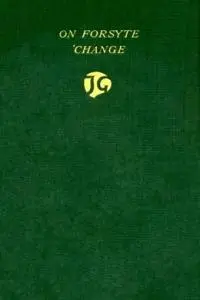
- Название:On Forsyte 'Change
- Автор:
- Издательство:epubBooks Classics
- Жанр:
- Год:2014
- ISBN:нет данных
- Рейтинг книги:3 / 5. Голосов: 1
-
Избранное:Добавить в избранное
- Отзывы:
-
Ваша оценка:
On Forsyte 'Change: краткое содержание, описание и аннотация
Предлагаем к чтению аннотацию, описание, краткое содержание или предисловие (зависит от того, что написал сам автор книги «On Forsyte 'Change»). Если вы не нашли необходимую информацию о книге — напишите в комментариях, мы постараемся отыскать её.
On Forsyte 'Change — читать онлайн бесплатно полную книгу (весь текст) целиком
Ниже представлен текст книги, разбитый по страницам. Система сохранения места последней прочитанной страницы, позволяет с удобством читать онлайн бесплатно книгу «On Forsyte 'Change», без необходимости каждый раз заново искать на чём Вы остановились. Поставьте закладку, и сможете в любой момент перейти на страницу, на которой закончили чтение.
Интервал:
Закладка:
When his cigar was about half smoked a change would come. The hand holding it would loll over the arm of the chair, trembling a little. The chin would slip slowly down between the wide apart points of the stiff white collar; the puffy rounding of the eyelids would become complete; a slight twitching would possess the lips, a faint steady puffing take its place—Swithin would be asleep. And those who passed would look at him with cold amusement, a kind of impatience, possibly a touch of compassion, for, on these occasions, as if mindful of past glories, Swithin did not snore. And then, of course, would come the moment of awakening. The chin would jerk up, the lips part, all breath would seem to be expelled from him in a long sigh; the eyes coming ungummed would emit a glassy stare; the tongue would move over the roof of the mouth and the lips; and an expression as of a cross baby would appear on the old face. Pettishly he would raise the half–smoked cigar, look at it as if it owed him something which it was not going to pay, and let it slip between finger and thumb into a spittoon. Then he would sit the same, yet not the same, waiting for some servant to come near enough for him to say: "Hi! Tell my valet to come, will you?" and when Alphonse appeared: "Oh! There you are! I nodded off. I'll go up now."
Assisted from the chair, he would stand fully a minute feeling giddy, then square but bearing heavily on the cane and one leg, would move towards the lift, followed by Alphonse and the special cushions. And someone perhaps would mutter as he passed: "There goes old Forsyte. Funny old boy, isn't he?"
But such was not the order of events on that particular April afternoon reported on Forsyte 'Change. For when, divested of hat and overcoat, he was about to walk to his accustomed corner, he was observed to raise his cane with the words: "Here! There's a lady sitting in my chair!"
A figure, indeed, in rather a short skirt, occupied that sacred spot.
"I'll go up!" said Swithin, pettishly. But as he moved, she rose and came towards him.
"God bless me!" said Swithin, for he had recognised his niece Euphemia.
Now the youngest child of his brother Nicholas was in some respects Swithin's pet aversion. She was, in his view, too thin, and always saying the wrong thing; besides, she squeaked. He had not seen her since, to his discomfort, he had sat next her at the concert of Francie's fourpenny foreigner.
"How are you, Uncle? I thought I MUST look you up while I was down."
"I've got gout," said Swithin. "How's your father?"
"Oh! just as usual. He says he's bad, but he isn't." And she squeaked slightly.
Swithin fixed her with his stare. Upset already by her occupation of his chair, he was on the point of saying: 'Your father's worth twenty of you,' but, remembering in time the exigencies of deportment, he murmured more gallantly: "Where have you sprung from?"
"My bicycle."
"What!" said Swithin. "You ride one of those things!"
Again Euphemia squeaked.
"Oh! Uncle! One of those things!"
"Well," said Swithin, "what else are they—invention of the devil. Have some tea?"
"Thank you, Uncle, but you must be tired after your drive."
"Tired! Why should I be tired? Waiter! Bring some tea over there—to my chair."
Having thus conveyed to her the faux fas she had committed by sitting in his chair, he motioned her towards it and followed.
On reaching the chair there was an ominous moment.
"Sit down," said Swithin.
For a moment Euphemia hovered on its edge, then with a slight squeak said: "But it's your chair, Uncle."
"Alphonse," said Swithin, "bring another."
When the other chair had been brought, the cushions placed for Swithin in his own, and they were seated, Euphemia said:
"Didn't you know that women were beginning to ride bicycles, Uncle?"
The hairs on Swithin's underlip stood out.
"Women," he said. "You may well say women. Fancy a lady riding a thing like that!"
Euphemia squeaked more notably.
"But, Uncle, why LIKE THAT?"
"With a leg on each side, disturbing the traffic," and glancing at Euphemia's skirt, he added: "Showing their legs."
Euphemia gave way to silent laughter.
"Oh! Uncle," she said, at last, in a strangled voice, "you'll kill me!"
But at this moment came tea.
"Help yourself," said Swithin, shortly; "I don't drink it." And, taking from the waiter a light for his cigar, he sat staring with pale eyes at his niece. Not till after her second cup did she break that silence.
"Uncle Swithin, do tell me why they called you 'Four–in–Hand Forsyte,' I've always wanted to know."
Swithin's stare grew rounder.
"Why shouldn't they?"
"'Four–in–hand'; but you never drove more than a pair, did you?"
Swithin preened his neck. "Certainly not! It was just a compliment to my—er—style."
"Style!" repeated Euphemia. "Oh, Uncle!" and she grew so crimson that he thought she had swallowed a crumb.
Then slowly but surely it dawned on him that he was the cause of her emotion. Into his cheeks a faint pink crept; something moved in his throat, something that might choke him if he were not careful. He did not stir.
Euphemia rose.
"I MUST be going, Uncle. I HAVE enjoyed seeing you, you're looking so well. Don't get up, please, and thank you ever so for the tea." She bent above him, pecked at his forehead, and showing her legs, walked towards the door. Her face was still very red and as she went, Swithin seemed to hear her squeak.
He stayed unmoving for a second, then struggled to get up. He had no stick to help him, no time to give to the process, and he struggled. He got on his feet, stood a moment to recover, and then, without his cane, walked, he knew not how, to the window of the hall that looked out on to the parade. There she was—that niece of his, that squeaker, mounting her bicycle, moving it, mounting it, riding it away. Into the traffic she went, pedalling, showing her ankles; not an ounce of grace, of elegance, of anything! There she went! And Swithin stood, drumming a puffy forefinger against the pane, as if denouncing what he saw. Style! Style! She—she had been laughing at him. Not a doubt of it! If he HAD only driven a pair, it had been the finest in the kingdom! He stood with that distressing pink still staining the pallor of his cheeks—ruffled to the bottom of his soul. Was he conscious of the full sting in his niece's laughter? Conscious of how the soubriquet 'Four–in–hand Forsyte' epitomised the feeling Society had ever held of him; the feeling that with his craving for distinction he had puffed himself out into the double of what he really was? Was he conscious of that grievous sneer? Only, perhaps, subconscious, but it was enough; a crabbed wrath possessed him to the soles of the patent leather boots still worn, in public, on his painful feet. So she rode one of 'those things,' and laughed at him, did she? He would show her. He left the window and went to the writing table. And there, his eyes round and yellow, his hand trembling, he took paper and began to write. In a shaky travesty of what had once been almost copperplate, he traced these lines:
"This is a codicil to the last Will of me Swithin Forsyte. To mark my disapproval of the manners and habits of my niece Euphemia, the daughter of my brother Nicholas Forsyte and Elizabeth his wife, I hereby revoke the bequest of the share of my property left to her in my said Will. I leave her nothing whatever."
He paused and read it through. That would teach her! Faithful to the ladies, the half of his property he had left to his three sisters in equal shares; the other half to his eight nieces in equal shares. Well, there would only be seven now! And he sounded the bell.
"Boy, fetch my valet and tell the hall porter to come here."
Читать дальшеИнтервал:
Закладка:
Похожие книги на «On Forsyte 'Change»
Представляем Вашему вниманию похожие книги на «On Forsyte 'Change» списком для выбора. Мы отобрали схожую по названию и смыслу литературу в надежде предоставить читателям больше вариантов отыскать новые, интересные, ещё непрочитанные произведения.








Обсуждение, отзывы о книге «On Forsyte 'Change» и просто собственные мнения читателей. Оставьте ваши комментарии, напишите, что Вы думаете о произведении, его смысле или главных героях. Укажите что конкретно понравилось, а что нет, и почему Вы так считаете.