Джон Голсуорси - On Forsyte 'Change
Здесь есть возможность читать онлайн «Джон Голсуорси - On Forsyte 'Change» весь текст электронной книги совершенно бесплатно (целиком полную версию без сокращений). В некоторых случаях можно слушать аудио, скачать через торрент в формате fb2 и присутствует краткое содержание. Год выпуска: 2014, Издательство: epubBooks Classics, Жанр: Историческая проза, на английском языке. Описание произведения, (предисловие) а так же отзывы посетителей доступны на портале библиотеки ЛибКат.
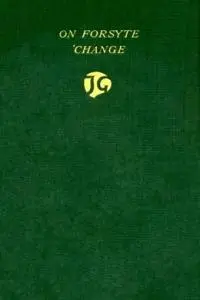
- Название:On Forsyte 'Change
- Автор:
- Издательство:epubBooks Classics
- Жанр:
- Год:2014
- ISBN:нет данных
- Рейтинг книги:3 / 5. Голосов: 1
-
Избранное:Добавить в избранное
- Отзывы:
-
Ваша оценка:
On Forsyte 'Change: краткое содержание, описание и аннотация
Предлагаем к чтению аннотацию, описание, краткое содержание или предисловие (зависит от того, что написал сам автор книги «On Forsyte 'Change»). Если вы не нашли необходимую информацию о книге — напишите в комментариях, мы постараемся отыскать её.
On Forsyte 'Change — читать онлайн бесплатно полную книгу (весь текст) целиком
Ниже представлен текст книги, разбитый по страницам. Система сохранения места последней прочитанной страницы, позволяет с удобством читать онлайн бесплатно книгу «On Forsyte 'Change», без необходимости каждый раз заново искать на чём Вы остановились. Поставьте закладку, и сможете в любой момент перейти на страницу, на которой закончили чтение.
Интервал:
Закладка:
"I borrowed it."
"When?"
"To–day."
"Who from?"
"A man called Davids."
"Money–lender?"
Young Jolyon bowed his head.
"And you preferred to go to a money–lender than to come to me?"
Young Jolyon's lips quivered; he pitched his cigar into the fire, not strong enough to bear it.
"I—I—knew you'd—you'd hate it so, Dad."
"I hate this more, Jo."
To both of them it seemed the worst moment they had ever been through, and it lasted a long time. Then old Jolyon said:
"What did you sign?"
"I borrowed a hundred and fifty, and promised to pay two hundred in six months."
"And how were you going to get that?"
"I don't know."
Old Jolyon, too, pitched his cigar into the fire, and passed his hand over his forehead.
Impulsively young Jolyon rose, and, oblivious of his whiskers, sat down on the arm of his father's chair, precisely as if he were not a swell. There were tears in his eyes.
"I'm truly sorry, Dad; only, you don't understand." Old Jolyon shook his head.
"No, I don't understand, Jo. That's the way to ruin."
"They were debts of honour, Dad."
"All debts are debts of honour. But that's not the point. It seems to me you can't face things. I know you're an affectionate chap, but that won't help you."
Young Jolyon got up.
"I CAN face things," he said: "I—! Oh! You can't realise."
Scattering the logs with his slippered foot, he stared into the glow. His eyes felt burned, his inside all churned up; and while the 'swell' within him drawled: 'A fuss about money'; all his love for his father was raw and quivering. He heard old Jolyon say:
"I'll go now, Jo. Have a list of your debts for me tomorrow. I shall pay them myself. We'll go to that money–lender chap together."
Young Jolyon heard him getting up, heard him with his coat and hat, heard him open the door; and, twisting round, cried:
"Oh! Dad!"
"Good–night, Jo!" He was gone.
Young Jolyon stood a long time by the dying fire. His father did not, could not know what a fellow had to do, how behave to—to be superior to fortune. He was old–fashioned! But, besides loving him, young Jolyon admired his father, admired him physically and mentally—as much—yes, more than the Honble. Crasher or Digby Grand. And he was miserable.
He sat up late, making a list of his debts as well as anyone could who had the habit of tearing up his bills. Repressed emotion tossed his slumbers, and when he woke the thought of the joint visit to Mr. Davids made him feel unwell.
Old Jolyon came at ten o'clock, looking almost haggard. He took the list from his son.
"Are these all, Jo?"
"So far as I can remember."
"Send any others in to me. Which of your friends are the gamblers?"
Young Jolyon coloured.
"You must excuse me, Dad."
Old Jolyon looked at him.
"Very well!" he said. "We'll go to this money–lender now."
They walked forth. By God's mercy no one had bounced in on his way to Newmarket. Young Jolyon caught sight of 'Donny' Covercourt on the far side of the quadrangle and returned him no greeting. Quite silent, side by side, father and son passed out into the street. Except for old Jolyon's remark:
"There's no end to these Colleges, it seems," they did not speak until they reached the office of Mr. Davids, above a billiard room.
Old Jolyon ascended, stumping the stairs with his umbrella; young Jolyon followed with his head down. He was bitterly ashamed; it is probable that old Jolyon was even more so.
The money–lender was in his inner office, just visible through the half–open doorway. Old Jolyon pushed the door with his umbrella.
Mr. Davids rose, apparently surprised, and stood looking round his nose in an ingratiating manner.
"This is my father," said young Jolyon, gazing deeply at his boots.
"Mr. Davids, I think?" began old Jolyon.
"Yeth, Thir. What may I have the pleasure—"
"You were good enough yesterday to advance my son the sum of a hundred and fifty pounds, for which he signed a promissory note for an extortionate amount. Kindly give me that note, and take this cheque in satisfaction."
Mr. Davids washed his hands.
"For what amount ith your cheque, Thir?"
Old Jolyon took a cheque from his pocket and unfolded it.
"For your money, and one day's interest at ten per cent."
Mr. Davids threw up his well–washed hands.
"Oh! No, Mithter Forthyte; no! Thath not bithneth. Give me a cheque for the amount of the promithory note, and you can have it. I'm not ancthious to be paid—not at all."
Old Jolyon clapped his hat on his head.
"You will accept my cheque!" he said, and thrust it under the money–lender's eyes.
Mr. Davids examined it, and said:
"You take me for a fool, it theemth."
"I take you for a knave," said old Jolyon. "Sixty–six per cent, forsooth!"
Mr. Davids recoiled in sheer surprise.
"I took a great rithk to lend your thon that money."
"You took no risk whatever. One day's interest at ten per cent is ninepence three–farthings; I've made it tenpence. Be so good as to give me that note."
Mr. Davids shook his head.
"Very well," said old Jolyon. "I've made some inquiries about you. I go straight from here to the Vice–Chancellor."
Mr. Davids again began to wash his hands.
"And thuppothe," he said, "I go to your thon's College and tell them that I lend him thith money?"
"Do!" said old Jolyon; "do! Come, Jo!" He turned and walked to the door, followed by his agonised but unmoved son.
"Thtop!" said Mr. Davids. "I don't want to make no trouble."
Old Jolyon's eyes twinkled under his drawn brows.
"Oh!" he said, without turning, "you don't! Make haste, then. I give you two minutes," and he took out his watch.
Young Jolyon stood looking dazedly at the familiar golden object. Behind him he could hear Mr. Davids making haste.
"Here it ith, Mithter Forthyte, here it ith!"
Old Jolyon turned.
"Is that your signature, Jo?"
"Yes," said young Jolyon, dully.
"Take it, then, and tear it up."
Young Jolyon took, and tore it savagely.
"Here's your cheque," said old Jolyon.
Mr. Davids grasped the cheque, changing his feet rapidly.
"Ith not bithneth, really ith not bithneth," he repeated.
"The deuce it isn't," said old Jolyon; "you may thank your stars I don't go to the Vice–Chancellor, into the bargain. Good–bye to you!" He stumped his umbrella and walked out.
Young Jolyon followed, sheepishly.
"Where's the station, Jo?"
Young Jolyon led the way, and they walked on, more silent than ever.
At last old Jolyon said:
"This has been a sad affair. It's your not coming to me, Jo, that hurt."
Young Jolyon's answer was strangled in his throat.
"And don't gamble, my boy. It's weak–minded. Well, here we are!"
They turned into the station. Old Jolyon bought The Times. They stood together, silent on the platform, till the London train came in; then young Jolyon put his hand through his father's arm, and squeezed it. Old Jolyon nodded:
"I shan't allude to this again, Jo. But there's just one thing: If you must be a swell, remember that you're a gentleman too. Good–bye, my boy!" He laid his hand on his son's shoulder, turned quickly and got in.
Young Jolyon stood with bared head, watching the train go out. He then walked, as well as he knew how, back to College.
Indeed, yes! A sad affair!
Revolt at Roger's, 1870
When the house of Roger Forsyte in Prince's Gate was burgled in the autumn of 1870, Smith was undoubtedly drunk and made no serious attempt to rebut the accusation. A broad man of extremely genial disposition, he had in the few months of his butlerdom in Roger's new house endeared himself to the young Rogers, and even Roger was wont to speak of him as 'an amiable chap.' To be drunk without anyone's knowing, is a tort; to be discovered drunk, a misdemeanour; to be drunk when burglary is committed under one's nose, a crime, if not a felony. This, at least, was Roger's view, and he acted on it by immediate dismissal. His spoons had gone and Smith must go, too.
Читать дальшеИнтервал:
Закладка:
Похожие книги на «On Forsyte 'Change»
Представляем Вашему вниманию похожие книги на «On Forsyte 'Change» списком для выбора. Мы отобрали схожую по названию и смыслу литературу в надежде предоставить читателям больше вариантов отыскать новые, интересные, ещё непрочитанные произведения.








Обсуждение, отзывы о книге «On Forsyte 'Change» и просто собственные мнения читателей. Оставьте ваши комментарии, напишите, что Вы думаете о произведении, его смысле или главных героях. Укажите что конкретно понравилось, а что нет, и почему Вы так считаете.