Ken Follett - World Without End
Здесь есть возможность читать онлайн «Ken Follett - World Without End» весь текст электронной книги совершенно бесплатно (целиком полную версию без сокращений). В некоторых случаях можно слушать аудио, скачать через торрент в формате fb2 и присутствует краткое содержание. Жанр: Историческая проза, на английском языке. Описание произведения, (предисловие) а так же отзывы посетителей доступны на портале библиотеки ЛибКат.
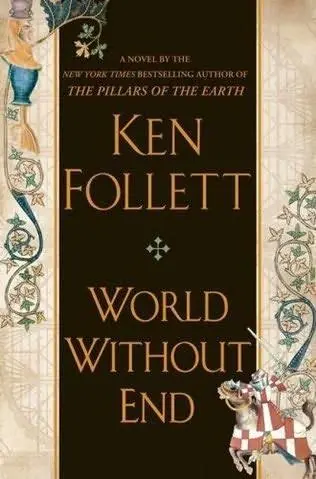
- Название:World Without End
- Автор:
- Жанр:
- Год:неизвестен
- ISBN:нет данных
- Рейтинг книги:5 / 5. Голосов: 1
-
Избранное:Добавить в избранное
- Отзывы:
-
Ваша оценка:
World Without End: краткое содержание, описание и аннотация
Предлагаем к чтению аннотацию, описание, краткое содержание или предисловие (зависит от того, что написал сам автор книги «World Without End»). Если вы не нашли необходимую информацию о книге — напишите в комментариях, мы постараемся отыскать её.
Ken Follett has 90 million readers worldwide. The Pillars of the Earth is his bestselling book of all time. Now, eighteen years after the publication of The Pillars of the Earth, Ken Follett has written the most-anticipated sequel of the year, World Without End.
In 1989 Ken Follett astonished the literary world with The Pillars of the Earth, a sweeping epic novel set in twelfth-century England centered on the building of a cathedral and many of the hundreds of lives it affected. Critics were overwhelmed-"it will hold you, fascinate you, surround you" (Chicago Tribune)-and readers everywhere hoped for a sequel.
World Without End takes place in the same town of Kingsbridge, two centuries after the townspeople finished building the exquisite Gothic cathedral that was at the heart of The Pillars of the Earth. The cathedral and the priory are again at the center of a web of love and hate, greed and pride, ambition and revenge, but this sequel stands on its own. This time the men and women of an extraordinary cast of characters find themselves at a crossroad of new ideas-about medicine, commerce, architecture, and justice. In a world where proponents of the old ways fiercely battle those with progressive minds, the intrigue and tension quickly reach a boiling point against the devastating backdrop of the greatest natural disaster ever to strike the human race-the Black Death.
Three years in the writing, and nearly eighteen years since its predecessor, World Without End breathes new life into the epic historical novel and once again shows that Ken Follett is a masterful author writing at the top of his craft.
World Without End — читать онлайн бесплатно полную книгу (весь текст) целиком
Ниже представлен текст книги, разбитый по страницам. Система сохранения места последней прочитанной страницы, позволяет с удобством читать онлайн бесплатно книгу «World Without End», без необходимости каждый раз заново искать на чём Вы остановились. Поставьте закладку, и сможете в любой момент перейти на страницу, на которой закончили чтение.
Интервал:
Закладка:
“To put it bluntly, yes.”
“And what name will you give them?”
“Didn’t I say? It’s your bishop, Henri of Mons. Excellent man: loyal, trustworthy, never makes trouble.”
“Oh, dear.”
“You’re not pleased?” Gregory’s relaxed air evaporated, and he became keenly attentive.
Merthin realized that this was what Gregory had come for: to find out how the people of Kingsbridge – as represented by Merthin – would feel about what he was planning, and whether they would oppose him. He collected his thoughts. The prospect of a new bishop threatened the spire and the hospital. “Henri is the key to the balance of power in this town,” he said. “Ten years ago, a kind of armistice was agreed between the merchants, the monks and the hospital. As a result, all three have prospered mightily.” Appealing to Gregory’s interest – and the king’s – he added: “That prosperity is of course what enables us to pay such high taxes.”
Gregory acknowledged this with a dip of his head.
“The departure of Henri obviously puts into question the stability of our relationships.”
“It depends on who replaces him, I should have thought.”
“Indeed,” said Merthin. Now we come to the crux, he thought. He said: “Have you got anyone in mind?”
“The obvious candidate is Prior Philemon.”
“No!” Merthin was aghast. “Philemon! Why?”
“He’s a sound conservative, which is important to the church hierarchy in these times of scepticism and heresy.”
“Of course. Now I understand why he preached a sermon against dissection. And why he wants to build a Lady chapel.” I should have foreseen this, Merthin thought.
“And he has let it be known that he has no problem with taxation of the clergy – a constant source of friction between the king and some of his bishops.”
“Philemon has been planning this for some time.” Merthin was angry with himself for letting it sneak up on him.
“Since the archbishop fell ill, I imagine.”
“This is a catastrophe.”
“Why do you say that?”
“Philemon is quarrelsome and vengeful. If he becomes bishop he will create constant strife in Kingsbridge. We have to prevent him.” He looked Gregory in the eye. “Why did you come here to forewarn me?” As soon as he had asked the question, the answer came to him. “You don’t want Philemon either. You didn’t need me to tell you what a troublemaker he is – you knew already. But you can’t just veto him, because he has already won support among senior clergy.” Gregory just smiled enigmatically – which Merthin took to mean he was right. “So what do you want me to do?”
“If I were you,” Gregory said, “I’d start by finding another candidate to put up as the alternative to Philemon.”
So that was it. Merthin nodded pensively. “I’ll have to think about this,” he said.
“Please do.” Gregory stood up, and Merthin realized the meeting was over. “And let me know what you decide,” Gregory added.
Merthin left the priory and walked back to Leper Island, musing. Who could he propose as bishop of Kingsbridge? The townspeople had always got on well with Archdeacon Lloyd, but he was too old – they might succeed in getting him elected only to have to do the whole thing again in a year’s time.
He had not thought of anyone by the time he got home. He found Caris in the parlour and was about to ask her when she pre-empted him. Standing up, with a pale face and a frightened expression, she said: “Lolla’s gone again.”
86
The priests said Sunday was a day of rest, but it had never been so for Gwenda. Today, after church in the morning and then dinner, she was working with Wulfric in the garden behind their house. It was a good garden, half an acre with a hen house, a pear tree and a barn. In the vegetable patch at the far end, Wulfric was digging furrows and Gwenda sowing peas.
The boys had gone to another village for a football game, their usual recreation on Sundays. Football was the peasant equivalent of the nobility’s tournaments: a mock battle in which the injuries were sometimes real. Gwenda just prayed her sons would come home intact.
Today Sam returned early. “The ball burst,” he said grumpily.
“Where’s Davey?” Gwenda asked.
“He wasn’t there.”
“I thought he was with you.”
“No, he quite often goes off on his own.”
“I didn’t know that.” Gwenda frowned. “Where does he go?”
Sam shrugged. “He doesn’t tell me.”
Perhaps he was seeing a girl, Gwenda thought. Davey was close about all sorts of things. If it was a girl, who was she? There were not many eligible girls in Wigleigh. The survivors of the plague had remarried quickly, as if eager to repopulate the land; and those born since were too young. Perhaps he was meeting someone from the next village, at a rendezvous in the forest. Such assignations were as common as heartache.
When Davey came home, a couple of hours later, Gwenda confronted him. He made no attempt to deny that he had been sneaking off. “I’ll show you what I’ve been doing, if you like,” he said. “I can’t keep it secret for ever. Come with me.”
They all went, Gwenda, Wulfric and Sam. The Sabbath was observed to the extent that no one worked in the fields, and the Hundredacre was deserted as the four of them walked across it in a blustery spring breeze. A few strips looked neglected: there were still villagers who had more land than they could cope with. Annet was one such – she had only her eighteen-year-old daughter Amabel to help her, unless she could hire labour, which was still difficult. Her strip of oats was getting weedy.
Davey led them half a mile into the forest and stopped at a clearing off the beaten track. “This is it,” he said.
For a moment Gwenda did not know what he was talking about. She was standing on the edge of a nondescript patch of ground with low bushes growing between the trees. Then she looked again at the bushes. They were a species she had never seen before. It had a squarish stem with pointed leaves growing in clusters of four. The way it had covered the ground made her think it was a creeping plant. A pile of uprooted vegetation at one side showed that Davey had been weeding. “What is it?” she said.
“It’s called madder. I bought the seeds from a sailor that time we went to Melcombe.”
“Melcombe?” Gwenda said. “That was three years ago.”
“That’s how long it’s taken.” Davey smiled. “At first I was afraid it wouldn’t grow at all. He told me it needed sandy soil and would tolerate light shade. I dug over the clearing and planted the seeds, but the first year I got only three or four feeble plants. I thought I’d wasted my money. Then, the second year, the roots spread underground and sent up shoots, and this year it’s all over the place.”
Gwenda was astonished that her child could have kept this from her for so long. “But what use is madder?” she said. “Does it taste good?”
Davey laughed. “No, it’s not edible. You dig up the roots, dry them and grind them to a powder that makes a red dye. It’s very costly. Madge Webber in Kmgsbridge pays seven shillings for a gallon.”
That was an astonishing price, Gwenda reflected. Wheat, the most expensive grain, sold for about seven shillings a quarter, and a quarter was sixty-four gallons. “This is sixty-four times as precious as wheat!” she said.
Davey smiled. “That’s why I planted it.”
“Why you planted what?” said a new voice. They all turned to see Nathan Reeve, standing beside a hawthorn tree as bent and twisted as he was. He wore a triumphant grin: he had caught them red-handed.
Davey was quick with an answer. “This is a medicinal herb called… hagwort,” he said. Gwenda could tell he was improvising, but Nate would not be sure. “It’s good for my mother’s wheezy chest.”
Читать дальшеИнтервал:
Закладка:
Похожие книги на «World Without End»
Представляем Вашему вниманию похожие книги на «World Without End» списком для выбора. Мы отобрали схожую по названию и смыслу литературу в надежде предоставить читателям больше вариантов отыскать новые, интересные, ещё непрочитанные произведения.








Обсуждение, отзывы о книге «World Without End» и просто собственные мнения читателей. Оставьте ваши комментарии, напишите, что Вы думаете о произведении, его смысле или главных героях. Укажите что конкретно понравилось, а что нет, и почему Вы так считаете.