Ken Follett - World Without End
Здесь есть возможность читать онлайн «Ken Follett - World Without End» весь текст электронной книги совершенно бесплатно (целиком полную версию без сокращений). В некоторых случаях можно слушать аудио, скачать через торрент в формате fb2 и присутствует краткое содержание. Жанр: Историческая проза, на английском языке. Описание произведения, (предисловие) а так же отзывы посетителей доступны на портале библиотеки ЛибКат.
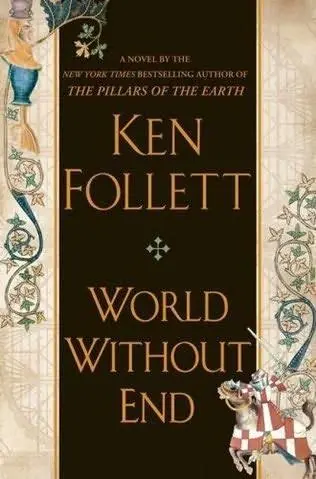
- Название:World Without End
- Автор:
- Жанр:
- Год:неизвестен
- ISBN:нет данных
- Рейтинг книги:5 / 5. Голосов: 1
-
Избранное:Добавить в избранное
- Отзывы:
-
Ваша оценка:
World Without End: краткое содержание, описание и аннотация
Предлагаем к чтению аннотацию, описание, краткое содержание или предисловие (зависит от того, что написал сам автор книги «World Without End»). Если вы не нашли необходимую информацию о книге — напишите в комментариях, мы постараемся отыскать её.
Ken Follett has 90 million readers worldwide. The Pillars of the Earth is his bestselling book of all time. Now, eighteen years after the publication of The Pillars of the Earth, Ken Follett has written the most-anticipated sequel of the year, World Without End.
In 1989 Ken Follett astonished the literary world with The Pillars of the Earth, a sweeping epic novel set in twelfth-century England centered on the building of a cathedral and many of the hundreds of lives it affected. Critics were overwhelmed-"it will hold you, fascinate you, surround you" (Chicago Tribune)-and readers everywhere hoped for a sequel.
World Without End takes place in the same town of Kingsbridge, two centuries after the townspeople finished building the exquisite Gothic cathedral that was at the heart of The Pillars of the Earth. The cathedral and the priory are again at the center of a web of love and hate, greed and pride, ambition and revenge, but this sequel stands on its own. This time the men and women of an extraordinary cast of characters find themselves at a crossroad of new ideas-about medicine, commerce, architecture, and justice. In a world where proponents of the old ways fiercely battle those with progressive minds, the intrigue and tension quickly reach a boiling point against the devastating backdrop of the greatest natural disaster ever to strike the human race-the Black Death.
Three years in the writing, and nearly eighteen years since its predecessor, World Without End breathes new life into the epic historical novel and once again shows that Ken Follett is a masterful author writing at the top of his craft.
World Without End — читать онлайн бесплатно полную книгу (весь текст) целиком
Ниже представлен текст книги, разбитый по страницам. Система сохранения места последней прочитанной страницы, позволяет с удобством читать онлайн бесплатно книгу «World Without End», без необходимости каждый раз заново искать на чём Вы остановились. Поставьте закладку, и сможете в любой момент перейти на страницу, на которой закончили чтение.
Интервал:
Закладка:
Caris understood. Formwork, or centering, was the wooden frame that held the masonry in place until the mortar dried.
Merthin said: “Not much room for formwork inside that narrow spire. And how would it be supported?” His tone was polite, but Caris could tell from its briskness that he did not like Harold.
“I could believe it if the spire was going to be round.”
Caris understood this, too. A round spire could be built by placing one circle of stones on top of another, each a little narrower than the last. No formwork was needed because the circle was self-supporting: the stones could not fall inwards because they pressed on one another. The same was not true of any shape with corners.
“You’ve seen the drawings,” Merthin said. “It’s an octagon.”
The corner turrets on the top of the square tower faced diagonally outwards, easing the eye as it progressed upwards to the different shape of the narrower spire. Merthin had copied this feature from Chartres. But it made sense only if the tower was octagonal.
Harold said: “But how can you build an octagonal tower without formwork?”
“Wait and see,” said Merthin, and he moved away.
As they walked down the main street Caris said: “Why won’t you tell people how you’re going to do it?”
“So that they can’t fire me,” he replied. “When I was building the bridge, as soon as I’d done the hard part they got rid of me, and hired someone cheaper.”
“I remember.”
“They can’t do that now, because no one else can build the spire.”
“You were a youngster then. Now you’re alderman. No one would dare sack you.”
“Perhaps not. But it’s nice to feel they can’t.”
At the bottom of the main street, where the old bridge had stood, there was a disreputable tavern called the White Horse. Caris saw Merthin’s sixteen-year-old daughter, Lolla, leaning on the wall outside, with a group of older friends. Lolla was an attractive girl, with olive skin and lustrous dark hair, a generous mouth and sultry brown eyes. The group was crowded around a dice game, and they were all drinking ale from large tankards. Caris was sorry, though not surprised, to see her stepdaughter carousing on the street at midday.
Merthin was angry. He went up to Lolla and took her arm. “You’d better come home for your dinner,” he said in a tight voice.
She tossed her head, shaking her thick hair in a gesture that was undoubtedly meant for the eyes of someone other than her father. “I don’t want to go home, I’m happy here,” she said.
“I didn’t ask what you wanted,” Merthin replied, and he jerked her away from the others.
A good-looking boy of about twenty detached himself from the crowd. He had curly hair and a mocking smile, and he was picking his teeth with a twig. Caris recognized Jake Riley, a lad of no particular profession who nevertheless always seemed to have money to spend. He sauntered over. “What’s going on?” he said. He spoke with the twig sticking out of his mouth like an insult.
“None of your damn business,” Merthin said.
Jake stood in his way. “The girl doesn’t want to leave.”
“You’d better get out of my way, son, unless you want to spend the rest of the day in the town stocks.”
Caris froze with anxiety. Merthin was in the right: he was entitled to discipline Lolla, who was still five years short of adulthood. But Jake was the kind of boy who might punch him anyway, and take the consequences. However, Caris did not intervene, knowing it might make Merthin angry with her instead of with Jake.
Jake said: “I suppose you’re her father.”
“You know perfectly well who I am, and you can call me Alderman, and speak respectfully to me, or suffer the consequences.”
Jake stared insolently at Merthin a moment longer then turned aside, casually saying: “Yes, all right.”
Caris was relieved that the confrontation had not turned into fisticuffs. Merthin never got into fights, but Lolla was capable of driving him to distraction.
They walked on towards the bridge. Lolla shook herself free of her father’s grasp and walked on ahead, arms folded under her breasts, head down, frowning and muttering to herself in a full-dress sulk.
This was not the first time Lolla had been seen in bad company. Merthin was horrified and enraged that his little girl should be so determined to seek out such people. “Why does she do it?” he said to Caris as they followed Lolla across the bridge to Leper Island.
“God knows.” Caris had observed that this kind of behaviour was more common in youngsters who had suffered the loss of a parent. After Silvia died, Lolla had been mothered by Bessie Bell, Lady Philippa, Merthin’s housekeeper Em, and of course Caris herself. Perhaps she was confused about who she should obey. But Caris did not voice this thought, as it might seem to suggest that Merthin had somehow failed as a parent. “I had terrible fights with Aunt Petranilla when I was that age.”
“What about?”
“Similar things. She didn’t like me spending time with Mattie Wise.”
“That’s completely different. You didn’t go to low taverns with rogues.”
“Petranilla thought Mattie was bad company.”
“It’s not the same.”
“I suppose not.”
“You learned a lot from Mattie.”
Lolla was undoubtedly learning a lot from handsome Jake Riley, but Caris kept that inflammatory thought to herself – Merthin was furious enough already.
The island was entirely built up now, and an integral part of the city. It even had its own parish church. Where once they had wandered across waste ground, they now followed a footpath that ran straight between houses and turned sharp corners. The rabbits had long gone. The hospital occupied most of the western end. Although Caris went there every day, she still felt a glow of pride when she looked at the clean grey stonework, the large windows in regular rows and the chimneys lined up like soldiers.
They passed through a gate into Merthin’s grounds. The orchard was mature, and blossom covered the apple trees like snow.
As always, they went in through the kitchen door. The house had a grand entrance on the river side which no one ever used. Even a brilliant architect can make a mistake, Caris thought with amusement; but, once again, she decided to give the thought no voice today.
Lolla stamped upstairs to her room.
From the front room a woman called: “Hello, everyone!” The two boys rushed into the parlour with glad cries. It was their mother, Philippa. Merthin and Caris greeted her warmly.
Caris and Philippa had become sisters-in-law when Caris married Merthin, but their past rivalry had continued to make Caris feel awkward in Philippa’s presence for some years. Eventually the boys had brought them together. When first Gerry then Roley enrolled at the priory school, it was natural for Merthin to look after his nephews, and then it became normal for Philippa to call at Merthin’s house whenever she was in Kingsbridge.
At first, Caris had felt jealous of Philippa for having attracted Merthin sexually. Merthin had never tried to pretend that his love for Philippa had been merely superficial. He clearly still cared about her. But Philippa nowadays cut a sad figure. She was forty-nine and looked older, her hair grey and her face lined with disappointment. She lived now for her children. She was a frequent guest of her daughter, Odila, the countess of Monmouth; and when she was not there she often visited Kingsbridge Priory to be close to her sons. She managed to spend very little time at Earlscastle with her husband Ralph.
“I’ve got to take the boys to Shiring,” she said, explaining her presence here. “Ralph wants them to attend the county court with him. He says it’s a necessary part of their education.”
Читать дальшеИнтервал:
Закладка:
Похожие книги на «World Without End»
Представляем Вашему вниманию похожие книги на «World Without End» списком для выбора. Мы отобрали схожую по названию и смыслу литературу в надежде предоставить читателям больше вариантов отыскать новые, интересные, ещё непрочитанные произведения.











Обсуждение, отзывы о книге «World Without End» и просто собственные мнения читателей. Оставьте ваши комментарии, напишите, что Вы думаете о произведении, его смысле или главных героях. Укажите что конкретно понравилось, а что нет, и почему Вы так считаете.