Ken Follett - World Without End
Здесь есть возможность читать онлайн «Ken Follett - World Without End» весь текст электронной книги совершенно бесплатно (целиком полную версию без сокращений). В некоторых случаях можно слушать аудио, скачать через торрент в формате fb2 и присутствует краткое содержание. Жанр: Историческая проза, на английском языке. Описание произведения, (предисловие) а так же отзывы посетителей доступны на портале библиотеки ЛибКат.
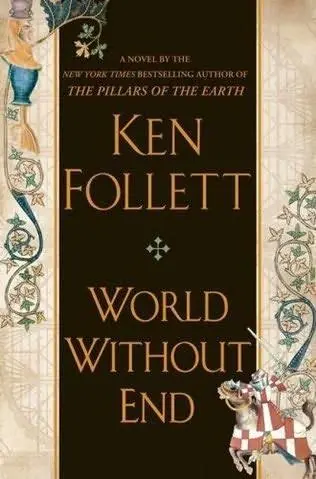
- Название:World Without End
- Автор:
- Жанр:
- Год:неизвестен
- ISBN:нет данных
- Рейтинг книги:5 / 5. Голосов: 1
-
Избранное:Добавить в избранное
- Отзывы:
-
Ваша оценка:
World Without End: краткое содержание, описание и аннотация
Предлагаем к чтению аннотацию, описание, краткое содержание или предисловие (зависит от того, что написал сам автор книги «World Without End»). Если вы не нашли необходимую информацию о книге — напишите в комментариях, мы постараемся отыскать её.
Ken Follett has 90 million readers worldwide. The Pillars of the Earth is his bestselling book of all time. Now, eighteen years after the publication of The Pillars of the Earth, Ken Follett has written the most-anticipated sequel of the year, World Without End.
In 1989 Ken Follett astonished the literary world with The Pillars of the Earth, a sweeping epic novel set in twelfth-century England centered on the building of a cathedral and many of the hundreds of lives it affected. Critics were overwhelmed-"it will hold you, fascinate you, surround you" (Chicago Tribune)-and readers everywhere hoped for a sequel.
World Without End takes place in the same town of Kingsbridge, two centuries after the townspeople finished building the exquisite Gothic cathedral that was at the heart of The Pillars of the Earth. The cathedral and the priory are again at the center of a web of love and hate, greed and pride, ambition and revenge, but this sequel stands on its own. This time the men and women of an extraordinary cast of characters find themselves at a crossroad of new ideas-about medicine, commerce, architecture, and justice. In a world where proponents of the old ways fiercely battle those with progressive minds, the intrigue and tension quickly reach a boiling point against the devastating backdrop of the greatest natural disaster ever to strike the human race-the Black Death.
Three years in the writing, and nearly eighteen years since its predecessor, World Without End breathes new life into the epic historical novel and once again shows that Ken Follett is a masterful author writing at the top of his craft.
World Without End — читать онлайн бесплатно полную книгу (весь текст) целиком
Ниже представлен текст книги, разбитый по страницам. Система сохранения места последней прочитанной страницы, позволяет с удобством читать онлайн бесплатно книгу «World Without End», без необходимости каждый раз заново искать на чём Вы остановились. Поставьте закладку, и сможете в любой момент перейти на страницу, на которой закончили чтение.
Интервал:
Закладка:
Sam had not said where he would go, and he had given no warning of his departure. If Davey had done the same, Gwenda would have known he had thought things out carefully and decided this was the best way. But she felt sure Sam had just followed an impulse. Someone had mentioned the name of a village, and he had woken up early the next morning and decided to go there immediately.
She told herself not to worry. He was twenty-two years old, big and strong. No one was going to exploit him or ill-treat him. But she was his mother, and her heart ached.
If she could not find him, no one else could, she figured, and that was good. All the same she yearned to know where he was living, and if he was working for a decent master, and whether the people were kind to him.
That winter, Wulfric had made a new light plough for the sandier acres of his holding, and one day in spring Gwenda and he went to Northwood to buy an iron ploughshare, the one part they could not make for themselves. As usual, a small group of Wigleigh folk travelled together to the market. Jack and Eli, who operated the fulling mill for Madge Webber, were stocking up on supplies: they had no land of their own so they bought all their food. Annet and her eighteen-year-old daughter, Amabel, had a dozen hens in a crate, to sell at the market. The bailiff, Nathan, came too, with his grown son Jonno, the childhood enemy of Sam.
Annet still flirted with every good-looking man who crossed her path, and most of them grinned foolishly and flirted back. On the journey to Northwood she chatted with Davey. Although he was less than half her age, she simpered and tossed her head and smacked his arm in mock reproach, just as if she were twenty-two rather than forty-two. She was not a girl any more, but she did not seem to know it, Gwenda thought sourly. Annet’s daughter, Amabel, who was as pretty as Annet had once been, walked a little apart, and seemed embarrassed by her mother.
They reached Northwood at mid-morning. After Wulfric and Gwenda had made their purchase, they went to get their dinner at the Old Oak tavern.
For as long as Gwenda could remember there had been a venerable oak outside the inn, a thick squat tree with malformed branches that looked like a bent old man in winter and cast a welcome deep shade in summer. Her sons had chased one another around it as little boys. But it must have died or become unstable, for it had been chopped down, and now there was a stump, as wide across as Wulfric was tall, used by the customers as a chair, a table, and – for one exhausted carter – a bed.
Sitting on its edge, drinking ale from a huge tankard, was Harry Ploughman, the bailiff of Outhenby.
Gwenda was taken back twelve years in a blink. What came to her mind, so forcefully that it brought tears to her eyes, was the hope that had lifted her heart as she and her family had set out, that morning in Northwood, to walk through the forest to Outhenby and a new life. The hope had been crushed, in less than a fortnight, and Wulfric had been taken back to Wigleigh – the memory still made her burn with rage – with a rope around his neck.
But Ralph had not had things all his own way since then. Circumstances had forced him to give Wulfric back the lands his father had held, which for Gwenda had been a savagely satisfying outcome, even though Wulfric had not been smart enough to win a free tenancy, unlike some of his neighbours. Gwenda was glad they were now tenants rather than labourers, and Wulfric had achieved his life’s ambition; but she still longed for more independence – a tenancy free of feudal obligations, with a cash rent to pay, the whole agreement written down in the manorial records so that no lord could go back on it. It was what most serfs wanted, and more of them were getting it since the plague.
Harry greeted them effusively and insisted on buying them ale. Soon after Wulfric and Gwenda’s brief stay at Outhenby, Harry had been made bailiff by Mother Caris, and he still held that position, though Caris had long ago renounced her vows, and Mother Joan was now prioress. Outhenby continued prosperous, to judge by Harry’s double chin and alehouse belly.
As they were preparing to leave with the rest of the Wigleigh folk, Harry spoke to Gwenda in a low voice. “I’ve got a young man called Sam labouring for me.”
Gwenda’s heart leaped. “My Sam?”
“Can’t possibly be, no.”
She was bewildered. Why mention him, in that case?
But Harry tapped his wine-red nose, and Gwenda realized he was being enigmatic. “This Sam assures me that his lord is a Hampshire knight I’ve never heard of, who has given him permission to leave his village and work elsewhere, whereas your Sam’s lord is Earl Ralph, who never lets his labourers go. Obviously I couldn’t employ your Sam.”
Gwenda understood. That would be Harry’s story if official questions were asked. “So, he’s in Outhenby.”
“Oldchurch, one of the smaller villages in the valley.”
“Is he well?” she asked eagerly.
“Thriving.”
“Thank God.”
“A strong boy and a good worker, though he can be quarrelsome.”
She knew that. “Is he living in a warm house?”
“Lodging with a good-hearted older couple whose own son has gone to Kingsbridge to be apprenticed to a tanner.”
Gwenda had a dozen questions, but suddenly she noticed the bent figure of Nathan Reeve leaning on the doorpost of the tavern entrance, staring at her. She suppressed a curse. There was so much she wanted to know, but she was terrified of giving Nate even a clue to Sam’s whereabouts. She needed to be content with what she had. And she was thrilled that at least she knew where he could be found.
She turned away from Harry, trying to give the impression of casually ending an unimportant conversation. Out of the corner of her mouth she said: “Don’t let him get into fights.”
“I’ll do what I can.”
She waved perfunctorily and went after Wulfric.
Walking home with the others, Wulfric carried the heavy ploughshare on his shoulder with no apparent effort. Gwenda was bursting to tell him the news, but she had to wait until the group straggled out along the road, and she and her husband were separated from the others by a few yards. Then she repeated the conversation, speaking quietly.
Wulfric was relieved. “At least we know where the lad has got to,” he said, breathing easily despite his load.
“I want to go to Outhenby,” Gwenda said.
Wulfric nodded. “I thought you might.” He rarely challenged her, but now he expressed a misgiving. “Dangerous, though. You’ll have to make sure no one finds out where you’ve gone.”
“Exactly. Nate mustn’t know.”
“How will you manage that?”
“He’s sure to notice that I’m not in the village for a couple of days. We’ll have to think of a story.”
“We can say you’re sick.”
“Too risky. He’ll probably come to the house to check.”
“We could say you’re at your father’s place.”
“Nate won’t believe that. He knows I never stay there longer than I have to.” She gnawed at a hangnail, racking her brains. In the ghost stories and fairy tales that people told around the fire on long winter evenings, the characters generally believed one another’s lies without question; but real people were less easily duped. “We could say I’ve gone to Kingsbridge,” she said at last.
“What for?”
“To buy laying hens at the market, perhaps.”
“You could buy hens from Annet.”
“I wouldn’t buy anything from that bitch, and people know it.”
“True.”
“And Nate knows I’ve always been a friend of Caris, so he’ll believe I could be staying with her.”
“All right.”
It was not much of a story, but she could not think of anything better. And she was desperate to see her son.
Читать дальшеИнтервал:
Закладка:
Похожие книги на «World Without End»
Представляем Вашему вниманию похожие книги на «World Without End» списком для выбора. Мы отобрали схожую по названию и смыслу литературу в надежде предоставить читателям больше вариантов отыскать новые, интересные, ещё непрочитанные произведения.


Обсуждение, отзывы о книге «World Without End» и просто собственные мнения читателей. Оставьте ваши комментарии, напишите, что Вы думаете о произведении, его смысле или главных героях. Укажите что конкретно понравилось, а что нет, и почему Вы так считаете.