Ken Follett - World Without End
Здесь есть возможность читать онлайн «Ken Follett - World Without End» весь текст электронной книги совершенно бесплатно (целиком полную версию без сокращений). В некоторых случаях можно слушать аудио, скачать через торрент в формате fb2 и присутствует краткое содержание. Жанр: Историческая проза, на английском языке. Описание произведения, (предисловие) а так же отзывы посетителей доступны на портале библиотеки ЛибКат.
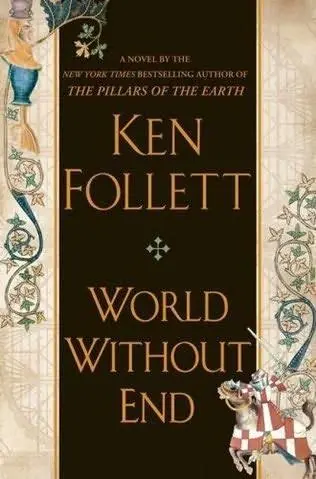
- Название:World Without End
- Автор:
- Жанр:
- Год:неизвестен
- ISBN:нет данных
- Рейтинг книги:5 / 5. Голосов: 1
-
Избранное:Добавить в избранное
- Отзывы:
-
Ваша оценка:
World Without End: краткое содержание, описание и аннотация
Предлагаем к чтению аннотацию, описание, краткое содержание или предисловие (зависит от того, что написал сам автор книги «World Without End»). Если вы не нашли необходимую информацию о книге — напишите в комментариях, мы постараемся отыскать её.
Ken Follett has 90 million readers worldwide. The Pillars of the Earth is his bestselling book of all time. Now, eighteen years after the publication of The Pillars of the Earth, Ken Follett has written the most-anticipated sequel of the year, World Without End.
In 1989 Ken Follett astonished the literary world with The Pillars of the Earth, a sweeping epic novel set in twelfth-century England centered on the building of a cathedral and many of the hundreds of lives it affected. Critics were overwhelmed-"it will hold you, fascinate you, surround you" (Chicago Tribune)-and readers everywhere hoped for a sequel.
World Without End takes place in the same town of Kingsbridge, two centuries after the townspeople finished building the exquisite Gothic cathedral that was at the heart of The Pillars of the Earth. The cathedral and the priory are again at the center of a web of love and hate, greed and pride, ambition and revenge, but this sequel stands on its own. This time the men and women of an extraordinary cast of characters find themselves at a crossroad of new ideas-about medicine, commerce, architecture, and justice. In a world where proponents of the old ways fiercely battle those with progressive minds, the intrigue and tension quickly reach a boiling point against the devastating backdrop of the greatest natural disaster ever to strike the human race-the Black Death.
Three years in the writing, and nearly eighteen years since its predecessor, World Without End breathes new life into the epic historical novel and once again shows that Ken Follett is a masterful author writing at the top of his craft.
World Without End — читать онлайн бесплатно полную книгу (весь текст) целиком
Ниже представлен текст книги, разбитый по страницам. Система сохранения места последней прочитанной страницы, позволяет с удобством читать онлайн бесплатно книгу «World Without End», без необходимости каждый раз заново искать на чём Вы остановились. Поставьте закладку, и сможете в любой момент перейти на страницу, на которой закончили чтение.
Интервал:
Закладка:
She spoke to nobody as she walked across the cloisters, up the stairs, and through the dormitory to her own room. She lay face down on her bed, her head pounding.
She had lost Menhin, she had lost her hospital, she had lost everything.
Head injuries could be fatal, she knew. Perhaps she would go to sleep now and never wake up.
Perhaps that would be for the best.
79
Merthin’s orchard had been planted in the spring of 1349. A year later most of the trees were established, and came out in a scatter of brave leaves. Two or three were struggling, and only one was inarguablv dead. He did not expect any of them to bear fruit yet but, by July, to his surprise, one precocious sapling had a dozen or so tiny dark-green pears, small as yet and as hard as stones, but promising ripeness in the autumn.
One Sunday afternoon he showed them to Lolla, who refused to believe that they would grow into the tangy, juicy fruits she loved. She thought – or pretended to think – that he was playing one of his teasing games. When he asked her where she imagined ripe pears came from, she looked at him reproachfully and said: “The market, silly!”
She, too, would ripen one day, he thought, although it was hard to imagine her bony body rounding out into the soft shape of a woman. He wondered whether she would bear him grandchildren. She was five years old, so that day might be only a decade or so away.
His thoughts were on ripeness when he saw Philippa coming towards him through the garden, and it struck him how round and full her breasts were. It was unusual for her to visit him in daylight, and he wondered what had brought her here. In case they were observed, he greeted her with only a chaste kiss on the cheek, such as a brother-in-law might give without arousing comment.
She looked troubled, and he realized that for a few days now she had been more reserved and thoughtful than usual. As she sat beside him on the grass he said: “Something on your mind?”
“I’ve never been good at breaking news gently,” she said. “I’m pregnant.”
“Good God!” He was too shocked to hold back his reaction. “I’m surprised because you told me…”
“I know. I was sure I was too old. For a couple of years my monthly cycle was irregular, and then it stopped altogether – I thought. But I’ve been vomiting in the morning, and my nipples hurt.”
“I noticed your breasts as you came into the garden. But can you be sure?”
“I’ve been pregnant six times previously – three children and three miscarriages – and I know the feeling. There’s really no doubt.”
He smiled. “Well, we’re going to have a child.”
She did not return the smile. “Don’t look pleased. You haven’t thought through the implications. I’m the wife of the earl of Shiring. I haven’t slept with him since October, haven’t lived with him since February, yet in July I’m two or at most three months pregnant. He and the whole world will know that the baby is not his, and that the countess of Shiring has committed adultery.”
“But he wouldn’t…”
“Kill me? He killed Tilly, didn’t he?”
“Oh, my God. Yes, he did. But…”
“And if he killed me, he might kill my baby, too.”
Merthin wanted to say it was not possible, that Ralph would not do such a thing – but he knew otherwise.
“I have to decide what to do,” said Philippa.
“I don’t think you should try to end the pregnancy with potions – it’s too dangerous.”
“I won’t do that.”
“So you’ll have the baby.”
“Yes. But then what?”
“Suppose you stayed in the nunnery, and kept the baby secret? The place is full of children orphaned by the plague.”
“But what couldn’t be kept secret is a mother’s love. Everyone would know that the child was my particular care. And then Ralph would find out.”
“You’re right.”
“I could go away – vanish. London, York, Paris, Avignon. Not tell anyone where I was going, so that Ralph could never come after me.”
“And I could go with you.”
“But then you wouldn’t finish your tower.”
“And you would miss Odila.”
Philippa’s daughter had been married to Earl David for six months. Merthin could imagine how hard it would be for Philippa to leave her. And the truth was that he would find it agony to abandon his tower. All his adult life he had wanted to build the tallest building in England. Now that he had at last begun, it would break his heart to abandon the project.
Thinking of the tower brought Caris to mind. He knew, intuitively, that she would be devastated by this news. He had not seen her for weeks: she had been ill in bed after suffering a blow on the head at the Fleece Fair, and now, though she was completely recovered, she rarely emerged from the priory. He guessed that she had lost some kind of power struggle, for the hospital was being run by Brother Sime. Philippa’s pregnancy would be another shattering blow for Caris.
Philippa added: “And Odila, too, is pregnant.”
“So soon! That’s good news. But even more reason why you can’t go into exile and never see her, or your grandchild.”
“I can’t run, and I can’t hide. But, if I do nothing, Ralph will kill me.”
“There must be a way out of this,” Merthin said.
“I can think of only one answer.”
He looked at her. She had thought this out already, he realized. She had not told him about the problem until she had the solution. But she had been careful to show him that all the obvious answers were wrong. That meant he was not going to like the plan she had settled on.
“Tell me,” he said.
“We have to make Ralph think the baby is his.”
“But then you’d have to…”
“Yes.”
“I see.”
The thought of Philippa sleeping with Ralph was loathsome to Merthin. This was not so much jealousy, though that was a factor. What weighed most with him was how terrible she would feel about it. She had a physical and emotional revulsion from Ralph. Merthin understood the revulsion, though he did not share it. He had lived with Ralph’s brutishness all his life, and the brute was his brother, and somehow that fact remained no matter what Ralph did. All the same, it made him sick to think that Philippa would have to force herself to have sex with the man she hated most in the world.
“I wish I could think of a better way,” he said.
“So do I.”
He looked hard at her. “You’ve already decided.”
“Yes.”
“I’m very sorry.”
“So am I.”
“But will it even work? Can you… seduce him?”
“I don’t know,” she said. “I’ll just have to try.”
The cathedral was symmetrical. The mason’s loft was at the west end in the low north tower, overlooking the north porch. In the matching south-west tower was a room of similar size and shape that looked over the cloisters. It was used to store items of small value that were used only rarely. All the costumes and symbolic objects employed in the mystery plays were there, together with an assortment of not-quite-useless things: wooden candlesticks, rusty chains, cracked pots, and a book whose vellum pages had rotted with age so that the words penned so painstakingly were no longer legible.
Merthin went there to check how upright the wall was, by dangling a lead pointer on a long string from the window; and while there he made a discovery.
There were cracks in the wall. Cracks were not necessarily a sign of weakness: their meaning had to be interpreted by an experienced eye. All buildings moved, and cracks might simply show how a structure was adjusting to accommodate change. Merthin judged that most of the cracks in the wall of this storeroom were benign. But there was one that puzzled him by its shape. It did not look normal. A second glance told him that someone had taken advantage of a natural crack to loosen a small stone. He removed the stone.
Читать дальшеИнтервал:
Закладка:
Похожие книги на «World Without End»
Представляем Вашему вниманию похожие книги на «World Without End» списком для выбора. Мы отобрали схожую по названию и смыслу литературу в надежде предоставить читателям больше вариантов отыскать новые, интересные, ещё непрочитанные произведения.









Обсуждение, отзывы о книге «World Without End» и просто собственные мнения читателей. Оставьте ваши комментарии, напишите, что Вы думаете о произведении, его смысле или главных героях. Укажите что конкретно понравилось, а что нет, и почему Вы так считаете.