Ken Follett - World Without End
Здесь есть возможность читать онлайн «Ken Follett - World Without End» весь текст электронной книги совершенно бесплатно (целиком полную версию без сокращений). В некоторых случаях можно слушать аудио, скачать через торрент в формате fb2 и присутствует краткое содержание. Жанр: Историческая проза, на английском языке. Описание произведения, (предисловие) а так же отзывы посетителей доступны на портале библиотеки ЛибКат.
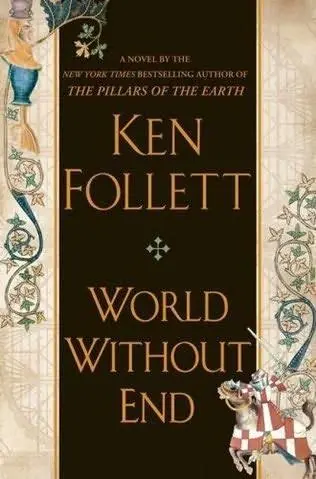
- Название:World Without End
- Автор:
- Жанр:
- Год:неизвестен
- ISBN:нет данных
- Рейтинг книги:5 / 5. Голосов: 1
-
Избранное:Добавить в избранное
- Отзывы:
-
Ваша оценка:
World Without End: краткое содержание, описание и аннотация
Предлагаем к чтению аннотацию, описание, краткое содержание или предисловие (зависит от того, что написал сам автор книги «World Without End»). Если вы не нашли необходимую информацию о книге — напишите в комментариях, мы постараемся отыскать её.
Ken Follett has 90 million readers worldwide. The Pillars of the Earth is his bestselling book of all time. Now, eighteen years after the publication of The Pillars of the Earth, Ken Follett has written the most-anticipated sequel of the year, World Without End.
In 1989 Ken Follett astonished the literary world with The Pillars of the Earth, a sweeping epic novel set in twelfth-century England centered on the building of a cathedral and many of the hundreds of lives it affected. Critics were overwhelmed-"it will hold you, fascinate you, surround you" (Chicago Tribune)-and readers everywhere hoped for a sequel.
World Without End takes place in the same town of Kingsbridge, two centuries after the townspeople finished building the exquisite Gothic cathedral that was at the heart of The Pillars of the Earth. The cathedral and the priory are again at the center of a web of love and hate, greed and pride, ambition and revenge, but this sequel stands on its own. This time the men and women of an extraordinary cast of characters find themselves at a crossroad of new ideas-about medicine, commerce, architecture, and justice. In a world where proponents of the old ways fiercely battle those with progressive minds, the intrigue and tension quickly reach a boiling point against the devastating backdrop of the greatest natural disaster ever to strike the human race-the Black Death.
Three years in the writing, and nearly eighteen years since its predecessor, World Without End breathes new life into the epic historical novel and once again shows that Ken Follett is a masterful author writing at the top of his craft.
World Without End — читать онлайн бесплатно полную книгу (весь текст) целиком
Ниже представлен текст книги, разбитый по страницам. Система сохранения места последней прочитанной страницы, позволяет с удобством читать онлайн бесплатно книгу «World Without End», без необходимости каждый раз заново искать на чём Вы остановились. Поставьте закладку, и сможете в любой момент перейти на страницу, на которой закончили чтение.
Интервал:
Закладка:
All the same, it was easily the best English scarlet that had ever been seen at Kingsbridge, and business was brisk. Mark and Madge sold it retail by the yard, measuring and cutting for individual customers, and Caris dealt with wholesale buyers, negotiating reductions for one bale or six with drapers from Winchester, Gloucester and even London. By midday on Monday she knew she would sell out before the end of the week.
When business slowed down for the dinner break she strolled around the fair. She felt a profound sense of satisfaction. She had triumphed over adversity, and so had Merthin. She stopped at Perkin’s stall to talk to the Wigleigh folk. Even Gwenda had triumphed. Here she was, married to Wulfric – something that had seemed impossible – and there was her baby, Sammy, a year old, sitting on the ground, fat and happy. Annet was selling eggs from a tray, as always. And Ralph had gone to France to fight for the king, and might never come back.
Farther on she saw Joby, Gwenda’s father, selling his squirrel furs. There was a wicked man. But he seemed to have lost his power to hurt Gwenda.
Caris stopped at her own father’s stall. She had persuaded him to buy fleece in smaller quantities this year. The international wool market could not possibly thrive when the French and English were raiding one another’s ports and burning ships. “How is business?” she asked him.
“Steady,” he said. “I think I’ve judged it about right.” He forgot that it had been her judgement, not his, that had counselled caution. But that was all right.
Their cook, Tutty, appeared with Edmund’s dinner: mutton stew in a pot, a loaf of bread and a jug of ale. It was important to look prosperous, but not overly so. Edmund had explained to Caris, many years ago, that although customers needed to believe they were buying from a successful business, they would resent contributing to the wealth of someone who appeared to be rolling in money.
“Are you hungry?” he asked her.
“Starving.”
He stood up to reach for the stew pot. Then he staggered, made an odd sound half way between a grunt and a cry, and fell to the ground.
The cook screamed.
Caris cried: “Father!” But she knew he would not respond. She could tell he was unconscious by the way he hit the earth, inertly heavy, like a sack of onions. She fought down the urge to scream. She knelt beside him. He was alive, and breathing hoarsely. She grasped his wrist and felt his pulse: it was strong, but slow. His face seemed flushed. It was always reddish, but now it seemed more so than usual.
Tutty said: “What is it? What is it?”
Caris forced herself to speak calmly. “He’s had a fit,” she said. “Fetch Mark Webber. He can carry Father into the hospital.”
The cook ran off. People from the neighbouring stalls gathered around. Dick Brewer appeared and said: “Poor Edmund – what can I do?”
Dick was too old and fat to lift Edmund. Caris said: “Mark’s coming to take him to the hospital.” She began to cry. “I hope he’ll be all right,” she said.
Mark appeared. He lifted Edmund easily, cradling him gently in his strong arms, and walked towards the hospital, negotiating his way through the crowds, calling: “Mind out, there! Out of the way, please! Injured man, injured man.”
Caris followed, distraught. She could hardly see through her tears, so she stayed close to Mark’s broad back. They reached the hospital building and went inside. Caris was grateful to see the familiar knobbly face of Old Julie. “Fetch Mother Cecilia, as quick as you can!” Caris said to her. The old nun hurried away, and Mark laid Edmund on a pallet near the altar.
Edmund was still unconscious, eyes closed, breathing hoarsely. Caris felt his forehead: he was neither hot nor cold. What had caused this? It had been so sudden. One moment he had been talking normally, the next he fell down unconscious. How could such a thing happen?
Mother Cecilia came. Her bustling efficiency was reassuring. She knelt beside the pallet and felt Edmund’s heart, then his pulse. She listened to his breathing and touched his face. “Get him a pillow and a blanket,” she said to Julie. “Then fetch one of the monk-physicians.”
She stood up and looked at Caris. “He’s had a fit,” she said. “He may recover. All we can do is make him comfortable. The physician may recommend bleeding, but apart from that the only treatment is prayer.”
That was not good enough for Caris. “I’m going for Mattie,” she said.
She ran out of the building and dodged through the fair, remembering that she had done exactly the same thing a year ago, rushing to fetch Mattie when Gwenda was bleeding to death. This time it was her father, and she felt a different kind of panic. She had been desperately worried about Gwenda, but now it was as if the world was falling apart. The fear that her father might die gave her the dreadful feeling she sometimes got in dreams, when she found herself on the roof of Kingsbridge Cathedral with no way down but to jump.
The physical effort of running through the streets calmed her a little, and she was in control of her emotions by the time she came to Mattie’s house. Mattie would know what to do. She would say: I’ve seen this before, I know what will happen next, here’s the treatment that helps.
Caris banged on the door. Hearing no immediate answer, she impatiently tried the latch and found it open. She dashed inside, saying: “Mattie, you have to come to the hospital right away, it’s my father!”
The front room was empty. Caris pulled aside the curtain that screened off the kitchen. Mattie was not there, either. Caris said aloud: “Oh, why would you be out of the house at this very moment?” She looked around for some clue as to where Mattie might have gone. Then she noticed how stripped the room appeared. All the little jars and bottles had gone, leaving the shelves bare. There were none of the mortars and pestles Mattie used for grinding ingredients, none of her small pots for melting and boiling, no knives for chopping herbs. Caris returned to the front half of the house and saw that Mattie’s personal possessions had also disappeared: her sewing box, her polished wood cups for wine, the embroidered shawl she had hung on the wall for decoration, the carved bone comb she treasured.
Mattie had packed up and gone.
And Caris could guess why. Mattie must have heard about Philemon’s questions in church yesterday. Traditionally, the ecclesiastical court held a session on the Saturday of Fleece Fair week. Only two years ago the monks had used the occasion for the trial of Crazy Nell on the absurd charge of heresy.
Mattie was no heretic, of course, but it was difficult to prove that, as many old women had learned. She had calculated her chances of surviving a trial, and found the answer frightening. Without telling anyone, she had packed up her possessions and left town. Probably she had found a peasant returning home after selling his produce, and persuaded him to take her on his ox-cart. Caris imagined her leaving at first light, her box beside her on the cart, the hood of her cloak pulled forward to hide her face. No one could even guess where she had gone.
“What am I going to do?” Caris said to the empty room. Mattie knew better than anyone else in Kingsbridge how to help sick people. This was the worst possible moment for her to disappear, just when Edmund lay unconscious in the hospital. Caris felt despair.
She sat down on Mattie’s chair, still panting from the effort of running. She wanted to run back to the hospital, but there was no point. She would not be able to help her father. Nobody could.
The town must have a healer, she thought; one who does not rely on prayers and holy water, or bleeding, but uses simple treatments that have been shown to work. And as she sat in Mattie’s empty house, she realized that there was one person who could fill the role, someone who knew Mattie’s methods and believed in her practical philosophy. That person was Caris herself.
Читать дальшеИнтервал:
Закладка:
Похожие книги на «World Without End»
Представляем Вашему вниманию похожие книги на «World Without End» списком для выбора. Мы отобрали схожую по названию и смыслу литературу в надежде предоставить читателям больше вариантов отыскать новые, интересные, ещё непрочитанные произведения.









Обсуждение, отзывы о книге «World Without End» и просто собственные мнения читателей. Оставьте ваши комментарии, напишите, что Вы думаете о произведении, его смысле или главных героях. Укажите что конкретно понравилось, а что нет, и почему Вы так считаете.