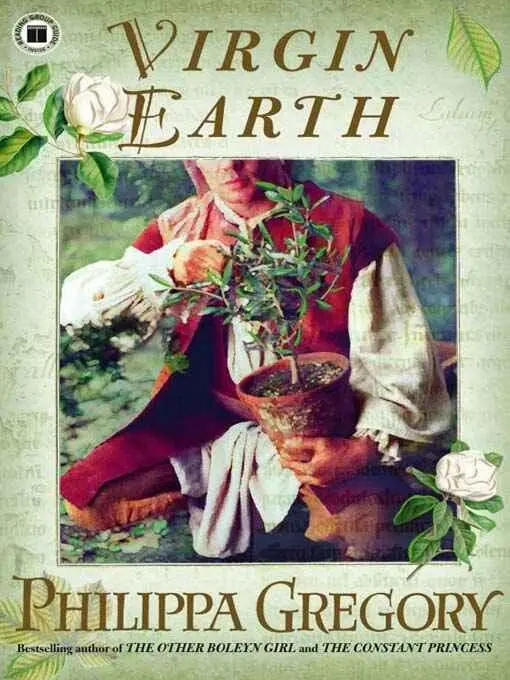
Philippa Gregory - Virgin Earth
Здесь есть возможность читать онлайн «Philippa Gregory - Virgin Earth» — ознакомительный отрывок электронной книги совершенно бесплатно, а после прочтения отрывка купить полную версию. В некоторых случаях можно слушать аудио, скачать через торрент в формате fb2 и присутствует краткое содержание. Жанр: Историческая проза, на английском языке. Описание произведения, (предисловие) а так же отзывы посетителей доступны на портале библиотеки ЛибКат.
- Название:Virgin Earth
- Автор:
- Жанр:
- Год:неизвестен
- ISBN:нет данных
- Рейтинг книги:4 / 5. Голосов: 1
-
Избранное:Добавить в избранное
- Отзывы:
-
Ваша оценка:
Virgin Earth: краткое содержание, описание и аннотация
Предлагаем к чтению аннотацию, описание, краткое содержание или предисловие (зависит от того, что написал сам автор книги «Virgin Earth»). Если вы не нашли необходимую информацию о книге — напишите в комментариях, мы постараемся отыскать её.
Virgin Earth — читать онлайн ознакомительный отрывок
Ниже представлен текст книги, разбитый по страницам. Система сохранения места последней прочитанной страницы, позволяет с удобством читать онлайн бесплатно книгу «Virgin Earth», без необходимости каждый раз заново искать на чём Вы остановились. Поставьте закладку, и сможете в любой момент перейти на страницу, на которой закончили чтение.
Интервал:
Закладка:
Johnnie hesitated.
“When you marched to Colchester were you quartered on poor farms with nothing to spare?” Lambert asked.
“Yes.”
“Then you’ve seen how badly some men live in the middle of plenty. The rents they have to pay are greater than the yield of their crops. We cannot have people forever struggling to make that gap meet. There has to be a balance. People must be paid a fair wage for their work.” He paused. “When you were quartered on a poor farmstead did you take your feed for your horses and a chicken for your dinner and leave them no recompense?”
Johnnie flushed scarlet and shamefacedly nodded.
“Aye, that’s the royal way,” Lambert said bitterly. “That’s the kingly way to behave.”
Johnnie flushed. “I didn’t want to,” he said. “But I had no wages.”
Lambert gripped his arm. “That’s how it happens,” he said. “If all the wealth is concentrated on the king, on the court, then there must be poverty everywhere else. The king raised an army but had no funds so he didn’t pay you, so you had to take forage without paying, so at the end of the line there is some poor widow with one hen and the king’s man comes by and takes all the eggs.”
Hester watched her stepson and Lambert walk to the end of the orchard and then turn toward the lake.
“I hope he can say something that will reconcile Johnnie,” she said. “I’ve been afraid that he will never be happy again.”
“He might,” John agreed. “He’s had the command of many men. He’ll have come across lads like Johnnie before.”
“It’s kind of him to take the trouble,” she said.
John gave a wry smile. “I imagine he’ll take away a pot of my best tulips as his payment, won’t he?”
Hester gave a little laugh. “Not the Semper Augustus, at any rate,” she promised.
Summer 1649
With the coming of the summer the numbers of visitors increased at the Ark and the social life of London was restored. There was an explosion of debate as to how the new society should be built, what should be allowed and what should be forbidden. Pamphlets, sermons, diatribes and journals poured off the little presses which had sprung up everywhere during the war years, new plays were written, new poems commissioned. There was a sense of excitement, of being at the very heart of change, a new world which no one had ever experienced before. Kings had been killed before in England and elsewhere – but only on the battlefield, or in secret, and their thrones snatched by other claimants. Never before had the whole system of kingship been questioned and found so badly wanting that the people chose to destroy it and put no one in its place.
Oliver Cromwell was to be known as chairman of the Council of State, and there would never be another king of England. Even then the new state did not go far enough for many. There was no opening of the electorate: poor men still had no voice in the planning of the nation. There was no abolition of tithes, which many had fought for. There was no reform of the law, nor the ownership of land. The Houses of Parliament were still one House of Lords and a House of Commons packed with landed gentlemen, still serving their own needs before any other; so that the justice that John Lambert had hoped for so passionately was still far away.
But there was a sense of excitement and optimism as palpable as the warmer weather of May and June. There was a sense of changes coming, of hope, of a chance to make England into a country which could be prosperous for the many instead of the few. Families who had been estranged for years, siding with the opposing armies, were able to make friends again. Churches which had been emptied because of doctrinal arguments were now reestablished with a new, freer, informal style of preaching. Men wanted to be done with ceremony, with artifice. Men wanted to speak freely to their God, and to speak freely to each other.
An informal association of philosophers, botanists, mathematicians, physicians and astronomers met regularly to debate, Dr. Thomas Wharton among them, and John Tradescant too. John Lambert was in London from March and rarely missed a meeting, drawn by their discussion of science and botany. Many of them took to visiting the Ark that summer, to stroll around the garden, to sit by the little lake, to admire anything new and interesting in the rarities room and stay for dinner.
Hester, rather on her mettle as a housewife, took pride both in being able to provide dinner for a dozen men and beds for half of them at a moment’s notice, and that it was the Tradescant house and garden which was the center of attraction.
The conversation would go far into the night, and as the levels fell in the bottles of port the speculation about everything from the functions of parts of the body, to the existence of angels, the movement of the planets in their spheres and the rise and fall of sugar sap in John’s maple tree became wilder and more imaginative. Elias Ashmole, a learned lawyer, one evening swore that he could predict to an hour’s accuracy the time of a man’s death if only midwives would have the sense to record the exact time of birth to let an astronomy chart be rigorously drawn.
“But would you want to know?” John asked, slurring slightly.
“I want to know everything,” Elias replied. “That is what I mean by being a man of science. I, for instance, am born beneath the planet Mercury, and you can see that I am a completely mercurial man. I’m quick and versatile.”
“And looks like a silver slug, just like the metal!” someone interposed under his breath.
“But a man should separate the personal from the inquiring in his life,” a physician remarked rather confusedly. “I want to know how blood flows through the veins. But I’m not going to open up my own arm to have a look at it. I am not my own experiment.”
“Not at all!” another man interrupted passionately. “Unless you are prepared to penetrate, even into your own heart, then you are not inquiring at all. It is mere diversion.”
“Oh yes! If you want to die of the plague in an experiment to see that it is infectious!”
“Truly, one cannot study patients from a distance,” Dr. Wharton observed. “When the plague was in London I…”
“And what else have we done in the body politic but make a change and see what flows from it? Cut out the heart and see if the brain can still think?”
“That was not an experiment! It was a decision to which we were driven. I don’t see Cromwell as a great physician of the body politic! He was clinging on while the horse bolted!”
“But I don’t mean that,” John said, holding to his first thought with difficulty. “I mean, would you always want to know the future? How would you bear it?”
“Of course you can know it,” Elias replied. “I have drawn my own chart and I can tell you, for instance, that I shall be a man of considerable fame. I cast my own predictions and they told me clearly: ‘I shall labor for a fortune with a wife and get it.’”
“A rich widow?” someone asked from farther down the table.
“Lady Mary Manwaring,” someone muttered. “Old enough to be his mother. He’s been advising her. Guess what he advised?”
“I shall be remembered,” Ashmole insisted. “I shall have my place in the temple of history.”
“For what?” one of the mathematicians demanded and burped slightly. “Pardon me. What will earn you your place in the temple of history? Simpling in John’s herb garden? Picking his flowers for potions? I don’t expect to see you gleaming all over gold with the philosopher’s stone in your laboratory. Seems to me that of all of us it will be John’s name which will be remembered.”
John laughed. “I just collect,” he said modestly. “I don’t set myself up as a scientist. Of course, I’m bound to wonder how things grow the way they do. I can’t believe that it was all made by God in one week. I can see that man can make new plants, with proper skills. I can see that we can make the earth more yielding, that we can make plants grow better. I have some onions for instance…”
Читать дальшеИнтервал:
Закладка:
Похожие книги на «Virgin Earth»
Представляем Вашему вниманию похожие книги на «Virgin Earth» списком для выбора. Мы отобрали схожую по названию и смыслу литературу в надежде предоставить читателям больше вариантов отыскать новые, интересные, ещё непрочитанные произведения.
Обсуждение, отзывы о книге «Virgin Earth» и просто собственные мнения читателей. Оставьте ваши комментарии, напишите, что Вы думаете о произведении, его смысле или главных героях. Укажите что конкретно понравилось, а что нет, и почему Вы так считаете.