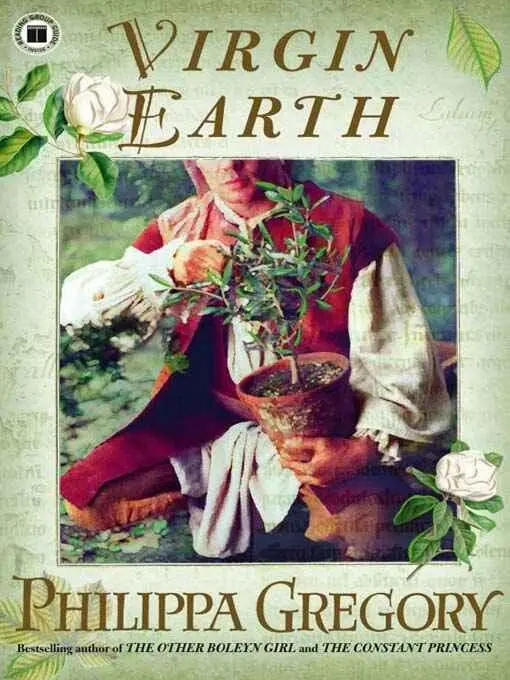
Philippa Gregory - Virgin Earth
Здесь есть возможность читать онлайн «Philippa Gregory - Virgin Earth» — ознакомительный отрывок электронной книги совершенно бесплатно, а после прочтения отрывка купить полную версию. В некоторых случаях можно слушать аудио, скачать через торрент в формате fb2 и присутствует краткое содержание. Жанр: Историческая проза, на английском языке. Описание произведения, (предисловие) а так же отзывы посетителей доступны на портале библиотеки ЛибКат.
- Название:Virgin Earth
- Автор:
- Жанр:
- Год:неизвестен
- ISBN:нет данных
- Рейтинг книги:4 / 5. Голосов: 1
-
Избранное:Добавить в избранное
- Отзывы:
-
Ваша оценка:
Virgin Earth: краткое содержание, описание и аннотация
Предлагаем к чтению аннотацию, описание, краткое содержание или предисловие (зависит от того, что написал сам автор книги «Virgin Earth»). Если вы не нашли необходимую информацию о книге — напишите в комментариях, мы постараемся отыскать её.
Virgin Earth — читать онлайн ознакомительный отрывок
Ниже представлен текст книги, разбитый по страницам. Система сохранения места последней прочитанной страницы, позволяет с удобством читать онлайн бесплатно книгу «Virgin Earth», без необходимости каждый раз заново искать на чём Вы остановились. Поставьте закладку, и сможете в любой момент перейти на страницу, на которой закончили чтение.
Интервал:
Закладка:
“Hey there,” John said gently from the landing stage.
Johnnie glanced up and saw his father. “Did you see it done?” he asked flatly.
“Aye.”
“Was it done quickly?”
“It was done properly,” John said. “He made a speech, he put his head on the block, he gave the sign and it was done in a single blow.”
“So it’s over,” Johnnie said. “I’ll never serve him.”
“It’s over,” John said. “Come ashore, Johnnie, there will be other masters and other gardens. In a few weeks people will have something else to talk about. You won’t have to hear about it. Come in, Johnnie.”
Spring 1649
John was wrong. The king’s execution was not a nine-day wonder, it swiftly became the theme of every conversation, of every ballad, of every prayer. Within days they were bringing to John the rushed printed accounts of the trial and eyewitness descriptions of the execution, and asking him if they were the truth. Only the most hard-hearted of round-heads escaped the mood of haunting melancholy, as if the death of a royal was a personal loss – whatever the character of the man, whatever the reason for his death. The country was gripped with a sickness of grief, a deep sadness which quite obscured the justice of the case and the reasons for his death. No one really cared why the king had to die. In the end, they were stunned that he had died at all.
John thought that perhaps others had believed like him: that a king in his health simply could not die. That something would intervene, that God himself must prevent such an act. That even now, time might run backward and the king be found alive. That John might wake up one morning to find the king in his palace and the queen demanding some absurd planting scheme. It was almost impossible to accept that no one would ever see him again. The chapbooks, the balladeers, the portraitists all fostered the illusion of the king’s surviving presence. There were more pictures of King Charles and stories about him than there had ever been during his life. He was better beloved than he had ever been when he had been idle and foolish and misjudging. Every error he had made had been washed away by the simple fact of his death, and the name he had given to himself: the Martyr King.
Then came the reports of miracles worked by his relics. People were cured of fits or sickness or rashes like the pox by the touch of a handkerchief that had been dipped in his blood. The pocketknives made from his melted-down statue would heal wounds if laid against them, would protect a baby from violent death if used to cut the cord. A sick lion in the Tower zoo had been comforted by the scent of his blood on a rag. Every day there was a new story about the saint, the people’s saint. Every day his presence in the country grew stronger.
No one was wholly unmoved; but Johnnie, still weak from his injury and defeat at Colchester, was struck very hard. He spent day after day in the boat on the little lake, lying wrapped in his cloak, his long legs folded over the stern and the heels of his boots dipping in the water while the boat drifted around nudging one bank and then another, and Johnnie stared up at the cold sky, saying nothing.
Hester went down to fetch him for his midday dinner and found him rowing slowly to the little landing stage to come in.
“Oh Johnnie,” she said. “You have your whole life before you, there’s no need to take it so hard. You did what you could, you kept faith with him, you ran away to serve him and you were as brave as any of his cavaliers.”
He looked at her with his dark Tradescant eyes and she saw the passionate loyalty of his grandfather without the security of his grandfather’s settled world. “I don’t know how we can live without a king,” he said simply. “It’s not just him. It’s the place he held. I can’t believe that we won’t see him again. His palaces are still there, his gardens. I can’t believe that he is not there too.”
“You should get back to work,” Hester said, grasping at straws. “Your father needs help.”
“We are gardeners to the king,” Johnnie said simply. “What do we do now?”
“There’s the trading business for Sir Henry in Barbados.”
He shook his head. “I’ll never be a trader. I’m a gardener through and through. I’d never be anything else.”
“The rarities.”
“I’ll come and help if you wish it, Mother,” he said obediently. “But they’re not the same, are they? Since we packed and unpacked them again. It’s not grandfather’s room anymore, it’s not the room we showed the king. We have most of the things and it should be the same. But it feels different, doesn’t it? As if by packing them and hiding them away, and then unpacking them, and then hiding them again, somehow spoiled it. And people don’t come as they used to. It’s as if everything is changed and no one knows yet how.”
Hester put her hand on his arm. “I just mean you should stop brooding and return to work. There is a time to mourn and you do yourself no favors if you exceed it.”
He nodded. “I will,” he promised. “If you wish it.” He hesitated as if he could not find the words for his feeling. “I never thought that I could feel so low.”
The three of them were at dinner when there was a knock at the door. Hester turned her head and they listened to the cook stamping irritably along the hall to open it. There was the noise of a mild disagreement. “It’ll be a sailor with something to sell,” Hester said.
“I’ll go,” Johnnie said, pushing back his chair. “You finish your dinner.”
“Call me before you agree a price,” John warned him.
Johnnie scowled at his father’s lack of trust; and went out of the door.
They heard him shout an oath, and then they heard the noise of his running footsteps down the hall, and the door to the terrace slam as he set off down the garden.
“Good God, what now?” John sprang to his feet and went to the front door. Hester paused by the window to see Johnnie, head down, running blindly toward the lake. She hesitated, and followed her husband.
A bewildered man was at the front door. “I offered him this for sale,” he said, showing a dirty piece of black cloth. “I thought it was the sort of thing you would like for your collection. But he jumped back as if it were poison and fled from me. What ails the lad?”
“He’s sick,” Hester said shortly. “What is it?”
The man suddenly gleamed with enthusiasm. “A piece of pall from the scaffolding of the Martyr King, Mrs. Tradescant. And if you like it you can have it and a penknife cast from the metal of his statue. And I may be able to find you a scrape of earth soaked with his sacred blood. All very reasonable considering the rarity of it and the price you will be able to charge for those coming to see it.”
Hester instinctively recoiled in distaste. She looked to John. His eyebrows were knotted in thought.
“We don’t take such things,” he said slowly. “We buy rarities, not relics.”
“You have Henry VIII’s hunting gloves,” the man pointed out. “And Queen Anne’s nightgown. Why not this? Especially as you could make your fortune with it.”
John took a swift turn away from the doorstep and down the hall. The man was right, anything to do with the king would be a goldmine for the Ark, and they were barely making enough money to pay the cook’s and Joseph’s wages.
He turned back to the front door. “I thank you, but no. We will not exhibit the king’s remains.”
Hester found that her shoulders had been hunched while she waited for her husband’s decision. “But please do bring us any other rare things you have,” she said pleasantly, and went to shut the door.
Читать дальшеИнтервал:
Закладка:
Похожие книги на «Virgin Earth»
Представляем Вашему вниманию похожие книги на «Virgin Earth» списком для выбора. Мы отобрали схожую по названию и смыслу литературу в надежде предоставить читателям больше вариантов отыскать новые, интересные, ещё непрочитанные произведения.
Обсуждение, отзывы о книге «Virgin Earth» и просто собственные мнения читателей. Оставьте ваши комментарии, напишите, что Вы думаете о произведении, его смысле или главных героях. Укажите что конкретно понравилось, а что нет, и почему Вы так считаете.