Philippa Gregory - Earthly Joys
Здесь есть возможность читать онлайн «Philippa Gregory - Earthly Joys» — ознакомительный отрывок электронной книги совершенно бесплатно, а после прочтения отрывка купить полную версию. В некоторых случаях можно слушать аудио, скачать через торрент в формате fb2 и присутствует краткое содержание. Жанр: Историческая проза, на английском языке. Описание произведения, (предисловие) а так же отзывы посетителей доступны на портале библиотеки ЛибКат.
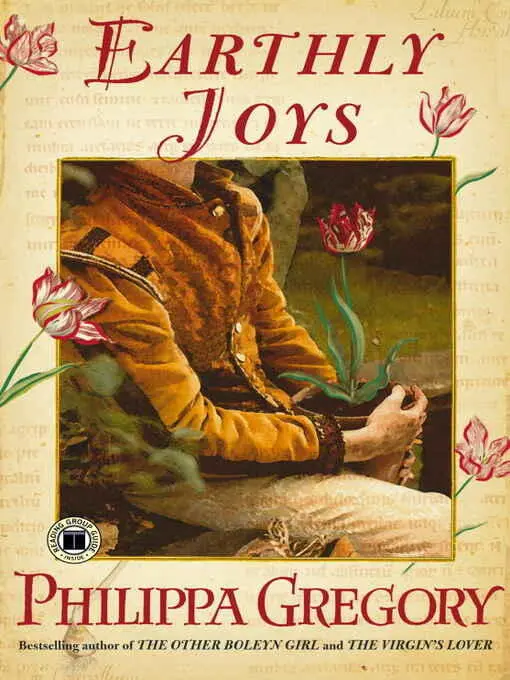
- Название:Earthly Joys
- Автор:
- Жанр:
- Год:неизвестен
- ISBN:нет данных
- Рейтинг книги:3 / 5. Голосов: 1
-
Избранное:Добавить в избранное
- Отзывы:
-
Ваша оценка:
Earthly Joys: краткое содержание, описание и аннотация
Предлагаем к чтению аннотацию, описание, краткое содержание или предисловие (зависит от того, что написал сам автор книги «Earthly Joys»). Если вы не нашли необходимую информацию о книге — напишите в комментариях, мы постараемся отыскать её.
Earthly Joys — читать онлайн ознакомительный отрывок
Ниже представлен текст книги, разбитый по страницам. Система сохранения места последней прочитанной страницы, позволяет с удобством читать онлайн бесплатно книгу «Earthly Joys», без необходимости каждый раз заново искать на чём Вы остановились. Поставьте закладку, и сможете в любой момент перейти на страницу, на которой закончили чтение.
Интервал:
Закладка:
“We said we would never work for another master,” Jane reminded him.
John nodded. “We never thought of this. But perhaps it won’t be so bad.” He turned and looked out of the window at his little farm. “I’ve heard they have a great orangery,” he said. “But they’ve never had much luck with getting the trees to flower. There’s a garden just for the king’s use and another for the queen. There’s a massive fountain in the great garden. The whole place is like a village set about with gardens, built all ramshackle with one court running into another, overlooking the Thames. The trick of it will be to make sure that every corner has a pretty plant, that the gardens pull the whole site together so that every corner has a view.”
Jane heard her father-in-law casting aside the principle of independence for the offer of a fine garden to make. She stalked to the door. “Shall I tell J or will you?” she asked coldly. “For he will not care for making pretty views for such a king.”
“I’ll tell him,” John said absently. “I wonder if we have enough chestnut saplings to use one at the center of each court?”
John told J the news at dinner but he knew from the moment his son entered the dining room that Jane had forewarned him, and that J was forearmed.
“I swore I’d never work for another master,” he said.
“This would be for me,” John corrected him, mildly. “Working for us all. For the good of us all.”
J glanced at his wife.
“It would be for the queen,” she said bluntly. “A woman of vanity and a heretic.”
“She may be both of those,” John agreed without hesitation. “But she’s only the paymaster. She will not supervise us at all. J need never speak to her.”
“There’s something about them, though, that sticks in my throat like dry bread,” J said thoughtfully. “There’s something about a man calling himself nearer to God than me. Something about a man thinking himself a better man than me – almost an angel. Even if I never saw him and never served him, there’s something about it which goes against the grain for me.”
“Because it’s heresy,” Jane said flatly.
J shook his head. “Not just because of that,” he said. “Because it denies me – it denies that I think, just as he thinks. That I have ideals, just as he has ideals. That I too want, think and pray for better days, for the coming of the Great Day, the Last Day. If he is as far above me as an angel then I need not think and hope and pray, for God would hardly listen to me when the king is on his knees. It’s as if his importance makes me more little.” He glanced around at their surprised faces. “I daresay I’m not making any sense,” he said defensively. “I’m not good at arguing these things. It’s just what I’ve been thinking.”
“But what you’re saying would deny any king,” John said. “This one or any other. A good one or a bad one.”
J nodded reluctantly. “I just can’t see that any man should set himself up to be above another. I can’t see that any man needs more than one house. I can’t see that any man needs dozens of houses and hundreds of servants. I can’t see that he can be closer to God with these things – I would have thought he would be farther and farther away.”
John shifted uncomfortably on his wooden seat. “This is Leveller talk, my son. Next thing you will be denying any king but King Jesus and taking off for the common and waste lands.”
“I don’t care what it’s called,” J said steadily. “I wouldn’t be frightened from speaking my mind because others think the same thoughts but express them wildly. I know that I must think that England would be better without a man at its head who claims to speak for us, and know us, and yet clearly knows nothing at all of what it is like to be a man such as me.”
“He has advisers.”
J shrugged. “He is surrounded by courtiers and flatterers. He hears what they tell him and they only tell him what he wants to hear. He can have no judgment, he can have no wisdom. He is trapped in his vanity and ignorance like a fish in a fishpond and since it knows nothing else it thinks it is something divinely special. If it could breathe air and see the sky it would know it is nothing more than a large fish.”
John snorted with laughter at the thought of the long mournful face of his monarch and the juxtaposition of the face of a carp.
“But who will you employ if J will not go?” Elizabeth asked practically.
“I’ll have to find someone,” John said. “There are dozens of men who would be glad of the place. But I would rather work with you, J. And it seems to me you are bound to work for me if I ask it.”
J shifted on his seat. “You would not drive me to rebellion,” he said. “You would respect my conscience, Father. I am a full-grown man.”
“You’re twenty-two,” John said bluntly. “Barely into your majority. You make your own choices; you are a man with a wife and child of your own. But I am still your father and it will be my work which will put the bread on your table, if you refuse to work.”
“I work here!” J exclaimed, stung. “I work hard enough!”
“In winter we earn almost no money,” John pointed out. “We live off our savings. There is no stock to sell, and the visitors tail off in the bad weather. Last year we were down to the bottom of our savings by the spring. The work at the palace would be money paid to us all the year round.”
“Papist gold,” Jane muttered to her plate.
“Honestly earned by us,” John countered. “I am an old man. I did not think to go out to work to keep you, J. I did not think your conscience would be more precious than your duty to me.”
J shot a furious look at his father. “It’s always the same!” he burst out. “You are always the one who is free to come and go. I am always the one who has to obey. And now that we have a home where I want to stay, and now you are free to stay yourself, you are still going away. And now I have to go too!”
“I am not free,” John said sternly. “The king commands me.”
“Defy the king!” J shouted. “For once in your life don’t go at some great man’s bidding. For once in your life speak for yourself! Think for yourself! Defy the king!”
There was a long shocked silence.
John rose from the table and walked to the window and looked out over the garden rinsed of color and lovely in the gray light of dusk. A star was shining over the chestnut tree and somewhere in the orchard a nightingale started to sing.
“I will never defy the king,” he said. “I will not even hear such talk in my house.”
The pause stretched till breaking point and then J spoke low and earnestly. “Father, this is not Queen Elizabeth and you are not still working for Robert Cecil. This is not a king as she was a queen. This is not a country as it was then. This is a country that has been run into debt and torn apart by heresy. It is ruled by a vain fool who is ruled in turn by a papist wife, in the pay of her brother, the King of France. I cannot bear to go and work for such a king nor for her. I cannot bear to be under their command. If you force me to this I would rather leave the country altogether.”
John nodded, taking in J’s words. The two women, Elizabeth and Jane, sat silent, hardly breathing, waiting to hear what John would reply.
“Do you mean this?”
J, breathing heavily, merely nodded.
John sighed. “Then you must follow your conscience and go,” he said simply. “For the king is my master before God, and he has ordered me. And I am your father and should command your duty and I have ordered you. If you choose to defy me then you should go, J. Just as Adam and Eve had to leave their garden. There are laws in heaven and earth. I cannot pretend to you that it is otherwise. I have tolerated loose thoughts and wild talk from you all your life, even in my lord’s garden. But if you will not serve the king then you should not garden in his garden. You should not garden in his country.”
Читать дальшеИнтервал:
Закладка:
Похожие книги на «Earthly Joys»
Представляем Вашему вниманию похожие книги на «Earthly Joys» списком для выбора. Мы отобрали схожую по названию и смыслу литературу в надежде предоставить читателям больше вариантов отыскать новые, интересные, ещё непрочитанные произведения.


Обсуждение, отзывы о книге «Earthly Joys» и просто собственные мнения читателей. Оставьте ваши комментарии, напишите, что Вы думаете о произведении, его смысле или главных героях. Укажите что конкретно понравилось, а что нет, и почему Вы так считаете.