Philippa Gregory - Earthly Joys
Здесь есть возможность читать онлайн «Philippa Gregory - Earthly Joys» — ознакомительный отрывок электронной книги совершенно бесплатно, а после прочтения отрывка купить полную версию. В некоторых случаях можно слушать аудио, скачать через торрент в формате fb2 и присутствует краткое содержание. Жанр: Историческая проза, на английском языке. Описание произведения, (предисловие) а так же отзывы посетителей доступны на портале библиотеки ЛибКат.
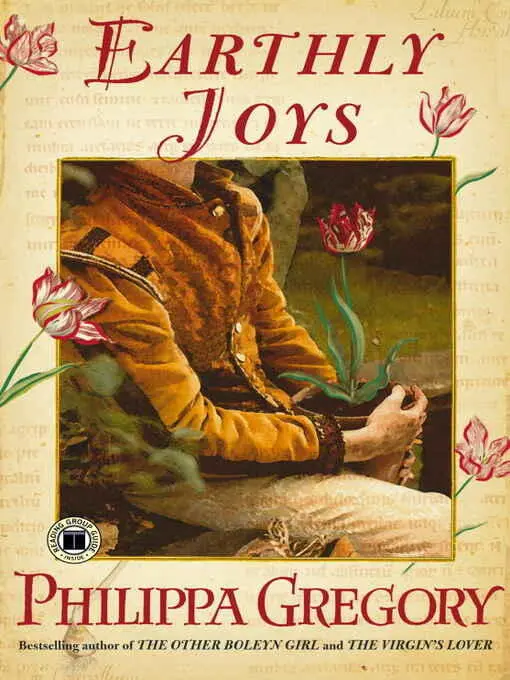
- Название:Earthly Joys
- Автор:
- Жанр:
- Год:неизвестен
- ISBN:нет данных
- Рейтинг книги:3 / 5. Голосов: 1
-
Избранное:Добавить в избранное
- Отзывы:
-
Ваша оценка:
Earthly Joys: краткое содержание, описание и аннотация
Предлагаем к чтению аннотацию, описание, краткое содержание или предисловие (зависит от того, что написал сам автор книги «Earthly Joys»). Если вы не нашли необходимую информацию о книге — напишите в комментариях, мы постараемся отыскать её.
Earthly Joys — читать онлайн ознакомительный отрывок
Ниже представлен текст книги, разбитый по страницам. Система сохранения места последней прочитанной страницы, позволяет с удобством читать онлайн бесплатно книгу «Earthly Joys», без необходимости каждый раз заново искать на чём Вы остановились. Поставьте закладку, и сможете в любой момент перейти на страницу, на которой закончили чтение.
Интервал:
Закладка:
John met his lord’s dark determined gaze. “You would destroy this country for your own triumph?”
Buckingham put his mouth very close to John’s ear. The silky curls tickled John’s neck. “Yes,” he whispered. “A thousand times over.”
“Then you are mad, my lord,” John said steadily. “And your country’s enemy.”
“Then cut me down like a mad dog,” Buckingham dared him with a wolfish grin. “Behead me for treason. Because my madness will run its course. I have to win the Isle of Rue, John. I don’t care what it costs.”
It was John who drew his hand away first; it was John who broke their interlocked gaze. Buckingham let him go and snapped his fingers at one of his companions, and took his arm in John’s place. “Come,” he said. “I must get my hair curled and then I shall sail for France.”
There was a roar of laughter and approval. Tradescant, sick and cold, turned away. The duke and his companions passed through the crowd and into the narrow corridor. One of the French officers bustled up.
“My lord duke! I bring news! The best news in the world!”
Buckingham stopped, the crowd behind him pressing forward in the corridor to hear.
“ La Rochelle has broken out! The Protestants are free and the French army is defeated! The French are suing for terms.”
Buckingham reeled, fighting for sobriety. “Never!”
“Indeed, yes!” the man declared, his English becoming less and less clear in his own excitement. “We have won! We have won!”
“Then we need not sail,” John thought aloud. “My God, we need not sail.”
Buckingham was suddenly powerful and decisive. “This alters everything,” he said.
“It does,” Tradescant agreed, pushing through to his side. “Thank God, yes. It does.”
“I must speak with the king,” Buckingham said. “Now is the time to strike against France; we need to go at once, we need to raise a greater army. We should go through the Netherlands, and then…”
“My lord,” John said desperately. “There is no need. Now we are excused. La Rochelle is free, our wrongs are avenged.”
Buckingham shook his head and laughed his wild boyish laugh. “John, after all the trouble I have taken to get here, d’you think I shall go peaceably home again without a cannon being fired! I am wild for a fight, and the men are wild for a fight! We will go to the very heart of France. Now is the time for an all-out attack, now they are failing. God knows how far we could go. We could take and keep French castles, French lands!”
He slapped the French officer on the back and stepped forward. Felton suddenly appeared at his side, pushing through the crowd. Tradescant recognized him with a gasp of fear, saw his eyes were wild and his hand was gripped on the knife in his pocket. He saw the officer who should protect the duke lounging in the doorway, his face buried in a cup of wine.
Buckingham turned to greet a new arrival and swept his graceful bow. There was a slice of time, which seemed to hold and wait, like a petal from a blossom lingering on its fall.
Tradescant saw Felton’s determined face and knew that the great love of his life, his master, was not, after all, untouchable.
“Save us from him,” Tradescant said softly. “Do it, Felton.”
Late Summer 1628
He was dead within moments, and it was John who leaped forward to catch him, and lowered the long slim body to the ground. Even dying in pain he still had the face of the saint that King James had called him. His skin had flushed as scarlet as an embarrassed maid with the shock of the wound, and then drained white as Italian marble. John cradled his heavy lolling head and felt the smooth tumbling black curls against his cheek for the last time. There was a loud sound of hoarse dry sobbing and John realized it was his own voice; then someone pulled him away from his lord and pressed a glass of spirits into his hand and left him.
He heard the noise of Felton’s capture, and the dreadful scream from Buckingham’s wife, Kate. He heard the running to and fro of men who were suddenly leaderless. He sat quite still, the glass of Hollands in his hand, while the room brightened as men drifted away and the August sunshine poured uncaringly through the window. The little motes of dust danced in the sunshine as if everything was still the same, when everything was different.
When he thought he could stand, John walked to the door of the house. To his left at the end of the street, the gray wall of the harbor was still there, still crumbling and unfit. Before him the rambling skyline of ramshackle houses and beyond them the tops of the masts of the fleet, still flying Buckingham’s flags. No one had ordered them to half-mast; people were still running around, denying the news, disbelieving their own denials. It was a beautiful day; the wind still blew steadily offshore. It would have been a good day to set sail. But Buckingham and John would never set sail together again.
John walked down the High Street like an old man, his boots unsteady on the cobbles, his limp pronounced. He felt that he was stepping into a new world, governed by new rules, and he could not honestly say that he was ready for it. He pulled his hat down over his eyes to shield him from the sun’s hard dazzle, and when a lad ran up and skidded to a halt before him, he shrank back, as if he too feared a blow, a fatal blow, to the heart.
“Is it true?” the boy yelled.
“What?”
“That the duke is dead?”
“Yes,” Tradescant said, his voice low.
“Praise God!” the boy sang out, and there was no doubting the relief and joy in his voice. “It’s true!” he yelled to another boy, a few yards away. “He’s dead! The Devil is dead!”
Tradescant put out his hand for the comfort of the sun-warmed wall and followed it, fingers trailing along the crumbling sandstone, like a blind man, to his lodging house. His landlord flung open the door.
“You’ll know – I’ve heard nothing but wild rumors – is he dead?”
“Yes.”
The man beamed as if he had been given a priceless gift. “Thank God,” he said. “Now the king will see reason.”
John felt his way to his room. “I am sick,” he said. “I shall rest.”
“You’ll not get much rest, I’m afraid!” his landlord said cheerfully. From the town they could hear the crackle of fireworks and a roar of cheering which was growing louder. “The whole town is going mad to celebrate. I’m off!”
He let himself out of his front door and ran down the street to where people were embracing, and dancing on street corners. Soldiers at the quayside were blasting their muskets into the skies and women who had come to kiss their husbands good-bye, expecting never to see them again, were weeping with relief. In a dozen churches the bells tolled as if for a mighty victory.
In all the world it seemed that only Tradescant grieved; only Tradescant and his lord lay still and silent all the long sunny joyous day.
It was not until midnight, lying in his bed, still gripping his hat in his hand, that John realized that he was free from his promise. He had been the duke’s man till death, and now death had come, and he was free.
Free and short of money, with no promise of wages and no job. Buckingham’s widow was sick with grief and the king himself ordered her into hiding in case an assassin struck against her as well.
It was as if the world had gone suddenly mad and no one knew what might happen next. There was no Lord High Admiral to command the expedition, there was no Lord Treasurer to keep the treasures of the kingdom, there was no chief adviser to make policy, there was no Favorite to rule everything. There was no king either, for when they gave Charles the news that Buckingham was dead he finished his prayers and went in silence to his room and locked himself away for two days and nights in silence, in darkness and fasting.
Читать дальшеИнтервал:
Закладка:
Похожие книги на «Earthly Joys»
Представляем Вашему вниманию похожие книги на «Earthly Joys» списком для выбора. Мы отобрали схожую по названию и смыслу литературу в надежде предоставить читателям больше вариантов отыскать новые, интересные, ещё непрочитанные произведения.
Обсуждение, отзывы о книге «Earthly Joys» и просто собственные мнения читателей. Оставьте ваши комментарии, напишите, что Вы думаете о произведении, его смысле или главных героях. Укажите что конкретно понравилось, а что нет, и почему Вы так считаете.