Philippa Gregory - Earthly Joys
Здесь есть возможность читать онлайн «Philippa Gregory - Earthly Joys» — ознакомительный отрывок электронной книги совершенно бесплатно, а после прочтения отрывка купить полную версию. В некоторых случаях можно слушать аудио, скачать через торрент в формате fb2 и присутствует краткое содержание. Жанр: Историческая проза, на английском языке. Описание произведения, (предисловие) а так же отзывы посетителей доступны на портале библиотеки ЛибКат.
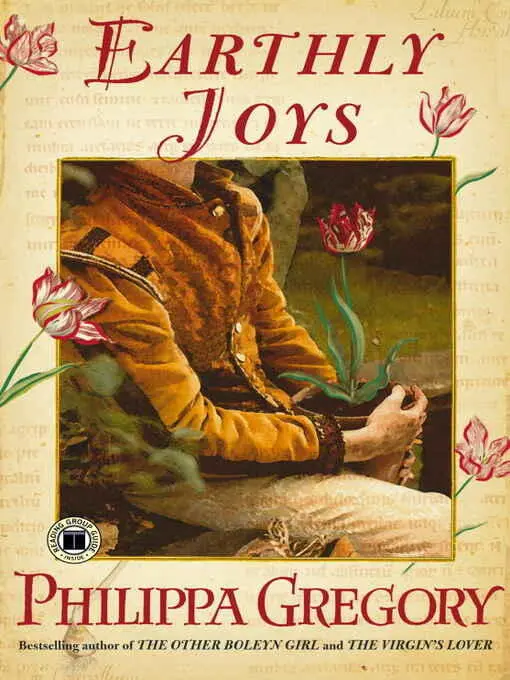
- Название:Earthly Joys
- Автор:
- Жанр:
- Год:неизвестен
- ISBN:нет данных
- Рейтинг книги:3 / 5. Голосов: 1
-
Избранное:Добавить в избранное
- Отзывы:
-
Ваша оценка:
Earthly Joys: краткое содержание, описание и аннотация
Предлагаем к чтению аннотацию, описание, краткое содержание или предисловие (зависит от того, что написал сам автор книги «Earthly Joys»). Если вы не нашли необходимую информацию о книге — напишите в комментариях, мы постараемся отыскать её.
Earthly Joys — читать онлайн ознакомительный отрывок
Ниже представлен текст книги, разбитый по страницам. Система сохранения места последней прочитанной страницы, позволяет с удобством читать онлайн бесплатно книгу «Earthly Joys», без необходимости каждый раз заново искать на чём Вы остановились. Поставьте закладку, и сможете в любой момент перейти на страницу, на которой закончили чтение.
Интервал:
Закладка:
“I cannot.”
She rose from the table and went toward the fireplace. John watched her go, as if she might have the key for them to escape from this knot of sin. But when she turned back to him her face was stony.
“What are you thinking?” he whispered.
“All that I think is that I have given you the wrong spoon,” she said with sudden clarity. She took off her apron, hung it on the hook and went out of the room.
“What d’you mean?” John shouted at her back as she went through the doorway.
“You need that one.”
He recoiled as her meaning struck him.
She was pointing to the spoon she used for cooking, the long spoon.
The news that King James was dead and his son was to be crowned the first King Charles arrived at Chorley the next day. Elizabeth was told in the marketplace at her small stall selling herbs. She nodded and said nothing. Her neighbor asked her if her husband was home and if he had brought any news of the doings from London.
“He was very tired last night,” Elizabeth said with her usual mixture of discretion and honesty. “He said hardly a word that made sense. I left him to sleep this morning. I expect he will tell me all the news from London when he wakes, and it will be old news by then.”
“It’s time for a change!” her neighbor said decisively. “I’m all for a new king. God bless King Charles, I say, and keep us safe from those damned Spaniards! And God bless the duke too! He knows what should be done, you can count on it!”
“God bless them both,” Elizabeth said. “And guide them in better ways.”
“And the king is to be married to a French bride!” the neighbor went on. “Why can he not marry a good English girl, brought up in our religion? Why does it have to be one of these papist princesses?”
Elizabeth shook her head. “I don’t know,” she said. “The ways of the world are strange indeed. You would think that with the whole of the country at their feet they would be content…” She paused for a moment and her neighbor waited, hoping against all likelihood for a juicy piece of gossip. “Vanity,” Elizabeth concluded, unsatisfactorily. “It is all vanity.”
She looked around the quiet market. “I shall go home,” she said. “Perhaps John is awake now.”
She packed her little pots of herbs into her basket, nodded to her neighbor and made her way through the muddy street to her own cottage.
John was seated at the table in the kitchen, a mug of small ale and a piece of bread untasted before him. When Elizabeth came in and hung her cape on the hook on the back of the door, he started up.
“I am sorry, Elizabeth,” he said quickly. “I was tired and angry yesterday.”
“I know,” she said.
“I was troubled by what I had seen and heard.”
She waited in case he would say more.
“The court life is a tempting one,” he said awkwardly. “You think you are at the very center of the world, and it takes you further and further away from the things which really matter. What I love more than anything else is gardening, and you, and J – the last thing I should be doing is dawdling like a serving wench in the halls of great men.”
She nodded.
“And then I think I am in the center of great events, and an actor on a great stage,” he went on. “I think it will all go wrong if I am not there. I think I am indispensable.” He broke off with a little laugh. “I am a fool, I know it. For look! He has come to the highest point of his power yet, and his first act was to send me home.”
“Shall you go to the house?” Elizabeth asked. “Will you go to work today?”
John turned to the door. “No. I’ll walk until I can live with myself. I feel…” He made a strange distressed gesture. “I feel all… racked… I can’t say more. I feel as if I have pulled myself out of shape and I need to restore myself somehow.”
Elizabeth took a small piece of linen and wrapped a piece of bread and cheese. “You walk,” she advised. “Here is your dinner, and when you come home tonight I will have a good supper prepared for you. You look like a man who has been poisoned.”
John recoiled as if she had slapped him. “Poisoned? What are you saying?”
Elizabeth’s face was graver than ever. “I meant that you looked as if the court had not agreed with you, John. What else should I mean?”
He passed his hand quickly over his face as if he were wiping away a cold sweat. “It does not,” he said. “It does not agree with me. For here I am as nervous as a deer when I should be quietly at peace and setting my seeds.”
He took the bread and cheese from her. “I’ll be home by dusk,” he promised.
She drew him to her, took his worried face in her hands and drew his head down to her. She put a kiss on his brow, as if she were his mother blessing and absolving him. “You say a little prayer as you walk,” she said. “And I shall pray for you while I set the house to rights.”
John reached for his hat and opened the door. “What shall you pray for me, Lizzie?” he asked.
Elizabeth’s look was calm and steady. “That you shall avoid temptation, husband. For I think you have chosen a way which is much among the snares of the world.”
John worked through the spring with a dogged sullenness on the gardens of New Hall. The cherries which had always been his special pleasure blossomed well, and he watched the pink and white buds swell and then bloom, denying his own feeling that since their master did not see them their sweetness was wasted.
Buckingham did not come. The rumor was that London was dreadfully infested by plague, the dead lying in the streets of the poorer quarters and the plague cart coming by two and three times a day, healthy citizens shrinking back into doorways and locking themselves into their houses, every man who could afford it moving out to the country and then finding that villages on the road from the capital barred their doors to London trade. No one knew how the plague spread; perhaps it was by touch, perhaps it was in the air. People spoke of a plague wind as the season grew warmer and said that the soft warm breezes of spring blew the plague into your skin and set the buboes like eggs in your armpit and groin.
John longed to see Buckingham and to know that he was well. He could hardly believe that the court would linger in London while the hot weather came. The young king must be mad to expose himself to such danger, to expose his friends. But no one at New Hall could say when the court would move, no one could tell John if the court would come on a visit, or even if the duke might come home alone, tired of the squabbles and rivalry of the court and longing to be quietly in his own house, in his garden, among those who loved him.
John unpacked the India rarities and laid them out, as his fancy took him, in a small room. They looked well all together, he thought. There were some handsome skins and some silks, and he ordered the maids to sew them to strips of stout canvas which he could fix to the walls to make into hangings. He had a cabinet made to hold the jewels, fastened with an intricate gold lock with only one key, which he held for the duke. Still, the duke never came.
Then John had news. The king’s delayed marriage to the French princess was to go ahead; the duke had already left for France.
“He’s out of the country?” John asked the steward, in the safe privacy of the household office.
William Ward nodded.
“Who has he taken from his household?” John demanded.
“You know his way,” Ward said. “He was up and gone within the day. He forgot half his great wardrobe. The moment the king said he was to go, he was gone. He took hardly a dozen servants for his own use.”
“He did not ask for me?”
Читать дальшеИнтервал:
Закладка:
Похожие книги на «Earthly Joys»
Представляем Вашему вниманию похожие книги на «Earthly Joys» списком для выбора. Мы отобрали схожую по названию и смыслу литературу в надежде предоставить читателям больше вариантов отыскать новые, интересные, ещё непрочитанные произведения.


Обсуждение, отзывы о книге «Earthly Joys» и просто собственные мнения читателей. Оставьте ваши комментарии, напишите, что Вы думаете о произведении, его смысле или главных героях. Укажите что конкретно понравилось, а что нет, и почему Вы так считаете.