Geraint Jones - Blood Forest
Здесь есть возможность читать онлайн «Geraint Jones - Blood Forest» весь текст электронной книги совершенно бесплатно (целиком полную версию без сокращений). В некоторых случаях можно слушать аудио, скачать через торрент в формате fb2 и присутствует краткое содержание. Город: London, Год выпуска: 2017, ISBN: 2017, Издательство: Michael Joseph, Жанр: Историческая проза, на английском языке. Описание произведения, (предисловие) а так же отзывы посетителей доступны на портале библиотеки ЛибКат.
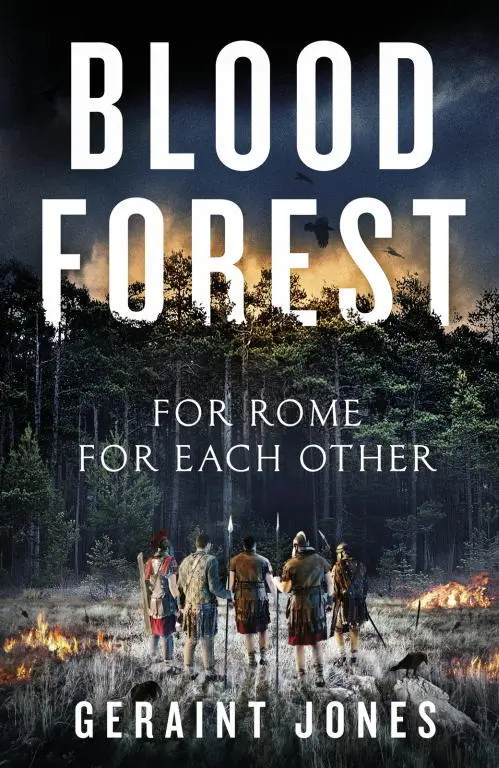
- Название:Blood Forest
- Автор:
- Издательство:Michael Joseph
- Жанр:
- Год:2017
- Город:London
- ISBN:978-1-405-92778-9
- Рейтинг книги:4 / 5. Голосов: 1
-
Избранное:Добавить в избранное
- Отзывы:
-
Ваша оценка:
Blood Forest: краткое содержание, описание и аннотация
Предлагаем к чтению аннотацию, описание, краткое содержание или предисловие (зависит от того, что написал сам автор книги «Blood Forest»). Если вы не нашли необходимую информацию о книге — напишите в комментариях, мы постараемся отыскать её.
Blood Forest — читать онлайн бесплатно полную книгу (весь текст) целиком
Ниже представлен текст книги, разбитый по страницам. Система сохранения места последней прочитанной страницы, позволяет с удобством читать онлайн бесплатно книгу «Blood Forest», без необходимости каждый раз заново искать на чём Вы остановились. Поставьте закладку, и сможете в любой момент перейти на страницу, на которой закончили чтение.
Интервал:
Закладка:
I saw none make it to the safety of the ramparts, but as the final screams died on the wind, a body of horsemen did ride towards us, the proud men in the saddle flushed with victory.
At the head of these German warriors, one nobleman rode alone, the wealth about his neck shining splendid even through the grey of the storm. He held a severed head aloft by its hair, and paraded it in front of the watching eyes of the Roman army, a harbinger of their doom. With a detachment brought on by exhaustion, I realized that this was a leader who not only wanted to destroy his enemy, but wanted them to know that their end was near, and terrible. He wanted them to suffer, and so without doubt he hated them. He hated Rome. He hated the legions. He hated me.
I looked at that magnificent warrior in the saddle, and I was surprised by all of this. Surprised and sickened to see the face of our enemy, and the architect of an army’s destruction.
Because it was a face that I knew well.
It was the face of Arminius.
41
Arminius, a traitor.
For a moment, I almost laughed at the irony of it all. Then, as the gorge of bile rose up from my stomach, and my legs threatened to buckle beneath me, I reached out to Titus. He sensed my weakness, a rough fist taking hold of the back of my armour and holding me upright as a father would his unruly child.
He spoke tonelessly. ‘We’re fucked now.’
All around us, panicked whispers took flight as the identity of the lone horseman was spread, men desperate to know the answers to their most feared questions: had all the German tribes risen in revolt? Were our bases on the Rhine overrun? Would the German prince treat with our leaders, and negotiate terms, or was he bent on the wholesale destruction of our forces?
‘He wants us dead,’ Titus grunted, considering the last one. ‘Look at him.’
I did.
Seated astride a powerful grey mare, Arminius appeared as the God of War himself, shoulders thick with armour and bearskin, long blond hair tangled by rain across the handsome face that betrayed not the slightest trace of a smile. Arminius was unmoved by the howling storm, a Roman head in his blood-covered hand. He appeared as confident as a man who was seeing the game unfold five steps ahead of his adversary.
‘He planned all this,’ Titus breathed, and looked at me.
I met his eyes, expecting suspicion in them, but I found none. I should not have been surprised. We had been through too much together – suffered too much together – for my own loyalty to be questioned now.
‘I’m sorry.’ Titus shrugged, in one of the rare gestures that betrayed his stone-like exterior. ‘I know you liked him.’
‘He’s your enemy,’ I managed, and then corrected myself. ‘He’s our enemy.’
I do not know if Titus would have replied, for a murmur ran through the ranks of watching troops on the rampart, and I turned to see the approach of the army’s staff officers. These panicked members of the senatorial class needed to confirm their fears with their own, wide eyes, and as they climbed the slippery battlement, some even wailed as they saw the lone figure on horseback.
‘Traitor!’ others called in anger.
Arminius was unmoved by it all.
He waited.
He waited and, eventually, he was given the audience that he desired – Varus.
The governor came to the ramparts like a cripple, the trials of the field, and now of treason, too much for a man who had considered Arminius a son. Varus slipped as he tried to scale the mud of the earthen bank, dropping to his knees in the dirt, and, seeing such feebleness as a portent, soldiers began to whisper that the gods had forsaken the legions, and that the army was doomed to be destroyed at the hands of Varus’s wayward child.
Knowing how much the older man had loved the prince, I expected that there would be some kind of exchange between governor and German. Some demand for an answer, or a prayer for peace.
There was none.
No accusations, or explanations. Arminius simply turned his hard eyes on to Varus and then threw the severed head towards the rampart. It hit the dirt with a wet thump and rolled away grotesquely into the grass. Then, his message delivered, Arminius simply pulled on the reins of his mount and trotted back towards his greatest ally, the forest.
With that simple act, he sealed the destruction of an army.
Varus was the first to fall on his sword.
There was no speech. No great oration. For the first time during the campaign the man drew his blade, turned it towards himself, and fell forward so that the weight of his flabby body carried the steel through his chest. Perhaps because his hands were shaking from cold, or nerves, Varus missed his heart, and lay floundering for a moment as his torn lungs gasped for air.
With those on the rampart, I watched this without comment. Like the men about me, I had already seen too much. This act of cowardice left me open-mouthed in shock, but such were the horrors of the forest that I could not be any more revolted by it than I could the rising and setting of the sun. The actions of the governor – and, moments later, those of his staff officers – unfolded so quickly that I seemed to be watching them in slow motion. Within an instant of Varus pulling his own sword, many of his staff lay dead by their own blades, their blood pooling in the mud of the camp they had hoped would prove their bastion.
‘Fuckers,’ Titus growled besides me. ‘Come on,’ he urged, pulling at the sleeve of my tunic. ‘No good’s gonna come of standing around here and watching these cunts do themselves in.’
Equally disgusted, many of the other soldiers began to move away, returning to their centuries, but not all. Some sat back in the mud, or dropped to their knees. Some wailed, while others gave in to despair in silence.
It was the beginning of the end, I knew.
As I stumbled along beside Titus, I recognized an old soldier standing amongst the dead of the army’s staff, his worn face twisted into ferocious anger. It was Caeonius, the camp prefect who had found me in the grove with Arminius, and who had saved me from crucifixion. Betrayed by both the German prince and the governor, and now left as the senior soldier in the army, it seemed that the weight of the legions would have to be borne by this man’s wide shoulders.
I pitied him. This was an unwinnable battle, but what choice did he have but to fight it? What choice did any of us have? We were not blinded by the same shame and honour that had forced the aristocratic leaders to fall on their swords. We wanted to live.
‘Felix,’ I heard, and turned.
The standard-bearer from the parade square, the bearskin over his head and shoulders thick with matted blood. Dirty bandages covered a wound on his arm. Here was a man who had stood in the thickest of the fighting.
‘Standard-bearer,’ I greeted him.
‘Your friend has come to kill us,’ the man said, though there was no malice in his words. He was resigned to his fate.
My friend.
‘He’s my enemy,’ I said, though I heard the uncertainty in my voice. ‘He lied to me.’ I told him, unable to see my hypocrisy.
The man turned his head away, looking at the crowd who had gathered about the bodies of the staff officers. ‘Look to your comrades, brother,’ he told me, offering his hand. ‘It’s going to be a long road home.’
I took it, and then watched as he stalked towards the frightened soldiers. I knew that we would never speak again.
We left the scene, walking in silence as Titus led us through the lines to our own century, but my mind screaming: Why – how – could Arminius have committed such treason? He had been raised a son of Rome. He had fought for Rome. Bled for Rome. Why this treason? A treason that had clearly been plotted carefully for months: the honeyed words into Varus’s ear; the disturbances that had required the legions’ response, all the time directed into the jaws of Arminius’s carefully baited trap.
Читать дальшеИнтервал:
Закладка:
Похожие книги на «Blood Forest»
Представляем Вашему вниманию похожие книги на «Blood Forest» списком для выбора. Мы отобрали схожую по названию и смыслу литературу в надежде предоставить читателям больше вариантов отыскать новые, интересные, ещё непрочитанные произведения.











Обсуждение, отзывы о книге «Blood Forest» и просто собственные мнения читателей. Оставьте ваши комментарии, напишите, что Вы думаете о произведении, его смысле или главных героях. Укажите что конкретно понравилось, а что нет, и почему Вы так считаете.