Geraint Jones - Blood Forest
Здесь есть возможность читать онлайн «Geraint Jones - Blood Forest» весь текст электронной книги совершенно бесплатно (целиком полную версию без сокращений). В некоторых случаях можно слушать аудио, скачать через торрент в формате fb2 и присутствует краткое содержание. Город: London, Год выпуска: 2017, ISBN: 2017, Издательство: Michael Joseph, Жанр: Историческая проза, на английском языке. Описание произведения, (предисловие) а так же отзывы посетителей доступны на портале библиотеки ЛибКат.
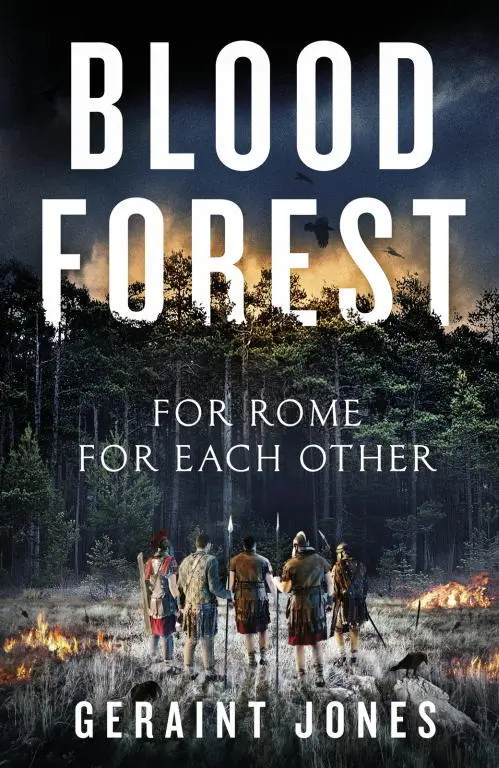
- Название:Blood Forest
- Автор:
- Издательство:Michael Joseph
- Жанр:
- Год:2017
- Город:London
- ISBN:978-1-405-92778-9
- Рейтинг книги:4 / 5. Голосов: 1
-
Избранное:Добавить в избранное
- Отзывы:
-
Ваша оценка:
Blood Forest: краткое содержание, описание и аннотация
Предлагаем к чтению аннотацию, описание, краткое содержание или предисловие (зависит от того, что написал сам автор книги «Blood Forest»). Если вы не нашли необходимую информацию о книге — напишите в комментариях, мы постараемся отыскать её.
Blood Forest — читать онлайн бесплатно полную книгу (весь текст) целиком
Ниже представлен текст книги, разбитый по страницам. Система сохранения места последней прочитанной страницы, позволяет с удобством читать онлайн бесплатно книгу «Blood Forest», без необходимости каждый раз заново искать на чём Вы остановились. Поставьте закладку, и сможете в любой момент перейти на страницу, на которой закончили чтение.
Интервал:
Закладка:
‘Felix,’ Pavo hissed again.
‘I’m here, sir,’ I answered, no doubt drawing a scornful look from Titus.
Pavo arrived beside me. ‘Titus, I’m going to an orders group. I’m taking Felix with me as runner.’
‘Him? Runner?’ I could picture Titus’s thick brow creasing beneath his helmet. ‘Take one of the young lads.’
‘I need someone I can trust. I’m taking him.’
‘Well, OK, then. If you need someone you can trust ,’ Titus seemed to find great amusement in the word.
Pavo turned back towards the camp, and I followed on his shoulder. I did not think that he truly trusted me, but simply recognized me for what I was: the fellow outcast in the century. This march was Pavo’s first taste of command in the field, and though there had been no battle, the enemy nipping on our heels might well prove a fearsome opponent. I had no doubt he was wary of his future. In his own mind, he was equally sure that I was an experienced veteran, and he wanted to make use of my knowledge in a way that he couldn’t with the other soldiers of the century.
‘Today,’ he began without preamble. ‘What did you make of it?’
It would not be a good idea to dispense with guile completely – Pavo was too ambitious – but it could not hurt to state the obvious.
‘The whole world knows that our strength is in our formations, so they hit hard and fast before we could rally. They won’t think about taking on this camp, or meeting us in the open.’
‘Yes, yes.’ He waved impatiently. ‘But is that all it is? Is that all we’ll bastard get, all the way through this campaign?’
I broke my stride as a dog darted between tents: one of the many camp followers who had stayed with the army on the march, rather than taking the soft route of the Lippe back to the Rhine.
‘I’m sure they’ll stand when we reach their towns,’ I answered tactfully, giving him what he wanted to hear. ‘That’s when we’ll get battle, and the plunder.’
Perhaps my words mollified the man, for he stayed silent until we reached the large command tent at the camp’s centre. Dozens of centurions were making their way inside, though most were the seasoned leaders of the cohorts’ First Centuries. As to why Pavo, a junior officer, had been summoned to such a gathering I was given no clue, but I thought this anomaly was probably another reason for his apprehension.
‘Wait here,’ he ordered me at the tent’s flap, and so I took my place in the rain amongst a dozen other miserable soldiers. The beating of the downpour against the hide of the tent kept all voices securely within its interior, and I suspect I would have remained ignorant of what passed within had it not been for the sharp eye of an old, frowning soldier – Caeonius, the camp prefect who had been party to my discovery as a blood-soaked ghoul in the sacred grove.
‘Gods!’ The officer’s smile spread genuinely beneath his bulbous nose. ‘You must be the only one in the army who’s looking better than the last time I saw him.’
‘Thank you, sir,’ I managed, despite my discomfort at the attention. ‘I’m surprised you recognize me.’
‘That was a sight I’ll not forget until I’m cold in my grave. What are you doing here? Do you remember anything now?’
I regretted that I did not, and then explained that I had been sent to a century as a battle casualty replacement, and how I had accompanied Pavo to the tent as his runner.
‘Well, you can’t bloody run if you’re all rust, can you? Get inside.’ He must have sensed my hesitation. ‘Just stand at the back and keep quiet. Don’t worry about it. Come on.’
What choice did I have? He was one of the highest-ranking individuals in the army, and so I followed the squat man inside, pressing myself against the canvas and hoping that my entrance would go unnoticed in the shadows.
The tent was packed with officers belonging to all of the army’s castes: the heavy mob of the Roman legions; auxiliary light infantry; cavalry, both Roman and provincial; engineers; artillery. Their backs to me, steam rising from beneath their armour, they appeared like some army of the dead.
Despite the crowd, Pavo’s height let me catch sight of him. He was standing close to the front, and I wondered what could have elevated him to the status he so strongly desired.
‘Thank you, gentlemen. Please be seated.’ Caeonius’s voice sounded from the front and the officers took their places on wooden benches – some aspects of Roman civilization could not be overlooked in the field, no matter the circumstances. Thankfully, there were not enough of these seats to go around, and I was not left to stand conspicuously alone. Then, my view blocked slightly by the chain-mailed shoulders of a cavalryman, I saw Governor Varus take centre stage.
It was no secret that he was a politician rather than a warrior, but even so I marvelled at the effect that only two days in the field had taken on the man. Varus’s eyes were dark-rimmed and his skin had the same waxen sheen as the tent.
‘Gentlemen,’ he began. ‘I have some grave news.’
Instantly, the tent seemed emptied of air as men held their breath, military minds churning over possible disasters and responses. I turned them over myself. Yes, the column had come under attack. Yes, the weather was terrible. But these were not incidents that should be insurmountable to an army in the field. What was the grave news? Why did Varus look so ghastly?
And then he told us.
‘Arminius is dead.’
24
For a moment, discipline slipped, the gathering erupting into hurried conversation, men wondering aloud what could have befallen the German prince, and what effect that would have on the campaign.
I heard none of it.
I felt as if my stomach had dropped past my knees. Knees that were shaking in grief.
Arminius was an enigma: the barbarian-born noble who was an accomplished Roman officer and an embodiment of the Empire. He was that rare kind of man who seemed unshackled by mortal worries, the energy of a dozen legions contained within his skin. He was witty, handsome and kind.
And somehow, I was sure that he was my friend.
And I knew – I knew – how ridiculous it was for me to think of a noble-born that way, but hadn’t Berengar, the prince’s shadow, said as much himself?
But what did it matter? He was dead.
‘How?’ several voices began to ask.
It was Caeonius who stepped up to answer. Like the legions he had come to embody, his manner of address was direct and brutally efficient.
‘Here are the facts as we know them. Arminius was supposed to arrive with his warriors today and join the column. He didn’t. Instead, a small group of riders came in. They talked to his scouts, and they immediately rode away together, and at speed—’
‘Why?’ a legate, commander of the Nineteenth Legion, interrupted.
‘All we know is that some auxiliary troops understood part of the exchange between the riders and the guides. They told them that Arminius and his men had been attacked, and that the prince was feared dead.’
Most of the tent held its silence, but the legate was an inquisitive and suspicious man. ‘So we don’t know that he’s dead?’
‘We don’t. At first light, we’ll send out cavalry detachments. Their orders are to find Arminius, and to bring his warriors here to join us.’
‘And if he is dead? Will they hold by their word to Rome?’ The legate, a politician like Varus, sounded doubtful. Caeonius’s lack of reply confirmed that he was of the same mind.
Now, Varus seemed to remember his position. The governor struggled to straighten his shoulders and present an authoritative figure, but still he sagged with grief. Perhaps to steady himself, he placed a friendly hand on Caeonius’s shoulder. ‘I would ask that all commanders now present their losses, and unit strength,’ he ordered with the gravity required in such dealings.
Читать дальшеИнтервал:
Закладка:
Похожие книги на «Blood Forest»
Представляем Вашему вниманию похожие книги на «Blood Forest» списком для выбора. Мы отобрали схожую по названию и смыслу литературу в надежде предоставить читателям больше вариантов отыскать новые, интересные, ещё непрочитанные произведения.












Обсуждение, отзывы о книге «Blood Forest» и просто собственные мнения читателей. Оставьте ваши комментарии, напишите, что Вы думаете о произведении, его смысле или главных героях. Укажите что конкретно понравилось, а что нет, и почему Вы так считаете.