Mary Russell - Doc
Здесь есть возможность читать онлайн «Mary Russell - Doc» весь текст электронной книги совершенно бесплатно (целиком полную версию без сокращений). В некоторых случаях можно слушать аудио, скачать через торрент в формате fb2 и присутствует краткое содержание. Год выпуска: 2011, ISBN: 2011, Издательство: RANDOM HOUSE, Жанр: Историческая проза, на английском языке. Описание произведения, (предисловие) а так же отзывы посетителей доступны на портале библиотеки ЛибКат.
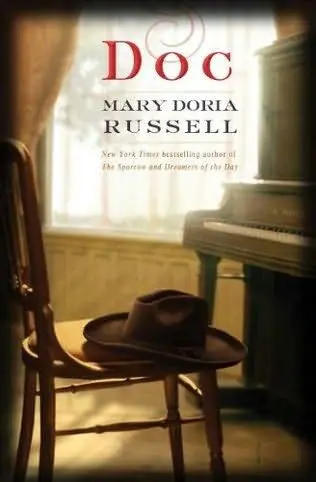
- Название:Doc
- Автор:
- Издательство:RANDOM HOUSE
- Жанр:
- Год:2011
- ISBN:978-0-679-60439-6
- Рейтинг книги:3 / 5. Голосов: 1
-
Избранное:Добавить в избранное
- Отзывы:
-
Ваша оценка:
Doc: краткое содержание, описание и аннотация
Предлагаем к чтению аннотацию, описание, краткое содержание или предисловие (зависит от того, что написал сам автор книги «Doc»). Если вы не нашли необходимую информацию о книге — напишите в комментариях, мы постараемся отыскать её.
Beautifully educated, born to the life of a Southern gentleman, Dr. John Henry Holliday is given an awful choice at the age of twenty-two: die within months in Atlanta or leave everyone and everything he loves in the hope that the dry air and sunshine of the West will restore him to health. Young, scared, lonely, and sick, he arrives on the rawest edge of the Texas frontier just as an economic crash wrecks the dreams of a nation. Soon, with few alternatives open to him, Doc Holliday is gambling professionally; he is also living with Mária Katarina Harony, a high-strung Hungarian whore with dazzling turquoise eyes, who can quote Latin classics right back at him. Kate makes it her business to find Doc the high-stakes poker games that will support them both in high style. It is Kate who insists that the couple travel to Dodge City, because 'that's where the money is.'
And that is where the unlikely friendship of Doc Holliday and Wyatt Earp really begins — before Wyatt Earp is the prototype of the square-jawed, fearless lawman; before Doc Holliday is the quintessential frontier gambler; before the gunfight at the O.K. Corral links their names forever in American frontier mythology — when neither man wanted fame or deserved notoriety.
Authentic, moving, and witty, Mary Doria Russell's fifth novel redefines these two towering figures of the American West and brings to life an extraordinary cast of historical characters, including Holliday's unforgettable companion, Kate. First and last, however, Doc is John Henry Holliday's story, written with compassion, humor, and respect by one of our greatest contemporary storytellers.
Doc — читать онлайн бесплатно полную книгу (весь текст) целиком
Ниже представлен текст книги, разбитый по страницам. Система сохранения места последней прочитанной страницы, позволяет с удобством читать онлайн бесплатно книгу «Doc», без необходимости каждый раз заново искать на чём Вы остановились. Поставьте закладку, и сможете в любой момент перейти на страницу, на которой закончили чтение.
Интервал:
Закладка:
It was Kate who kept them eating when things got thin. And if that had made a Jew of her, well, so be it! Jews weren’t the only ones liable to be beaten and robbed and run out of town at any moment, without being able to go to the police. You never really owned anything but the clothes you stood up in. If you knew what was what, you made damn sure there was money sewn into seams, or gems hidden in hems—
“Katie!” James repeated. “You going to the parade?” he asked when he had her attention. “I can’t get Bessie to come.”
“It’s bad enough gettin’ squeezed for donations by every damn politician in town,” Bessie said. “Watchin’ Yankees march down Front Street, wavin’ their damn flags, bangin’ their damn drums, and playin’ ‘The Battle Hymn of the God -dam Republic’ is more than I can stomach—Oh, James, no,” she wailed suddenly. “You ain’t really gonna wear that!”
“Course I am!” James said, shrugging into a ragged blue jacket that was moth-eaten and crusty with old bloodstains. “It’s Fourth of July, honey!”
“I keep throwin’ that damn thing out,” Bessie told Kate, “but he keeps findin’ it and bringin’ it back in.” Bess shuddered. “It’s like a woman savin’ the sheets she gave birth on, for Lord’s sake!”
“Come on, Bess!” James urged. “You and Kate can make fun of George Hoover, and blow kisses to Bob Wright, and cheer when I march by.”
“No, sir, I am goin’ to bed.” Bessie groaned and got to her feet. “You two go on. Keep each other out of trouble!”
She watched them leave, Kate fitting nicely under James’s good arm, which was draped casually over the little Hungarian’s shoulders. Bessie wondered sometimes about James and Kate … It wouldn’t have bothered her, of course. There were times when James got randy and Bessie’d simply had enough and wanted her body to herself for a few hours. It was only fair when James turned to one of the girls, but he and Kate seemed close in a different way. He treated her more like she was his baby sister Adelia, and Kate was more at ease with James than she was with other men. They seemed to understand each other, and Bessie was glad, for not many people understood her husband.
James was as hardheaded and stubborn as any of the Earps and—Lord!—he could be sarcastic! But there was a real sweetness to that man: a special sort of gentleness that you see sometimes in people who’ve been hurt bad but who don’t want revenge.
When he left Nashville for the front in ’63, Bessie never expected to see James again, and she went back to work without giving him a second thought. Then one day his brother Virgil showed up at the house with the news that James had been wounded and was likely dying. He kept asking Virg to go see if Bessie would come visit. It was little enough to do, so she went.
“Arm’s no good, honey,” James whispered with the ghost of a grin, “but I bet the rest of me’ll work fine!”
To her own astonishment, Bessie burst into tears.
She’d seen a lot of ruined boys by then, but somehow this one got under her skin. She went to the hospital as often as she could get away from the business, expecting each visit would be the last. James held on, though, week after week, and then he started to gain. Early in the spring of ’64, he asked Bessie to marry him.
“James, you know what I do,” she protested.
“Yes,” he said. “Yes, I do, honey. You give a lot of boys some real good memories before they die.”
That was James all over. He saw something honorable in her work. He believed Bessie herself to be decent and good. In spite of everything, maybe even because of it, he respected her.
Which was why, in 1878, Mrs. James Cooksey Earp was one of a bare handful of lawfully married women living in downtown Dodge. That was also why, she supposed, both Margaret Hoover and Alice Wright—wives of the two richest men in Dodge—found it possible to speak to her.
Odd, but it was Alice who was more open about it. Alice Wright was a strange one: a small, pretty, reserved woman who made herself noticeable in a group only by her silence. Bessie had seen her around town, of course, and over at Bob’s store, but then one day, Mrs. Wright walked right in the front door of the brothel and asked to speak to Bessie in private. Oh, Lord, Bess thought. She’s gonna ask me to refuse Bob courtesy of the house.
Alice took the offered seat in Bessie’s office, folded her hands into her lap in a composed and determined manner. Head up, eyes level, she said, “I would like to learn how to stop a baby from coming, Mrs. Earp. I expect you know how that works.”
When she got over her shock, Bessie asked how far along Alice was. Alice said she wasn’t pregnant. She just didn’t want any more children. So Bessie gave her the best recipe she had, which was “four ounces of shredded cotton root in a gallon of water. Boil it down to a pint. Drink half a cup every couple of hours as soon as you’re late. It’ll bring on bleedin’ in a day or so.” And from that day on, Mrs. Wright and Mrs. Earp had a remarkably cordial relationship. They weren’t friends exactly—Alice Wright didn’t seem to be friends with anybody, really—but they spoke pleasantly to each other at Bob’s store, in front of everybody. And every month, Alice gave Bessie a triumphant little smile.
Maggie Carnahan, by contrast, was apt to cut Bessie dead in public now that she was Mrs. George Hoover. Bessie had never quite decided if Maggie’s snubs were insulting or pathetic or simply funny. Like Bessie’s mamma used to say, “There’s no worse snob in the world than a planter’s house nigger,” and Maggie Carnahan was Black Irish.
Even before she married, Maggie had set great store by the appearance of respectability. Fresh off the boat from Belfast, she went to work with a cousin who was a lady’s maid in New York City. To this day, Maggie clung to the standards set by three months’ strict training in The Way Things Ought To Be Done, though the job itself didn’t last, for the crash of ’73 bankrupted the New Yorkers Maggie had worked for.
Things went from bad to worse for the girl as she moved west, town by town. By the end of ’75 Maggie had fetched up in Dodge City, where Bessie gave her a job. That’s how George and Maggie met.
Big George didn’t seem bothered by his little wife’s past. “Can’t reform unless you were a sinner first,” he’d declare to anyone who’d listen. Maggie would cringe and look away when he said that. By Maggie’s lights, a fallen woman started out lower on the ladder to righteousness than a saloon owner who’d rotted customers’ stomachs by the thousands. In Bessie’s opinion, the most admirable thing about George Hoover was that he didn’t see a lot of moral distance between selling flesh and selling snakehead liquor. “Vice is vice,” George always said. “One part of hell is as hot as the next parcel over.”
What got Bessie riled was the way George sent his wife around to collect “campaign contributions.” Maggie hated being used as a bagman, and George must have known how it embarrassed her. (Eddie Foy thought that was particularly funny. “Imagine it! An Irish whore, by way of New York and Chicago, dismayed by political corruption.”) Maggie worked hard to make what she was doing seem nicer, and her latest cover was asking for a donation to the City Beautification Fund.
George had added a big glass garden room to their house last year, and that had inspired Maggie’s notion of putting flower boxes all around the Dodge City train station to give newcomers a better first impression of the town. Making that Ulster accent seem cultured wasn’t easy, but Maggie did her level best to sound like a lady from New York when she put the bite on.
Читать дальшеИнтервал:
Закладка:
Похожие книги на «Doc»
Представляем Вашему вниманию похожие книги на «Doc» списком для выбора. Мы отобрали схожую по названию и смыслу литературу в надежде предоставить читателям больше вариантов отыскать новые, интересные, ещё непрочитанные произведения.









Обсуждение, отзывы о книге «Doc» и просто собственные мнения читателей. Оставьте ваши комментарии, напишите, что Вы думаете о произведении, его смысле или главных героях. Укажите что конкретно понравилось, а что нет, и почему Вы так считаете.