Mary Russell - Doc
Здесь есть возможность читать онлайн «Mary Russell - Doc» весь текст электронной книги совершенно бесплатно (целиком полную версию без сокращений). В некоторых случаях можно слушать аудио, скачать через торрент в формате fb2 и присутствует краткое содержание. Год выпуска: 2011, ISBN: 2011, Издательство: RANDOM HOUSE, Жанр: Историческая проза, на английском языке. Описание произведения, (предисловие) а так же отзывы посетителей доступны на портале библиотеки ЛибКат.
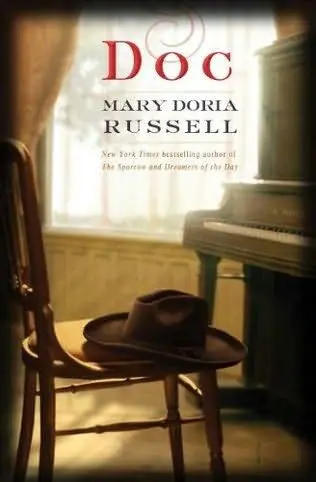
- Название:Doc
- Автор:
- Издательство:RANDOM HOUSE
- Жанр:
- Год:2011
- ISBN:978-0-679-60439-6
- Рейтинг книги:3 / 5. Голосов: 1
-
Избранное:Добавить в избранное
- Отзывы:
-
Ваша оценка:
Doc: краткое содержание, описание и аннотация
Предлагаем к чтению аннотацию, описание, краткое содержание или предисловие (зависит от того, что написал сам автор книги «Doc»). Если вы не нашли необходимую информацию о книге — напишите в комментариях, мы постараемся отыскать её.
Beautifully educated, born to the life of a Southern gentleman, Dr. John Henry Holliday is given an awful choice at the age of twenty-two: die within months in Atlanta or leave everyone and everything he loves in the hope that the dry air and sunshine of the West will restore him to health. Young, scared, lonely, and sick, he arrives on the rawest edge of the Texas frontier just as an economic crash wrecks the dreams of a nation. Soon, with few alternatives open to him, Doc Holliday is gambling professionally; he is also living with Mária Katarina Harony, a high-strung Hungarian whore with dazzling turquoise eyes, who can quote Latin classics right back at him. Kate makes it her business to find Doc the high-stakes poker games that will support them both in high style. It is Kate who insists that the couple travel to Dodge City, because 'that's where the money is.'
And that is where the unlikely friendship of Doc Holliday and Wyatt Earp really begins — before Wyatt Earp is the prototype of the square-jawed, fearless lawman; before Doc Holliday is the quintessential frontier gambler; before the gunfight at the O.K. Corral links their names forever in American frontier mythology — when neither man wanted fame or deserved notoriety.
Authentic, moving, and witty, Mary Doria Russell's fifth novel redefines these two towering figures of the American West and brings to life an extraordinary cast of historical characters, including Holliday's unforgettable companion, Kate. First and last, however, Doc is John Henry Holliday's story, written with compassion, humor, and respect by one of our greatest contemporary storytellers.
Doc — читать онлайн бесплатно полную книгу (весь текст) целиком
Ниже представлен текст книги, разбитый по страницам. Система сохранения места последней прочитанной страницы, позволяет с удобством читать онлайн бесплатно книгу «Doc», без необходимости каждый раз заново искать на чём Вы остановились. Поставьте закладку, и сможете в любой момент перейти на страницу, на которой закончили чтение.
Интервал:
Закладка:
“Not at all, Miss Isabelle. I beg pardon for givin’ you that impression. It was an amusin’ turn of phrase, is all. Now, if you would be so kind as to act as our interpreter, ask young Mr. Eberhardt, please, if I may have a look at the tooth that is troublin’ him. Tell him that I’d like to use this little mirror to look inside his mouth.”
Belle did her best, which must have been good enough. Wilfred climbed into the seat.
Dr. Holliday showed the boy the mirror and let Wilfred use it to peek around in the dentist’s own mouth. Belle had seen all this before when she’d brought her sisters and brothers in, but she settled herself behind the desk in the corner of the office to watch the dentist work, while thinking, just hypothetically, of course, Isabelle Holliday. Mrs. John Holliday. Belle Holliday …
In the past two years, she had often studied the paired daguerreotypes on the mantelpiece at home: pictures taken to commemorate her parents’ wedding day. No doubt about it, Alice Armstrong was a lovely child at thirteen. In Belle’s opinion, her mother might have caught herself a better husband if she’d waited a year or two before settling on a man, but Alice was probably practical even as an infant. Picky, after all, requires at least one alternative to reject. A Missouri farm wasn’t likely to provide even that much choice in the way of suitors. Bob Wright’s proposal was the only one Alice was likely to get.
Gazing at her father’s photograph, Belle had tried but simply could not imagine a beautiful little girl like Alice looking at the nineteen-year-old Bob Wright and thinking, My hero! Not with Bob’s bland boyish face and his dreadful little chin, which looked so much worse now that he was wearing that big, full mustache! Belle could hardly stand to be in the same room with him these days, given the amount of sheer physical effort required not to cringe.
Still, there must have been something attractive about her father, once upon a time. Certainly, he had always been a man to make the most of an opportunity—if you could believe his own boasts, that is. Belle had caught him in so many lies, she no longer gave him the benefit of the doubt and checked every claim.
Yes, her mother had confirmed, before he turned twenty, Bob Wright was leading trains of forty freight wagons, delivering supplies to mining camps and railway crews and army depots on the far frontier. And before Alice turned twenty, Bob had indeed made his little bride the mother of three surviving children.
In the ordinary way of things, there might have been even more children by then, Belle supposed with a shudder, except that Bob was often gone for long stretches, tending to business interests scattered across Missouri, Kansas, Oklahoma, Colorado, and New Mexico.
Her father routinely offered that as praiseworthy evidence of gumption, but it also meant letting his wife fend for herself and their kids in a dirt-floored soddy with nobody but wolves and savages for neighbors. Belle’s own earliest memory was of huddling with her brothers under a feather bed while their mother loaded guns for the hired hand during an Indian raid. And then there was the time they all nearly drowned, fleeing downriver by canoe during an attack …
What kind of man hears about something like that when he gets home, and then leaves again a couple of weeks later? That’s what Belle wanted to know.
To her misfortune, Alice Wright always seemed to do just fine on her own, which absolved her husband of the need to stick around. He’d come home now and then, get her pregnant, light out again. And there she’d be with all those little children and a new one on the way, and no word from her husband for months at time, and no way to know if she was a widow or simply abandoned.
Like most entrepreneurs, Bob Wright was hostile to federal power and interference, but he saw no harm at all in the postwar scramble for government contracts. And don’t think Belle hadn’t spotted that hypocrisy. Land grants, mineral rights and rights-of-way, mail monopolies, Indian agencies—that was where the real money was. After the war, her father was in there with the best of them, snout in the federal trough.
From what Belle was able to patch together, her mother had hoped things would get better when the family moved to Fort Dodge after Bob got the sutler contract, but Belle was old enough to remember how gloomy and angry and cold her mother turned when they got there. Living inside the fort during the Indian wars meant there was more danger of attracting an attack by hostiles, but also more help in surviving it. So that was a mixed blessing. And having neighbors might have made a nice change, except it turned out the only other civilians at the fort were buffalo hunters passing through and the Irish girls who called themselves laundresses.
As a child, Belle found the girls’ curly hair and bright dresses pretty, and their breezy manner amusing and gay. She enjoyed their songs and laughter, and liked that she was their pet, but quickly learned that her mother absolutely despised them and that it was wise to keep her own fascination well hidden.
Now that she was grown, she understood, of course. Whatever Bob Wright had done with such women during his long absences, it was something a wife could ignore; at Fort Dodge, the women were right there , mocking and obnoxious. Alice might not be eager for yet another pregnancy, but neither did she welcome the constant bitter reminders of what was going on behind her back.
A lot of things got better when they moved to Dodge City. The house Bob built for the family was an enormous improvement over their little shack at the fort. Buffalo hunters and Indians were becoming a distant memory, but the whores were everywhere . Laughing and lewd, or drunk and desperate. Walking the streets, browsing in the store. Leaning from second-story windows, calling out to passersby.
Alice insisted that Belle’s dresses be made in dark, sober colors and expensive fabrics, to avoid her being taken for one of them . “You never know who might be watching, Belle,” her mother told her over and over, “so you must conduct yourself as a lady at all times.” Alice allowed Belle to go out only between the hours of ten and noon, so her maiden eyes would not be subject to the spectacle of open prostitution. As though Belle hadn’t seen worse, back at the fort. As though she didn’t know what her own father was doing over at Bessie Earp’s bordello.
Since Belle’s last birthday, Alice’s concern for her daughter’s future had bubbled into a rolling boil of desperation. “Even if we started planning a wedding tomorrow, you’d be sixteen before your first baby.”
“Don’t fret, Mother,” Belle replied, selecting the voice of Sweet Reason. “Abraham and Sarah had a baby when she was ninety-nine, so I guess I have a few years left.”
The remark earned her a slap, but it was worth it.
All year, Belle had endured a series of her mother’s dreary Sunday dinners, each one a transparent job interview. A visiting banker, lumpish and self-important. A railroad man, bumptious and balding. Tommy McCarty, son of the town’s doctor, who was nice enough, really, but boring. A cattleman’s nephew, educated at Harvard, who could only talk about how sophisticated Boston was and how he couldn’t wait to go back East.
Don’t let me stop you, Belle thought. There’s a train leaving in the morning.
The latest, and most persistent, in this tiresome procession was Elijah Garrett Grier, who’d been calling on the Wrights regularly for months. Eli Grier was from a prominent Connecticut family and he was a war hero, her mother told Belle before the gentleman arrived that first Sunday. Even Belle had to admit that Captain Grier had seemed like a real possibility when he rode up to the house on his beautiful Arabian mare. Slim and straight-backed, good-looking and worldly, Eli Grier was almost as old as her father, but with his well-brushed tailored uniform, and his silver captain’s bars, and his tall cavalry boots all shined up, he was quite handsome.
Читать дальшеИнтервал:
Закладка:
Похожие книги на «Doc»
Представляем Вашему вниманию похожие книги на «Doc» списком для выбора. Мы отобрали схожую по названию и смыслу литературу в надежде предоставить читателям больше вариантов отыскать новые, интересные, ещё непрочитанные произведения.








Обсуждение, отзывы о книге «Doc» и просто собственные мнения читателей. Оставьте ваши комментарии, напишите, что Вы думаете о произведении, его смысле или главных героях. Укажите что конкретно понравилось, а что нет, и почему Вы так считаете.