Alison Weir - Captive Queen
Здесь есть возможность читать онлайн «Alison Weir - Captive Queen» весь текст электронной книги совершенно бесплатно (целиком полную версию без сокращений). В некоторых случаях можно слушать аудио, скачать через торрент в формате fb2 и присутствует краткое содержание. Год выпуска: 2010, ISBN: 2010, Издательство: BALLANTINE, Жанр: Историческая проза, на английском языке. Описание произведения, (предисловие) а так же отзывы посетителей доступны на портале библиотеки ЛибКат.
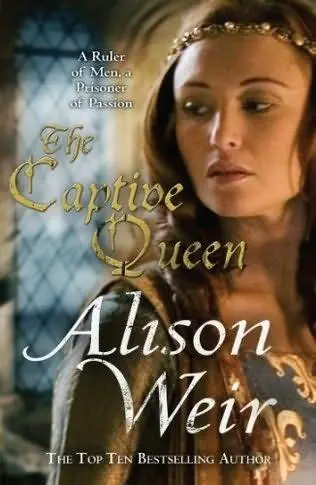
- Название:Captive Queen
- Автор:
- Издательство:BALLANTINE
- Жанр:
- Год:2010
- ISBN:978-0-345-52195-8
- Рейтинг книги:3 / 5. Голосов: 1
-
Избранное:Добавить в избранное
- Отзывы:
-
Ваша оценка:
Captive Queen: краткое содержание, описание и аннотация
Предлагаем к чтению аннотацию, описание, краткое содержание или предисловие (зависит от того, что написал сам автор книги «Captive Queen»). Если вы не нашли необходимую информацию о книге — напишите в комментариях, мы постараемся отыскать её.
Renowned for her highly acclaimed and bestselling British histories, Alison Weir has in recent years made a major impact on the fiction scene with her novels about Queen Elizabeth and Lady Jane Grey. In this latest offering, she imagines the world of Eleanor of Aquitaine, the beautiful twelfth-century woman who was Queen of France until she abandoned her royal husband for the younger man who would become King of England. In a relationship based on lust and a mutual desire for great power, Henry II and Eleanor took over the English throne in 1154, thus beginning one of the most influential reigns and tumultuous royal marriages in all of history. In this novel, Weir uses her extensive knowledge to paint a most vivid portrait of this fascinating woman.
Captive Queen — читать онлайн бесплатно полную книгу (весь текст) целиком
Ниже представлен текст книги, разбитый по страницам. Система сохранения места последней прочитанной страницы, позволяет с удобством читать онлайн бесплатно книгу «Captive Queen», без необходимости каждый раз заново искать на чём Вы остановились. Поставьте закладку, и сможете в любой момент перейти на страницу, на которой закончили чтение.
Интервал:
Закладка:
Henry regarded him warily, but he believed Raymond to be a man of honor who surely would not speak lightly. “Pray do,” he said.
“Then I advise you, Lord King, to beware of your wife and sons!” the count said earnestly. To his consternation, Henry burst out in harsh laughter.
“Do not concern yourself,” he rasped. “My sons are headstrong and led astray by those around them who preach sedition. My wife is a fond and foolish mother who should know better than to indulge them, and who has corrupted their minds with folly. This is not news to me, although I thank you for your care for my safety. But never fear, the situation is under control.”
He dismissed Raymond, who departed in evident relief, but when he was alone once more, Henry fell to brooding. Was Eleanor up to something? He did not think, after his threats, that she would go so far as to privately involve Louis—anyway, the Young King had done that openly, quite brazenly, in fact. He did not believe her capable of such perfidy, or of forgetting her nuptial vows.
It was his sons who were the culprits in this. In their rash ambition, they posed the greater danger. He was haunted by a prophecy of Merlin, which he had read in his book: “The cubs shall awake and shall roar loud, and, leaving the woods, shall seek their prey within the walls of cities. Among those who shall be in their way they shall make great carnage, and shall tear out the tongues of bulls.” Were the cubs that the seer had foretold his own sons?
He would not wait to find out. They must be stopped, and now. Briskly, he gave orders that certain knights of the Young King’s household be sent away; they, he believed, had been dripping sedition into his boy’s ear. To the latter’s howls of protest, he remained deaf.
The gathering broke up. The kings returned to their kingdoms, the counts to their domains. Henry himself planned to go north with Eleanor and their sons to Poitiers; when he had set the affairs of the duchy in order, he would press on to Normandy. The Young King he would take with him. He would not let the boy out of his sight. He would make sure there was not the slightest opportunity for any intrigue.
“I am not a child!” Young Henry had once shouted.
“Then stop acting like one,” his father said tartly. “Then I might begin to take you seriously.”
Henry genuinely trusted that his eldest son was the cause of all the present trouble, and the one to be watched. Richard could safely be left with Eleanor, to share control in Aquitaine. Kept apart from Young Henry, Richard would be harmless, he was convinced. Geoffrey he would summon, to keep them both company, and to divert Richard. And so, with his house in order, or so he believed, he soon departed from the duchy and dragged his seething heir off to Normandy.
46
Poitiers, 1173
Young Henry had escaped! Eleanor shook—she knew not with joy or fear—when she heard the news. He had endured his father’s vigilance as far as Chinon, clearly aware that he would soon be breaking free of it. Then he had stolen out of the bedchamber that Henry insisted they share, bribed the guards to lower the drawbridge, and ridden for Paris as if the four horsemen of the Apocalypse were at his heels. In vain did Henry send men in pursuit, and soon it dawned on him that his son’s flight had been planned down to the last detail, no doubt with the secret connivance of King Louis.
One day, and that not far distant, she knew that men would point the finger at her, accusing her of being Young Henry’s accomplice, yet she was as astonished at his escape as the rest of the world, and holding her breath to see what would come of it. She could not but rejoice that he had escaped his father’s repressive vigilance, which had become so destructive, and prayed that Henry would now see sense. She had lost all patience with him.
She sent relays of messengers secretly to Paris. She had to know what was happening. They brought back momentous news.
“Lady, King Louis and the Young King have pledged themselves to aid each other against their common enemy.” That could only be Henry, she realized, although the sweating man on his knees before her had not dared to say so.
“Lady, the King has sent a deputation of bishops to Paris to ask the King of France to return his son. When King Louis asked, ‘Who sends this message?’ he was told it was the King of England. ‘The King of England is here!’ the French King said. ‘But if you refer to his father, know that he is no longer King. All the world knows that he resigned his kingdom to his son.’” Eleanor could not resist a smile at that; she had not known that Louis had it in him to throw down the gauntlet in this manner.
“Lady, the Lord King is preparing for war; he is looking to the safety of his castles and his person. Many of the barons of England and Normandy have taken the Young King’s part and declared for him!”
This was becoming serious.
“What of William Marshal?” Eleanor inquired. That wise man of integrity: how would he view all this?
“He is for the Young King.”
War! Eleanor could not believe that things had gone this far. Louis was making threats, Henry’s barons were rallying to arms, and his sons were chomping at the bit to teach him a lesson. And suddenly, with the malevolent Bertran de Born at his side, the Young King materialized in Poitiers, hurriedly embracing his mother.
“I am come in secret,” he told her. “I need your aid, and that of my brothers.”
“Tell me truly, my son,” Eleanor asked seriously, “what you hope to gain from taking up arms against your father.”
“I thought you supported me!” he flared.
“I do; I believe you have a just grievance. But we all need to be clear what the objective is. Do you intend to force the King to share his power with you, or do you mean—as report has suggested—to overthrow him and rule in his stead?”
“Would it make a difference to your supporting me?” Ah, she thought, so he does understand the moral issue at stake.
“It might have done once,” she said bitterly, “but your father has since forfeited all right to my loyalty. I am as a widow; he has insulted and abandoned me, and he has treated you, his sons and mine, with contempt—and I will not stand by and allow it. A rotten branch must be cut off before it infects the healthy tree.”
“You are prepared to go that far?” Young Henry was staring at her in amazement.
“Yes,” she told him. “Your father has forced me to make a choice between my loyalty to my husband and king, and my desire to protect the interests of my children. I am a mother. There can be no contest. Whatever love and duty he once had from me, as of right, he has killed, stone dead.” She stepped forward and hugged her tall son.
“What has he done to you?” he asked angrily.
“He struck me, that you know. I do not care to go into the rest.”
“You do not need to,” the Young King fumed. “None of us are blind. We know about the Fair Rosamund.” The words were spat out with a sneer.
“It seems I was the only one who didn’t,” Eleanor said lightly. “But now we must forget about all that, and discuss this war with your brothers.”
She summoned Richard and Geoffrey to her solar. Constance arrived too, full of her own opinions, but Eleanor shooed her away impatiently. She did not want the silly girl meddling where she had no business to. The Young King’s brothers were surprised to see him, and listened gravely, and in mounting fury, to what he and their mother had to say.
“It is up to you what you do,” Eleanor told them both. “You are almost grown to man’s estate, and I will not treat you like children.”
Richard got up and embraced Young Henry. “I choose to follow my brother rather than my father, because I believe he has right on his side.”
Читать дальшеИнтервал:
Закладка:
Похожие книги на «Captive Queen»
Представляем Вашему вниманию похожие книги на «Captive Queen» списком для выбора. Мы отобрали схожую по названию и смыслу литературу в надежде предоставить читателям больше вариантов отыскать новые, интересные, ещё непрочитанные произведения.





Обсуждение, отзывы о книге «Captive Queen» и просто собственные мнения читателей. Оставьте ваши комментарии, напишите, что Вы думаете о произведении, его смысле или главных героях. Укажите что конкретно понравилось, а что нет, и почему Вы так считаете.